What is night shift management in care homes?
Discover how effective night shift management in care homes ensures resident safety, continuity of care, and staff well-being. Learn more!
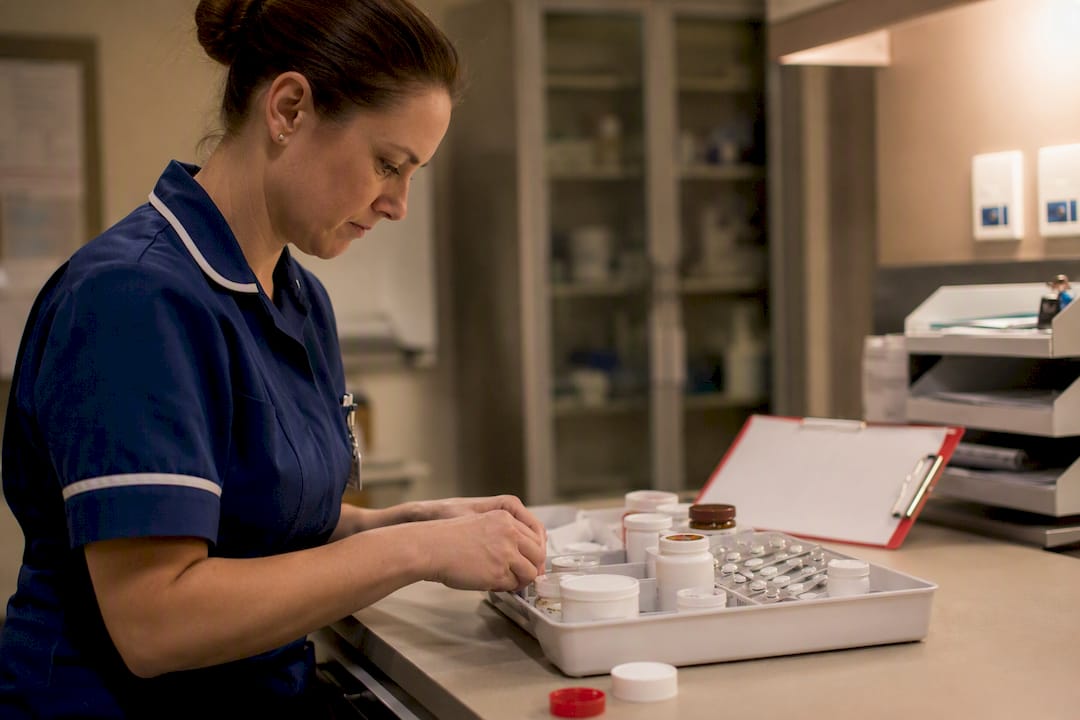
Night shift management is the system a care home uses to keep residents safe, cared for, and monitored between the last daytime handover and the first morning check, run by staff with clear authority to act alone. Three things have to work at once: safety (someone is always awake, alert, and able to respond), continuity of care (medication, observations, and personal care carry on exactly as they would at 2pm), and staff welfare (the people doing this job are protected from fatigue and isolation, not just expected to cope).
Night care can account for as much as half of a full 24 hour care regime, which means a rota built on the lazy assumption that nights are “quieter” is usually wrong from the outset.
- Safety — enough competent staff, awake and equipped to respond to falls, deterioration, or fire
- Continuity — medication rounds, repositioning, and care plans followed exactly as documented for daytime
- Welfare — fatigue managed, isolation reduced, and health checks offered under the Working Time Regulations
Every decision about staffing levels, sleep-in versus waking cover, and escalation routes has to sit inside the legal frameworks covered next: the Working Time Regulations 1998, HSE shift-work guidance, and CQC’s expectations for round-the-clock oversight.
Key Takeaways
Night-shift management in care homes works only when safety, continuity of care, and staff welfare are governed with the same rigour, documentation, and audit trail as daytime operations.
| Point | Details |
|---|---|
| Define night work clearly | Match your policy’s definition of night worker to the Working Time Regulations’ hour limits and rest entitlements. |
| Assign named authority | A designated night duty lead with delegated authority closes the management gap that causes most night-time incidents. |
| Match staffing to assessed need | Choose waking, sleep-in, or single-carer cover based on documented resident dependency, not on cost alone. |
| Document everything | Handovers, night logs, health assessments, and audits need to be evidenced, not just performed. |
| Automate the audit trail | Platforms like Timeprof capture attendance, fatigue risk, and handover records automatically for inspection readiness. |
Table of Contents
- What legal framework governs night shifts in care homes?
- Who is responsible for what during a night shift?
- Which night staffing model suits your home?
- How do you assess and manage night-work risk?
- How should you design rotas and set night staffing levels?
- What should handover and night-time documentation include?
- How should medication and clinical tasks be managed overnight?
- How do you manage lone-working and site security at night?
- What training and wellbeing support do night staff need?
- What happens after an incident overnight?
- What should a night-shift management policy include?
- How do you implement and audit night-shift practice?
- What digital tools genuinely help manage night shifts?
- What do experienced managers wish they’d known sooner?
- Where a workforce platform fits into night-shift management
- Frequently asked questions about night-shift management
- Sources
What legal framework governs night shifts in care homes?
Three sources of authority sit behind every night rota you write. The Working Time Regulations 1998 define a night worker as someone who normally works at least three hours during the “night period” (typically 11pm to 6am, though employers can vary this by agreement) and cap their average working time at eight hours in any 24-hour period. HSE’s shift-work guidance goes further, treating fatigue as a manageable risk rather than an inevitable cost of night work. CQC does not publish a separate night-specific rulebook, but its fundamental standards on safe staffing and safe care apply identically at 3am as they do at 3pm.
In practice this means:
- Night workers get an average of no more than eight hours in 24, calculated over a reference period, not per shift
- Staff working over six hours are entitled to a break of at least 20 minutes, and shifts longer than six hours need at least 11 consecutive hours’ rest before the next one, per sector-specific night shift guidance
- Employers must offer free health assessments before someone starts night work and periodically afterwards
- Risk assessments covering shift patterns, fatigue, and health surveillance are a legal duty, not a nice-to-have
Pro Tip: Keep a single, dated folder (digital or paper) holding every health assessment offer, risk assessment review, and rota change consultation. Inspectors and auditors rarely ask “did you comply?” first. They ask “show me.”
Who is responsible for what during a night shift?
Ambiguity about who holds authority at 3am is where most night-time incidents start. A named night duty lead with explicit authority closes what social care researchers call the “management gap”: the vacuum left when standard daytime staff are simply asked to cover nights without any change in job description, training, or decision-making power.
Roles typically break down like this:
- Registered manager — sets the policy, staffing model, and escalation structure, and is accountable to CQC even while asleep at home
- Person in charge (night) — the senior figure on shift, holds delegated authority for decisions, incidents, and calling emergency services or on-call support
- Night duty lead / senior carer — coordinates the team, oversees medication rounds, and owns the handover into the morning shift
- Waking night and sleep-in staff — carry out direct care, observations, and respond to call bells under the night duty lead’s direction
- Agency staff — must be briefed on the specific home’s escalation routes and safeguarding contacts before their first shift, not left to guess
For each shift, record who was person in charge, what was delegated, and any deviation from the standard rota, matching the governance and oversight expectations sector policy templates set out for night operations.
Which night staffing model suits your home?
There is no single right answer here. The correct model depends on the assessed needs of the people living in your home, not on what’s cheapest to roster.
- Waking night staff are awake, dressed, and actively working throughout the shift. Use this where residents have high dependency, frequent repositioning needs, or unpredictable behaviour that needs constant vigilance.
- Sleep-in staff are present and available but expected to sleep unless called. This only works where a proper risk assessment confirms residents genuinely don’t need waking cover, and sector policy explicitly warns that any intervention during a sleep-in shift must be logged and reviewed, because repeated call-outs are a sign the model is wrong.
- Single-carer cover suits smaller settings but carries real lone-working risk: no immediate backup for a fall, a fire, or a medical emergency.
- On-call escalation backs up any of the above with a manager or senior clinician reachable by phone, but it only works if the on-call person actually answers and knows the home.
If sleep-in staff are being woken more than occasionally, or a single carer is regularly requesting backup, that’s your signal to reconfigure the model or add clinical cover, not to hope the pattern improves on its own.
How do you assess and manage night-work risk?
Night-time risk assessment is not a paperwork exercise you do once and file. HSE’s own guidance frames it as an ongoing cycle: assess, design the shift pattern to reduce the hazard, train staff, then review.
- Gather data on resident dependency, incident history, staff sickness patterns, and previous near-misses at night
- Identify hazards — fatigue, lone-working exposure, residents with behavioural or medical needs that peak overnight, building or fire risks
- Rate the risk for each hazard against current staffing and physical safeguards
- Document controls — specific actions, who owns them, and a review date
- Consult staff before changing rosters; HSE guidance is explicit that involving night workers in planning builds acceptance and produces safer patterns than management imposing changes unilaterally
Fatigue controls worth building into every rota:
- Cap consecutive night shifts, even where the Working Time Regulations’ averaging rules technically allow more
- Design tasks so the heaviest physical work (repositioning, mobility support) doesn’t cluster in the final hour of a long shift
- Protect rest breaks in practice, not just on paper. A 20-minute break interrupted six times isn’t a break
- Offer health assessments before someone starts nights, and again periodically, as HSE and sector policy both require
Rotas built around automated fatigue risk checks catch patterns a manager scanning a spreadsheet at speed will usually miss, such as a member of staff quietly picking up every Friday night for three months running.
How should you design rotas and set night staffing levels?
Good rota design starts from assessed need, works backwards to a legal skill mix, and only then gets fitted around staff preference. Getting the order wrong is how homes end up short-staffed on the nights that matter most.
Core principles that hold regardless of home size:
- Match skill mix to dependency: a home with several residents needing two-person moves cannot run on one waking carer, whatever the sleep-in budget says
- Build in genuine rest between shifts, not the legal minimum with nothing to spare if a shift overruns
- Limit consecutive nights, even where averaging technically permits more, because fatigue compounds faster than the regulations assume
- Keep patterns predictable where possible; constantly shifting a worker between days and nights disrupts sleep more than a stable, if demanding, night-only pattern
Common patterns include long waking nights (typically 9pm to 7am), short-night splits with an evening and an early-morning carer overlapping, and rolling patterns that rotate a small team through nights in blocks rather than continuously. Each has trade-offs between staff wellbeing and continuity of relationships with residents.
For contingency, every home needs a written escalation order: who gets called first when someone phones in sick, at what point agency cover is booked rather than hoped for, and which non-essential tasks (deep cleaning, non-urgent paperwork) get pushed to daytime if the team is genuinely stretched. Practical rota planning guidance can help managers build these contingency triggers into a standard template rather than improvising them at 11pm.
What should handover and night-time documentation include?
A handover is only as good as what the outgoing team chooses to say, and a rushed five-minute exchange at 9pm is where critical information gets lost. Essential handover content includes clinical updates since the last shift, outstanding tasks, current PRN medication guidance, and any safeguarding concerns raised during the day.
Night logs should capture:
- Frequency and time of welfare checks, matched to each resident’s care plan (not a blanket “every two hours” applied indiscriminately)
- Repositioning carried out, with times
- Observations that fall outside the resident’s normal baseline
- Any call bell responses, interventions, or contact with on-call staff, with outcomes recorded
Monitoring matters as much as recording. Spot checks and unannounced night visits by managers or senior staff serve two purposes: catching problems early, and demonstrating oversight to inspectors.
Pro Tip: Frame unannounced night audits as coaching, not catching people out. Research into inspection practice suggests that a supportive framing reduces staff defensiveness and actually improves practice over time, whereas a “gotcha” approach just teaches people to hide problems.
How should medication and clinical tasks be managed overnight?
Medication administration at night follows exactly the same MAR chart standards as daytime, but with fewer people around to catch an error. PRN protocols need to be specific enough that a tired member of staff at 3am doesn’t have to make a judgement call about dosage or timing; where controlled drugs are involved, the same witnessed administration and recording rules apply regardless of the hour.
A clear escalation flow matters more overnight than at any other time, because there’s no colleague two doors down to ask. That flow should specify:
- Who to call first for clinical deterioration (on-call nurse, 111, 999, depending on severity)
- What to do immediately if a medication error occurs, including who must be informed and by when
- How the incident gets documented before the shift ends, not left for the morning team to reconstruct
Pre-shift checklists should confirm emergency equipment (oxygen, first aid kit, defibrillator where fitted) is present and in date, and that call bell and nurse-call systems are functioning before the day team leaves.
How do you manage lone-working and site security at night?
Reduced staffing at night means lone-working risk climbs even in homes that would never describe themselves as understaffed during the day. Core controls include a check-in protocol (a call or app check at set intervals), personal panic alarms, a clearly named on-call escalation contact, and an explicit instruction that staff can and should leave any situation they judge unsafe rather than wait for permission.
Security measures worth reviewing on a set schedule rather than only after an incident:
- Door control and access logs, particularly external doors used by visiting agency or emergency staff
- CCTV coverage of entry points and communal areas, checked for actual functionality, not just presence
- Lighting in corridors, car parks, and fire exits
- Alarm response times, tested rather than assumed
If a lone worker reports feeling unsafe more than once, or an on-call contact repeatedly fails to answer, that’s an immediate trigger to review the staffing model itself, not just to remind staff to follow the protocol.
What training and wellbeing support do night staff need?
Night staff, including agency workers, need the same induction and competency checks as daytime staff, plus role-specific additions covering lone working, escalation routes, and the particular clinical risks that present overnight. Competency should be reassessed periodically, not signed off once and forgotten.
Wellbeing measures that reduce fatigue-related harm and turnover:
- Health checks offered before night work starts and at regular intervals afterwards, in line with the Working Time Regulations
- Genuine access to counselling or occupational health support, not just a poster in the staff room
- Willingness to adjust rosters for staff struggling with the pattern, rather than treating every request as a performance issue
Pro Tip: Ask your night team directly what would improve morale before assuming you already know. Practitioner accounts of night shift work consistently mention feeling forgotten by daytime management as a bigger driver of turnover than the shift pattern itself. A five-minute conversation costs nothing and often surfaces the actual problem.
What happens after an incident overnight?
The immediate priority is always resident and staff safety: stabilise the situation, call emergency services if needed, then escalate to the on-call manager or registered manager without delay. Evidence, whether that’s a fallen item, a medication pack, or a witness account, needs preserving before the scene gets tidied.
Investigation should follow a clear timeline: what happened, when, who was involved, what was done, and what needs to change. Document this while memories are fresh, ideally before the shift ends.
- Confirm whether the incident meets CQC’s notifiable event criteria and, if so, action the notification promptly
- Record corrective actions and who owns them
- Write a clear handover note for the daytime team covering what happened and what to watch for
What should a night-shift management policy include?
A written policy is what turns good intentions into something you can actually evidence at inspection. It should cover, at minimum:
- Definitions of night shift and night worker, matched to the Working Time Regulations
- Roles and delegated authority for each position on a night shift
- The staffing models used in your home and the criteria for choosing between them
- Risk assessment process and review frequency
- Rota rules, including rest periods and consecutive-night limits
- Handover format and lone-working procedures
- Incident reporting and regulatory notification steps
Structure the document with clear headings covering each of the above, plus appendices holding your actual checklists, night-log templates, and an escalation flowchart staff can follow without having to think under pressure.
Pro Tip: Keep evidence of policy application, not just the policy document itself, in one place inspectors can access quickly: signed training records, completed risk assessments, and a log of policy reviews with dates. A policy nobody can prove is followed is barely better than no policy at all.
How do you implement and audit night-shift practice?
Rolling out a new or revised policy works best in stages rather than all at once.
- Pilot the new rota or procedure on a small scale, ideally with your most experienced night team first
- Brief every member of staff, including agency workers, before go-live, not after
- Run competency checks against the new procedures within the first month
- Roll out fully once the pilot has surfaced and fixed any practical gaps
Track a handful of indicators consistently: handover quality (spot-checked against a simple standard), missed or late checks, incident rate per month, and staff sickness or fatigue indicators. Schedule unannounced night audits on a regular cadence rather than only when something goes wrong, and always follow up with documented actions.
What digital tools genuinely help manage night shifts?
Paper rotas and phone-tree handovers work until they don’t, usually at the exact moment you need them most. Digital handovers, automated fatigue checks against rota patterns, real-time attendance tracking, and app-based on-call escalation all reduce the human error that creeps in at 3am, and they leave an audit trail inspectors can review without you scrambling for paperwork.
- Digital handover logs that time-stamp entries automatically
- Fatigue alerts that flag when someone’s pattern breaches your own internal limits, not just the legal minimum
- On-call escalation built into a mobile app rather than a personal phone number on a laminated sheet
Pro Tip: Start with one or two features (handover and attendance are the highest-impact first steps) rather than switching every process at once. A partial rollout done well beats a full rollout nobody trusts.
Platforms built for shift-based sectors, including Time Prof’s approach to mobile scheduling, are designed around exactly this kind of real-time visibility and audit-ready record-keeping.
What do experienced managers wish they’d known sooner?
Enforce the small routines relentlessly: the same handover format every single night, the same checklist before anyone goes home, the same escalation number on every notice board. Consistency at night matters more than cleverness, because tired staff at 3am follow habit, not memory.
Three pitfalls come up again and again. First, treating sleep-in cover as automatically cheaper without checking whether residents’ needs actually support it. Second, leaving agency staff to work out the escalation process for themselves on their first shift. Third, assuming a quiet night log means nothing happened, rather than checking whether checks were actually completed on schedule.
Where a workforce platform fits into night-shift management
Everything covered above, the rota rules, the fatigue checks, the handover logs, the audit trail, still has to be built and maintained by someone, and doing it manually across a spreadsheet and a WhatsApp group is exactly where compliance gaps open up. Timeprof brings rota planning, attendance tracking, fatigue-aware scheduling, and audit logs into one platform, so a night duty lead’s handover, a health assessment record, and a rota change all sit in the same place instead of three.
For a night-shift specific example: geofenced clock-in confirms staff actually arrived on site for their shift, real-time notifications flag a rota gap the moment someone calls in sick rather than an hour later, and every health assessment offer and risk review sits in an audit trail you can pull up in seconds rather than hunting through a filing cabinet at inspection time. If your current process still relies on remembering who’s covering Friday night, Timeprof’s platform is built to replace that guesswork with a single source of truth. Book a demo to see how it maps onto your existing rota before you change anything.
Frequently asked questions about night-shift management
What is night shift management in care homes, in practical terms? It is the combined system of staffing, policy, and documentation that keeps a care home safely run overnight, covering who is in charge, how risks are assessed, and how records prove compliance.
What counts as a night worker under UK law? Someone who normally works at least three hours during the defined night period, typically 11pm to 6am, qualifies as a night worker under the Working Time Regulations 1998.
Do sleep-in staff count the same as waking night staff? No. Sleep-in cover is only appropriate where risk assessment confirms residents don’t need active overnight monitoring, and any intervention during a sleep-in shift must be logged and reviewed.
How often should night-shift risk assessments be reviewed? Reviews should happen whenever resident needs, staffing levels, or incident patterns change, and at minimum on a scheduled annual basis alongside routine policy reviews.
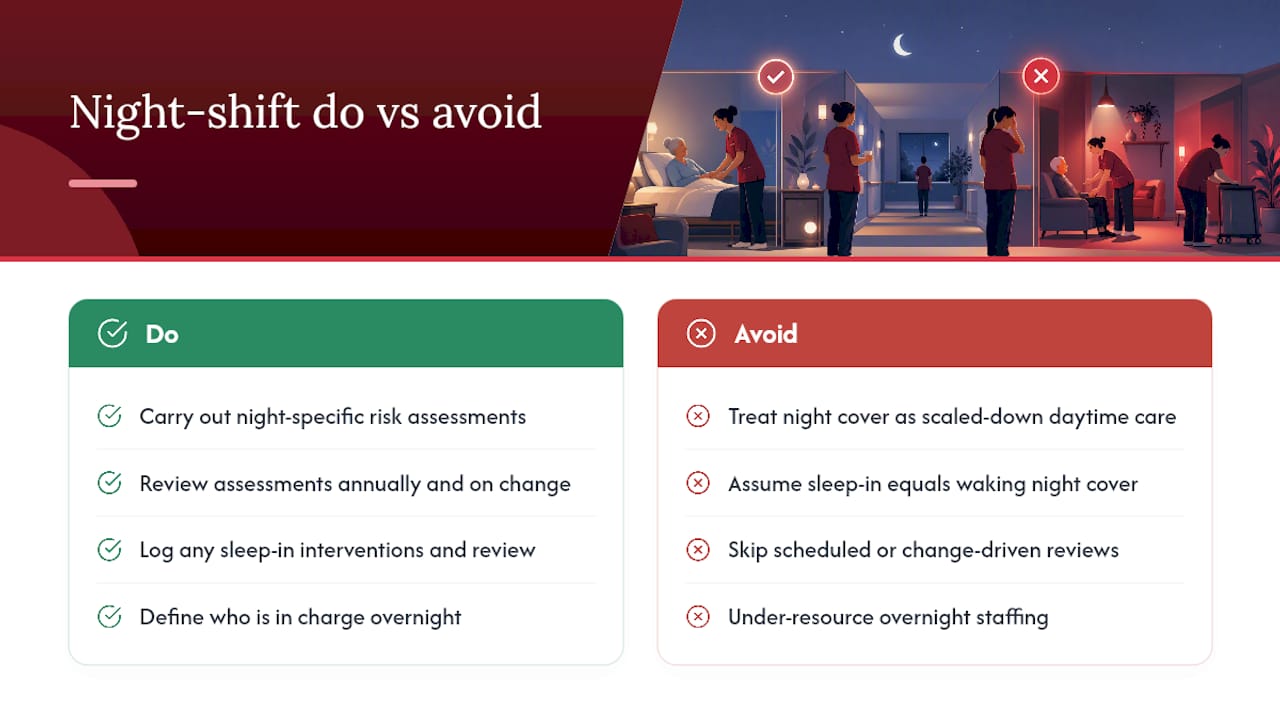
What is the biggest mistake care homes make with night shifts? Treating night cover as a scaled-down version of daytime care rather than assessing it on its own merits, which usually means it’s under-resourced relative to actual need.
Sources
- HSE shift work guidance (HSG256)
- The Working Time Regulations 1998 (SI 1998/1833)
- CH213‑Night shift management policy (e-Care Hub)
- Night care in care homes: in‑depth (Croneri)