Shift scheduling compliance: what UK managers must know
Discover what shift scheduling compliance means for UK managers. Ensure legal adherence and safeguard employee rights with our essential guide.

Shift scheduling compliance means applying statutory working-time rules and safety guidance at the moment each shift is created, changed, or worked. Not once a month in a spreadsheet review. At the point of publication. Under the Working Time Regulations 1998, the Employment Rights Act 2025, and HSE guidance on managing shift work, the obligation is continuous and per-shift, not periodic.
Three checks every manager should run right now:
- Daily rest: does every shift leave at least 11 consecutive hours before the next one starts?
- Notice: was this shift communicated with enough lead time to satisfy the Employment Rights Act 2025 reasonable-notice test?
- Record: does a timestamped record exist proving both of the above?
Pro Tip: Set a recurring weekly calendar block to audit the coming week’s rota against these three checks before shifts are published, not after.
Table of Contents
- What does shift scheduling compliance actually cover under UK law?
- Why compliance must be treated as a live safety control, not a paperwork exercise
- How to design rotas that block illegal shifts before they happen
- How to prove compliance: the records you must keep
- When to move from spreadsheets to rule-based scheduling
- A manager’s step-by-step compliance checklist for this week
- Key takeaways
- The compliance gap most managers do not see until it is too late
- How Timeprof helps you evidence shift scheduling compliance
- Authoritative UK sources for further reading
What does shift scheduling compliance actually cover under UK law?
The legal framework rests on three pillars, and each one carries a distinct obligation.
Working Time Regulations 1998 set the statutory floor. Regulation 10 requires at least 11 consecutive hours’ daily rest between shifts. Regulation 11 requires an uninterrupted rest period of not less than 24 hours in each seven-day period, or an equivalent arrangement over 14 days where a collective or workforce agreement permits. The average working week must not exceed 48 hours unless the worker has signed a valid opt-out. Night workers face additional health-assessment requirements and hour limits.
Employment Rights Act 2025 changes the notice picture significantly. Sections 27BJ–27BK create a statutory right to reasonable notice of a shift and reasonable notice of any cancellation or change. Critically, the Act creates a presumption: notice given less than a specified amount of time before a shift starts is presumed not to be reasonable unless the employer can show otherwise. For zero-hours and variable-hours workers, last-minute SMS messages or informal phone calls now carry direct tribunal risk.
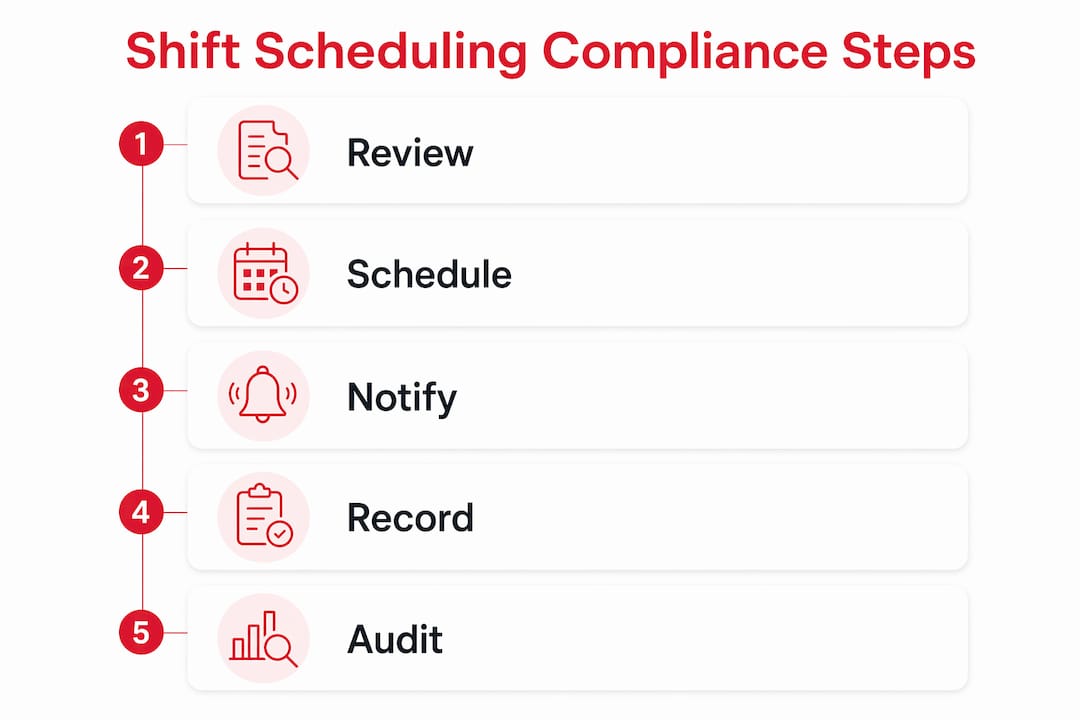
HSE guidance goes further than hours alone. The duty to manage fatigue actively sits under the Health and Safety at Work etc. Act 1974, meaning meeting the Working Time Regulations minimum is not sufficient if your rota still produces chronic fatigue.
Pro Tip: Treat the Working Time Regulations as a floor, not a ceiling. Where your risk assessment shows fatigue risk, build in rest beyond the statutory minimum.
Why compliance must be treated as a live safety control, not a paperwork exercise

The most common managerial mistake is treating the rota as a static document rather than a live control. By the time a tribunal or HSE inspector asks questions, the rota has changed three times and the original version no longer exists.
Specific risks that appear repeatedly in security, hospitality, and healthcare operations:
| Risk | What goes wrong | Consequence |
|---|---|---|
| Clopening | Close at midnight, open at 6 AM | Breaches 11-hour daily rest |
| Informal SMS changes | No timestamped record | Presumed unreasonable under ERA 2025 |
| Spreadsheet overwrites | Original rota lost | No audit trail for tribunal |
| Overtime creep | Average week drifts past 48 hours | WTR breach without opt-out |
| Split shifts | Rest periods fragmented | Fatigue risk under HSE guidance |
Practitioner analysis consistently identifies the same root failure: rota, attendance, and payroll records sit in separate systems and cannot be linked when a challenge arrives. The paper trail simply does not exist.
HSE research makes clear that fatigue management is a core employer duty, not an optional welfare gesture. A security officer working a clopening pattern, or a healthcare worker on a run of consecutive nights, represents a foreseeable safety risk the employer is obliged to control.
Pro Tip: Never overwrite a published rota. Archive each version with a timestamp so you can prove what was communicated and when.
How to design rotas that block illegal shifts before they happen
Good rota design is rule-based, not intuition-based. The table below maps the key rules to their legal basis and the record each one requires.
| Rota rule | Legal basis | Record required |
|---|---|---|
| Minimum 11 hours between shifts | WTR Regulation 10 | Timestamped shift start/end log |
| Minimum 24 hours rest per 7-day period | WTR Regulation 11 | Weekly hours summary |
| Average week ≤ 48 hours (or signed opt-out) | WTR Regulation 4 | 17-week rolling average calculation |
| Reasonable notice of shift | ERA 2025, s.27BJ | Notification delivery record with timestamp |
| Reasonable notice of change/cancellation | ERA 2025, s.27BK | Amended notification with timestamp |
| Night-worker hour limits | WTR Regulation 6 | Night-hours log and health assessment |
Compliant shift example: A hospitality worker finishes at 11 PM on Friday. Their next shift starts at 10 AM Saturday. That is 11 hours’ rest. The shift was published Tuesday with a timestamped notification. The worker acknowledged receipt. Compliant.
Non-compliant shift example: The same worker is asked by text at 11:30 PM Friday to cover a 7 AM Saturday breakfast shift. That is 7.5 hours’ rest, breaching Regulation 10. The notice was informal and unrecorded, breaching ERA 2025. Two breaches, one shift.
Every shift published should include: start and end time, location, role, expected hours, and the timestamp of when notice was given. For shift planning best practices in regulated sectors, also include the skills or qualifications required for the role.
Pro Tip: Build a “clopening block” rule into your scheduling process: if a worker’s previous shift ended fewer than 11 hours ago, the system or your manual check should prevent the new shift from being published.
How to prove compliance: the records you must keep
Compliance without evidence is not compliance. When a tribunal claim arrives, you need to produce a joined record showing what was scheduled, when it was communicated, whether it was acknowledged, when the worker clocked in and out, and how they were paid.
Essential records:
- Published rota with timestamp of first publication
- Notification delivery record (channel, recipient, date, time)
- Worker acknowledgement (written or digital)
- Clock-in and clock-out records, ideally with geofence verification
- Pay records showing hours worked and remuneration
- Any amendments, with their own timestamps and re-notifications
Retention: keep shift records for at least two years to cover the six-month tribunal complaint window plus investigation time. Payroll records have their own statutory retention requirements under HMRC rules.
For care and healthcare settings, digital time-tracking tools that capture geofenced clock-in with timestamps provide exactly the kind of immutable attendance record that satisfies both HSE and tribunal requirements.
Pro Tip: Run a monthly audit: pull one week’s rota, the corresponding attendance log, and the payroll extract. If you cannot link all three for every shift, that is your audit gap.
When to move from spreadsheets to rule-based scheduling
Spreadsheets work until they do not. The operational signs that you have passed that point:
- Clopening incidents appearing more than once a month
- Last-minute changes communicated by phone or text with no record
- Overtime costs rising without a clear cause
- Multi-site rotas managed by different people with no central view
- An audit request that you cannot answer within 48 hours
A realistic rollout for a medium-sized operation runs roughly eight to twelve weeks: two weeks for data clean-up and policy review, two weeks for pilot site configuration, four weeks of live pilot with parallel records, then full rollout. Budget for staff training, payroll integration testing, and a policy update that reflects the new notice standards under the Employment Rights Act 2025.
Common barriers and practical responses:
- User resistance: involve team leaders in the pilot; let them see the reduction in last-minute calls before mandating the tool.
- Legacy payroll integration: map the data fields before procurement, not after; most modern platforms export in standard formats.
- Policy gaps: update your shift-change policy to reflect ERA 2025 notice requirements before go-live, not as an afterthought.
Moving off spreadsheets to a rule-based system means illegal shifts are blocked before they are published, not discovered after a complaint. That shift in timing is the practical difference between prevention and remediation.
Pro Tip: Select one high-risk site as your pilot: the one with the most clopening incidents or the most frequent last-minute changes. Success there builds the internal case for full rollout.
A manager’s step-by-step compliance checklist for this week
Work through these in order. The first four can be done today.
- Pull this week’s published rota and identify any shift pairs with fewer than 11 hours between them.
- Check whether every shift published in the last seven days has a timestamped notification record.
- Confirm that any shift changes made informally (by phone or text) have been followed up with a written, timestamped record.
- Reconcile one site’s clock-in log against the published rota for the same week.
- Calculate the 17-week rolling average for any worker approaching or exceeding 48 hours per week.
- Update your shift-change notification template to include: shift date, start time, end time, location, role, and timestamp of notice.
- Draft a breach triage note: who to inform (line manager, HR), how to record the breach, and what remedial steps apply (rest period, revised notice, pay adjustment if applicable).
For the next 30 days, implement a clopening block in your scheduling process, run the monthly audit described in the previous section, and review your notice template against the ERA 2025 reasonable-notice presumption.
Pro Tip: After any compliance breach, document it in a short incident note: what happened, which rule was affected, what was done to remedy it, and what rota rule change prevents recurrence. That note is your evidence of good-faith management.
Key takeaways
Shift scheduling compliance is a per-shift, legally enforceable duty under the Working Time Regulations 1998, the Employment Rights Act 2025, and HSE fatigue guidance — not a periodic HR review.
| Point | Details |
|---|---|
| Compliance is per-shift | Every shift must individually satisfy rest, notice, and record requirements at the moment it is published. |
| ERA 2025 raises the notice bar | Last-minute or informal shift changes carry a tribunal presumption of unreasonableness for zero-hours and variable-hours workers. |
| Fatigue is a safety issue | HSE guidance requires active fatigue management beyond WTR minima; chronic fatigue rotas breach the Health and Safety at Work etc. Act 1974. |
| Records must be joined | Rota, attendance, and payroll records must be linkable for tribunal-grade evidence; separate systems create audit gaps. |
| Timeprof automates the controls | Timeprof’s rule-based scheduling blocks illegal shifts, timestamps notifications, and joins rota, attendance, and payroll into a single audit view. |
The compliance gap most managers do not see until it is too late
The conventional wisdom is that shift scheduling compliance is primarily about hours. Get the rest periods right, keep the average week under 48 hours, and you are covered. That framing misses the most common source of tribunal exposure: the notice and record gap.
Most managers in security, hospitality, and healthcare are diligent about rest periods. They know the 11-hour rule. What they consistently underestimate is the documentation burden the Employment Rights Act 2025 has created around how shifts are communicated. An informal call to cover a shift is not just inconvenient for the worker. Under the ERA 2025 presumption, it is legally risky for the employer, because the burden of proving reasonable notice falls on you, and a phone call leaves nothing to prove it with.
The quickest wins are not technological. They are procedural: a notice template that captures the right information, a rule that blocks clopening before it is published, and a habit of archiving every rota version. These cost nothing and reduce the most common risks immediately.
Where compliance and morale converge is transparency. Workers who receive clear, timely, written shift notifications report higher trust in their employer. That is not a soft benefit. In sectors with high turnover, like hospitality and care, scheduling transparency is a retention lever as much as a legal one.
After a breach, the instinct is to move on quickly. Resist it. A short incident note documenting what happened, which rule was affected, and what rota change prevents recurrence is the evidence that distinguishes a good-faith employer from a negligent one in any subsequent investigation.
How Timeprof helps you evidence shift scheduling compliance
Rota compliance is only as strong as the records behind it. Timeprof brings scheduling, attendance, notifications, and audit logs into one platform, so the joined evidence trail that tribunals and HSE inspectors ask for actually exists.
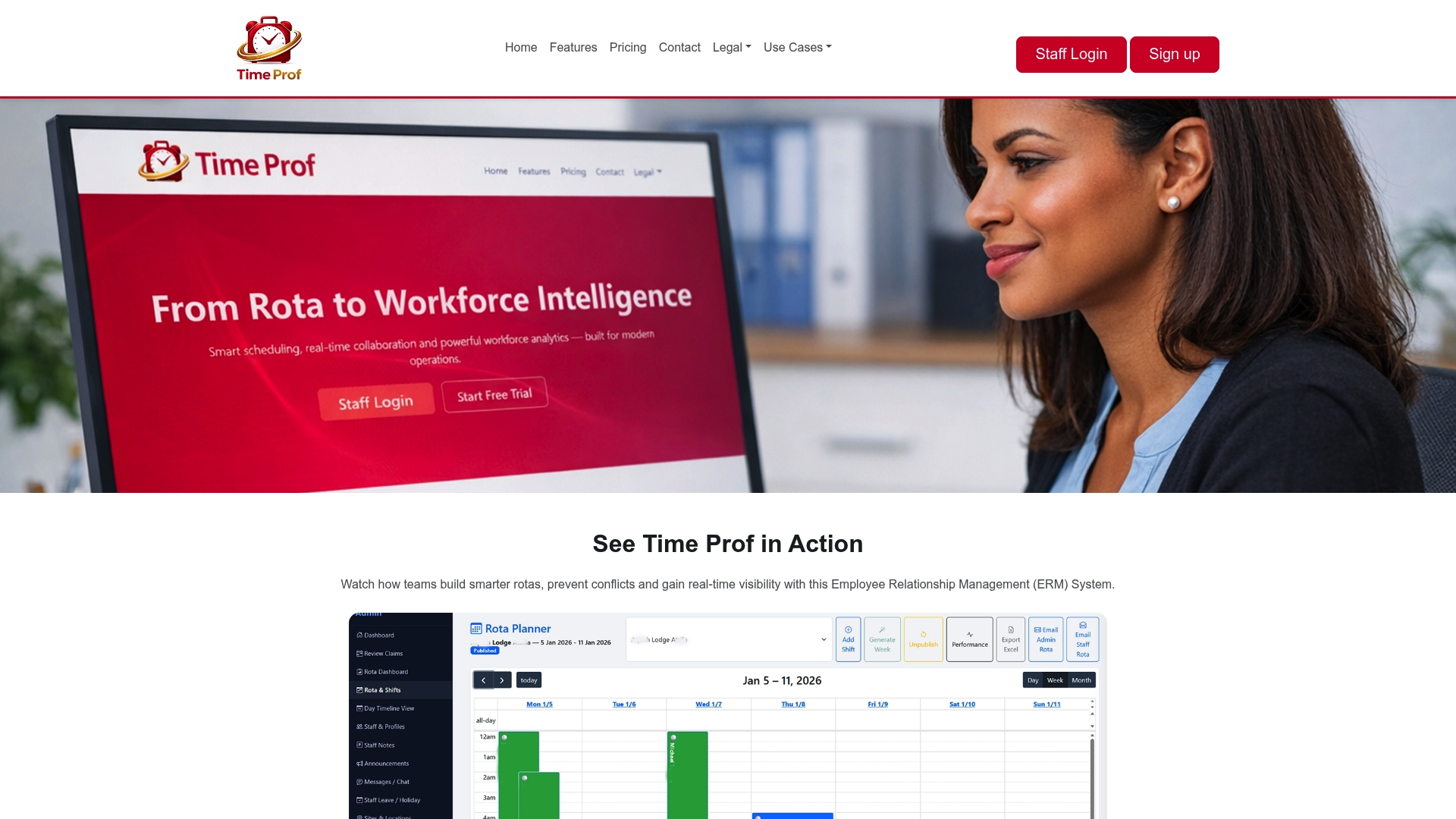
The features map directly to the risks described above: automated clopening blocks prevent illegal shifts from being published; timestamped notifications satisfy the ERA 2025 reasonable-notice presumption; geofenced clock-in ties attendance to the published rota; and multi-site dashboards give managers a single compliance view across every location. Role-based access and immutable audit records mean the right people see the right data, and nothing gets overwritten.
For managers ready to move beyond spreadsheets, the practical next step is a 30-day pilot on your highest-risk site. Visit Timeprof to see how the platform maps to your compliance requirements and request a demonstration.
Authoritative UK sources for further reading
Use these primary sources when updating your shift policy, responding to a tribunal query, or briefing senior management on compliance obligations.
- Working Time Regulations 1998, Regulation 10 (daily rest): the 11-hour daily rest requirement
- Working Time Regulations 1998, Regulation 11 (weekly rest): 24-hour weekly rest and 14-day arrangement options
- Working Time Regulations 1998 (full text): maximum average weekly hours and night-worker provisions
- Employment Rights Act 2025, sections 27BJ–27BK: reasonable notice of shifts, cancellations, and changes; tribunal complaint procedure
- HSE: Managing Shift Work (HSG256): fatigue management guidance and employer duties under the Health and Safety at Work etc. Act 1974
When building or updating your shift policy, cross-reference the ERA 2025 notice provisions against your current notification process first. That is where the most immediate gap is likely to be.
This article provides general information about UK shift scheduling law and is not legal advice. Confirm current rules with the primary sources above or a qualified employment law professional for your specific situation.