Automate rota fatigue risk checks for managers
Discover how to automate rota fatigue risk checks to ensure employee safety with real-time alerts, actionable fixes, and audit-ready records.

Yes, you can automate rota fatigue risk checks, and the case for doing so is straightforward. An HSE Fatigue Risk Index (FRI) engine, derived from HSE Research Report RR446, scores every shift the moment it is published or changed, flags high-risk patterns in real time, and produces versioned, audit-ready records that hold up at CQC or DVSA inspections. Three things follow from that immediately.
- Real-time flags appear before a shift is worked, not after an incident has occurred.
- Suggested minimal fixes (move a start time, extend a break) let managers resolve a breach without rebuilding the whole rota.
- Versioned audit reports give inspectors a documented record of what was flagged, who approved it, and what changed.
Automation does not replace supervisory judgement. A high FRI score is a prompt to act, not a verdict that an incident will happen. Managers retain final accountability; the system makes that accountability faster and better evidenced.
Pro Tip: Set your system to log every threshold breach and its resolution from day one, even during a pilot. That log becomes your most persuasive artefact at an inspection.

Table of Contents
- How does an automated fatigue engine calculate risk from your rota?
- What features should you require from any automated fatigue-check system?
- How do you implement automated FRI checks in your rota process?
- When should automation block a shift and when should it only flag?
- What data and technical connections does automated scoring need?
- What do UK regulators expect, and how does automation help you demonstrate compliance?
- What do pilot studies and research say about fatigue scoring tools?
- How does Timeprof operationalise automated fatigue checks for UK organisations?
- Key takeaways
- The gap between fatigue policy and fatigue evidence
- Timeprof gives you audit-ready fatigue checks from your first rota import
- Useful sources and primary references for UK fatigue risk management
How does an automated fatigue engine calculate risk from your rota?
The HSE Fatigue Risk Index works by combining several shift-level inputs into a numerical score. No single input tells the full story; the score emerges from their interaction, which is exactly why manual spreadsheet checks miss so much.
The standard inputs a scoring engine needs are:
- Shift start time (circadian timing, particularly whether the shift falls in the early morning window)
- Shift duration (total hours on duty, including any overtime)
- Rest period before the shift (hours since the previous shift ended)
- Consecutive shifts worked (how many days without a rest day)
- Night work (whether the shift crosses the 0000–0600 window)
- Cumulative load (rolling windows of 7 and 21 days to catch slow-building fatigue)
A validated biomathematical model goes further than a simple hours check by accounting for circadian timing, rotation direction, and cumulative sleep debt. That matters because a schedule can be fully compliant with the Working Time Regulations and still carry substantial physiological risk.
| Input | What it measures | Typical manager interpretation |
|---|---|---|
| Shift start time | Circadian disruption risk | Early starts raise scores sharply |
| Shift duration | Acute fatigue accumulation | Long shifts compound rest-period risk |
| Rest period | Recovery adequacy | Under 11 hours triggers a quick-return flag |
| Consecutive shifts | Cumulative fatigue build-up | multiple consecutive shifts without a rest day |
| Night work | Circadian misalignment | Night shifts after a short rest carry the highest scores |
| 21-day cumulative load | Chronic fatigue risk | Sustained high scores across a rolling window |

The engine converts those inputs into a per-shift score and a plain-English flag. A single high score on an isolated shift is worth reviewing; a pattern of medium scores across a rolling 21-day window is often the more serious signal, because it indicates a worker who has had no meaningful recovery opportunity. FRI is the most commonly referenced standard in UK practice for this purpose, but it is a risk metric, not a legal ceiling. It informs control decisions; it does not set a statutory limit.
What features should you require from any automated fatigue-check system?
Not all fatigue-check tools are equal, and vendor marketing often obscures the gaps. Before you commit to any system, hold it against this checklist.
- HSE FRI or validated biomathematical scoring. The engine must implement RR446-aligned logic and expose per-shift scores alongside plain-English flags. A system that only checks Working Time Regulations hours is not a fatigue-risk tool; it is a compliance checker. Commercial FRMS platforms typically combine both, giving a fuller governance picture.
- Real-time sync with live rota and attendance data. Scores must reflect actual worked hours, not only planned shifts. A worker who clocked out two hours late yesterday has a different risk profile today than the rota suggests.
- Configurable thresholds and escalation rules. You need to define when the system informs, when it requires manager approval, and when it blocks publication. Those thresholds should be documented and version-controlled themselves.
- Version control and audit-ready PDF exports. Every rota change, every flag, and every manager sign-off must be time-stamped and exportable. Inspectors from CQC and DVSA expect to see this evidence, and practitioners consistently cite versioned PDFs as the most persuasive artefact at inspection.
- Swap and overtime checks against real 21-day history. A swap request looks safe in isolation; it may not look safe when the engine checks what that worker has actually worked over the past three weeks.
- Role-based access, two-factor authentication, and a full audit trail. Who approved what, and when, must be unambiguous.
Pro Tip: Ask any vendor to show you a sample audit PDF before you sign anything. If it does not show the score, the flag, the approver, and the timestamp in one document, it will not satisfy an inspector.
How do you implement automated FRI checks in your rota process?
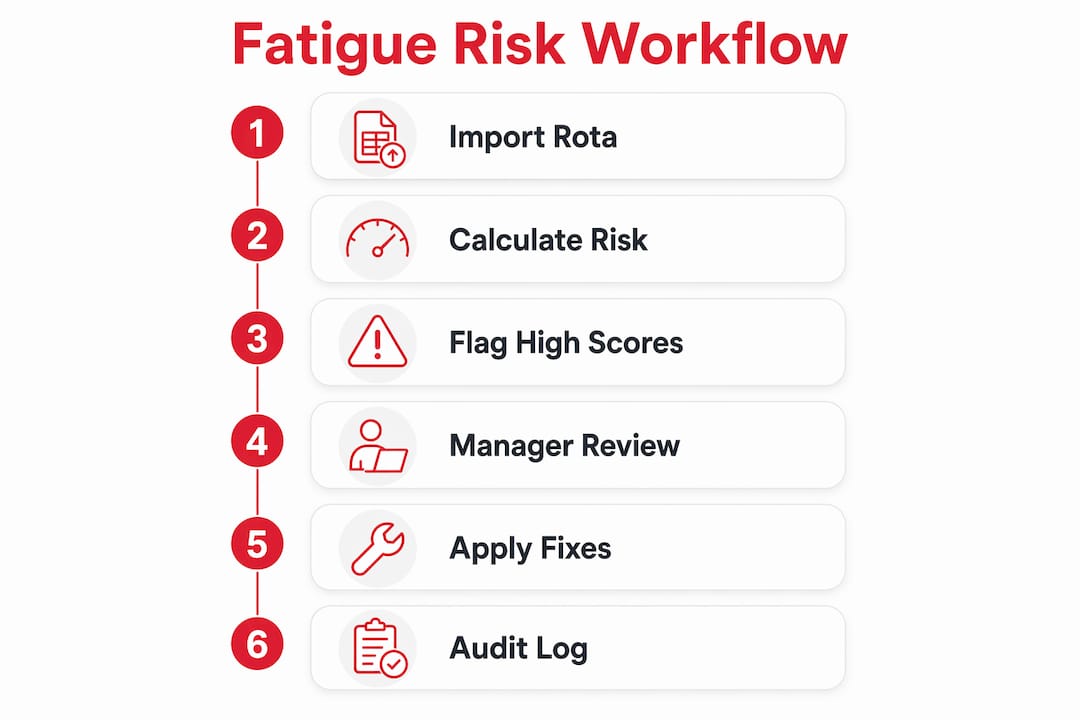
Implementation is a six-step process. The pilot phase is where most organisations learn the most, so do not skip it in the rush to go live.
-
Define policy and scope. Decide which sites, roles, and shift patterns are in scope. Identify safety-critical activities where a block threshold is appropriate and document the thresholds that will require action. This policy document becomes part of your audit evidence.
-
Map your data sources. Confirm where the authoritative data lives: your rota system, your HRIS, your time-and-attendance feed, or a combination. Identify the fields you need (worker ID, shift start/end, break windows, actual clock-in/out, change history) and the integration method for each source.
-
Run a retrospective pilot. Score at least 12 weeks of historic rotas through the engine before going live. Cross-reference high-score periods against your incident and near-miss logs. This is the step that produces procurement-grade evidence and helps you calibrate thresholds to your actual workforce patterns rather than generic defaults.
-
Configure approval workflows. Decide your escalation bands (inform / review required / block), who receives alerts at each level, and what constitutes an acceptable minimal fix. Document these decisions. They are part of your FRMS policy.
-
Train managers and staff. Managers need to understand what a score means, how swap checks work, and how to use suggested fixes. Staff need to know that the system exists and what it means for their schedules. A short briefing session and a one-page reference card are usually sufficient for frontline staff.
-
Verify and retain. Keep versioned reports for at least 12 weeks from the point of any flagged event. Collect inspector-facing PDFs and record who signed off each change. Build a corrective workflow for data-quality issues (missing clock-outs, overlapping shifts) so gaps do not undermine your scores.
Practical timeline: a retrospective pilot typically takes 2–4 weeks. Phased rollout across multiple sites runs 4–12 weeks depending on the number of integration points and the complexity of your approval workflows.
When should automation block a shift and when should it only flag?
The answer depends on the severity of the physiological risk and the operational consequences of a block. A blanket block policy protects safety but can create staffing crises; a flag-only policy preserves flexibility but relies entirely on managers acting on every alert. The sensible approach is three escalation bands.
- Inform (low risk). The cumulative score is nudging upward but no single shift is problematic. The system logs the pattern and surfaces it on the manager’s dashboard. No approval required, but the trend is visible.
- Review required (medium risk). A quick return under 11 hours, a sixth consecutive shift, or a cumulative score crossing a configured threshold. The shift cannot be published without a named manager sign-off. The system records the decision.
- Block / require change (high risk). A seventh consecutive shift, a night shift following a rest period under eight hours, or a score that crosses your documented upper threshold. The system prevents publication and presents suggested minimal fixes before the manager can proceed.
The most effective systems surface the smallest rota change that resolves the breach rather than forcing a full rebuild. Moving a start time by 30 minutes or extending a break by 20 minutes often drops a score below the block threshold. That is the difference between a system managers trust and one they route around.
Pro Tip: Configure your “review required” band to include a suggested fix alongside the alert. Managers who see a ready-made solution act on it; managers who see only a red flag often override it.
Point-in-time worker self-assessments can complement roster scoring as an additional control layer, triggered automatically when a worker’s score crosses a configured threshold. They are not required to obtain useful rota-level scores, but they add a second data point for safety-critical roles.
What data and technical connections does automated scoring need?
Getting the integration right is where most implementations either succeed or stall. The technical groundwork is not complicated, but it requires clear decisions about data ownership.
- Establish your source of truth. Decide whether the rota system, the HRIS, or the time-and-attendance feed is authoritative for worked hours. Conflicts between sources produce scoring errors, so this decision must be made before any integration is built.
- Required fields for scoring: worker identifier, shift start and end times, break windows, actual clock-in and clock-out times, and a change history that records who edited what and when.
- Integration methods: CSV import works for smaller organisations or retrospective pilots. API sync is preferable for live scoring. Direct connectors to common rota and time-and-attendance systems reduce manual handling. Scheduled batch jobs handle historic reconciliation.
- Data quality checks to build in: time zone normalisation, daylight saving handling (a particular source of errors around the March and October clock changes), overlapping shifts, and missing clock-outs. Each of these needs a corrective workflow, not just a flag.
- Reporting and retention: store versioned PDF reports and score history for a minimum of 12 weeks. For organisations subject to CQC or DVSA inspection, longer retention is advisable. The real-time workforce control model means scores update as attendance data arrives, so the report at the end of a shift reflects actual hours worked, not the planned rota.
Understanding how availability data shapes safe rostering is equally important here. A worker who has flagged limited availability for a period may have a different risk profile than the raw shift data suggests, and a well-integrated system will account for that.
What do UK regulators expect, and how does automation help you demonstrate compliance?
CQC, HSE, and DVSA do not prescribe a specific fatigue scoring tool, but they do expect employers to demonstrate active monitoring, documented controls, and records of who approved changes when a risk was identified. That expectation is explicit in CQC Regulation 18, which requires providers to deploy sufficient numbers of suitably skilled staff and to manage the risks that arise from staffing decisions.
At an inspection, the evidence that tends to satisfy regulators includes:
- Versioned rota exports showing what was planned and what changed
- FRI scores per shift with plain-English flags
- Manager sign-offs recorded against each flagged event
- A documented escalation policy with configured thresholds
- PDF exports covering the inspection window (typically the preceding 12 weeks)
Automation supports all of these. Continuous scoring means there are no gaps in the record. Time-stamped approvals mean the inspector can see that a manager reviewed a flag and made a documented decision, rather than simply ignoring it. Swap checks against real 21-day history mean the record reflects what workers actually experienced, not what was planned.
The safety management software market has matured to the point where audit-ready fatigue reporting is a standard expectation, not a premium feature. If a system cannot produce a PDF that shows score, flag, approver, and timestamp in one document, it is not fit for purpose in a regulated UK environment.
What do pilot studies and research say about fatigue scoring tools?
The evidence base for FRI-style calculators is solid enough to justify investment, though it is worth being precise about what the research shows and what it does not.
Pilot studies in healthcare settings demonstrate that FRI-style tools are useful for identifying high-risk rotas and guiding redesign. The methodology involves retrospective scoring of historic schedules and cross-referencing with incident and near-miss timelines to test whether high-score periods align with safety events. That alignment, when found, provides procurement-grade evidence for the investment.
A University of Surrey review of fatigue risk assessment tools commissioned by Transport for London evaluated the comparative validity of available tools, confirming that biomathematical models outperform simple hours-based checks in identifying physiologically risky schedules. The review is a useful reference when evaluating vendor claims.
What the research does not show is that a high score predicts a specific incident. Fatigue scoring indicates statistically elevated risk across a population of workers in similar conditions. A high score is a prompt for control action, not a guarantee that something will go wrong on that particular shift. That distinction matters when you are setting thresholds: the goal is to reduce the probability of harm across your workforce, not to achieve a zero-score rota.
Prospective pilots, where roster changes are made based on scoring and outcomes are tracked over subsequent weeks, provide the strongest validation. Running one before full rollout is both good practice and, increasingly, what procurement panels expect to see.
How does Timeprof operationalise automated fatigue checks for UK organisations?
Timeprof connects rota planning, staff availability, geofenced clocking, and fatigue scoring into a single platform, so the inputs for automated checks are always current and the outputs are always audit-ready.
The platform maps directly to the implementation checklist described earlier:
- FRI-based scoring with configurable thresholds: per-shift scores and plain-English flags, with escalation bands configured to your policy. Thresholds are documented within the system, not held in a separate spreadsheet.
- Real-time attendance sync: geofenced clock-in and clock-out data feeds the scoring engine, so actual worked hours update risk scores as shifts are completed. Planned and actual diverge constantly in shift-based industries; Timeprof closes that gap.
- Swap and overtime checks against 21-day history: before a swap is approved, the system checks what both workers have actually worked over the preceding three weeks, not just what the rota shows.
- Versioned rota records and PDF audit exports: every change is time-stamped, every approver is recorded, and the full history is exportable as a PDF suitable for CQC or DVSA inspection.
- Role-based access and two-factor authentication: approval workflows are enforced at the system level, not by convention.
- Structured onboarding and pilot support: Timeprof supports a 2–4 week retrospective pilot on a single site, scoring historic rotas and producing a sample audit PDF before any live deployment.
| Timeprof feature | Maps to requirement |
|---|---|
| FRI scoring engine | HSE RR446-aligned per-shift scores and flags |
| Geofenced clock-in/out | Actual hours feed for live score updates |
| 21-day swap check | Real history check before swap approval |
| Versioned rota records | Audit trail for CQC/DVSA inspection |
| PDF audit export | Inspector-ready evidence document |
| Role-based approvals | Documented manager sign-off at each escalation band |
The reduce scheduling errors guide on the Timeprof blog covers the broader scheduling context, including how automated rule-based rostering reduces the manual errors that compound fatigue risk. For organisations managing common scheduling challenges across multiple sites, the single-platform approach means fatigue data and rota data are never out of sync.
Key takeaways
Automated FRI scoring is audit-ready and operationally practical, but it only works when connected to real attendance data and backed by a documented escalation policy.
| Point | Details |
|---|---|
| FRI scoring is the UK standard | HSE RR446-aligned scoring gives per-shift risk scores that inspectors recognise and expect. |
| Escalation bands preserve flexibility | Configure inform, review, and block thresholds so automation supports decisions without creating operational crises. |
| Pilot before full rollout | Score 12 weeks of historic rotas and cross-reference incident logs before going live on all sites. |
| Audit PDFs are your inspection evidence | Versioned reports with scores, flags, approver names, and timestamps satisfy CQC and DVSA expectations. |
| Timeprof delivers end-to-end | Timeprof connects rota planning, geofenced attendance, 21-day swap checks, and PDF audit exports in one platform. |
The gap between fatigue policy and fatigue evidence
Most organisations in shift-based industries have a fatigue policy. Far fewer have the evidence to show they are actually following it. That gap is where inspectors find their most productive lines of questioning, and it is the gap that automated scoring closes.
The conventional wisdom is that fatigue management is primarily about setting rules: no more than X consecutive shifts, minimum Y hours between shifts. Those rules matter, but they are only as good as the system that enforces them. A manager under pressure to fill a gap will override a rule in a spreadsheet without leaving any trace. An automated system with a documented escalation policy and a time-stamped approval log makes that override visible and accountable.
What I find most underestimated is the value of the suggested minimal fix. Managers do not resist fatigue checks because they do not care about safety; they resist them because a red flag with no solution creates more work at the worst possible moment. A system that says “move this start time by 30 minutes and the score drops below threshold” is a system managers will actually use. That behavioural reality should shape how you configure escalation rules from the outset, not as an afterthought.
The research from healthcare pilots confirms what operational experience suggests: high-score periods correlate with elevated incident rates. That correlation does not make fatigue scoring a crystal ball, but it does make it a credible, defensible basis for the control decisions managers are already making informally. Formalising those decisions with a scoring engine and an audit trail is not bureaucracy. It is the difference between a policy that exists and a policy that works.
Timeprof gives you audit-ready fatigue checks from your first rota import
Fatigue risk management does not have to start with a six-month implementation project. Timeprof is built to get you from a CSV rota export to live FRI scores, versioned records, and a sample inspection PDF within a 2–4 week pilot on a single site.
During a pilot, Timeprof scores your historic rotas, runs swap checks against real 21-day attendance history, and produces a sample audit PDF showing scores, flags, approver sign-offs, and timestamps in one document. That PDF is what you hand to an inspector. It is also what you use internally to calibrate thresholds before you go live across all sites.
The platform connects rota planning, geofenced clocking, and fatigue scoring without requiring a separate integration project. You import your rota data, configure your escalation bands, and the scoring engine runs continuously from that point forward.
To start a pilot or request a sample audit PDF, visit Timeprof and import a CSV from your current rota system. The team will walk you through threshold configuration and have scores running on your actual data within days.
Useful sources and primary references for UK fatigue risk management
These are the authoritative references managers and safety officers should consult when building or procuring an automated fatigue-check system.
- HSE Research Report RR446 is the methodological foundation for FRI scoring in the UK. It defines the inputs, the scoring logic, and the interpretation of results. Any vendor claiming HSE FRI compliance should be able to map their engine to RR446 explicitly. The report is available via the HSE website.
- PMC pilot study on FRI tools in healthcare (pmc.ncbi.nlm.nih.gov) provides peer-reviewed evidence that FRI-style calculators identify high-risk rotas and support redesign decisions. Useful for internal business cases and procurement panels.
- University of Surrey / Transport for London fatigue risk assessment tools review (2022) (TfL PDF) evaluates the comparative validity of available tools. A credible independent reference when assessing vendor claims.
- CQC Regulation 18 sets the staffing and risk-management expectations for health and social care providers. Inspectors use it to assess whether providers are actively monitoring fatigue risk and documenting their controls.
- DVSA and Network Rail guidance set equivalent expectations for transport and rail operators. Both expect documented evidence of active fatigue monitoring, not simply a policy statement.
- Timeprof product and blog resources (timeprof.co.uk) cover the platform’s fatigue scoring, audit export, and pilot options. The blog includes practical guides on scheduling errors and real-time workforce control.
When evaluating vendor white papers against regulator guidance, apply a simple test: does the vendor document map their outputs to what a named regulator (CQC, HSE, DVSA) would expect to see at inspection? Marketing materials that describe features without connecting them to regulatory evidence requirements are a weaker basis for procurement decisions than those that do.