How availability affects rota planning: a manager's guide
Discover how availability affects rota planning. Learn to create efficient schedules that prevent burnout and improve service quality.

Staff availability is defined as the confirmed windows in which an employee can legally, physically, and competently work a given shift. Understanding how availability affects rota planning is the foundation of safe, efficient scheduling. Yet availability alone does not guarantee a workable rota. The real challenge is converting raw availability into what workforce planners call “usable capacity,” which accounts for skills, legal working time limits, and operational demand. Get this distinction wrong and you risk compliance failures, staff burnout, and service gaps that no amount of last-minute cover can fix.
How availability affects rota planning: availability vs usable capacity
Rotas built around assessed operational need rather than maximum availability reduce service failures and compliance risks. This is the single most important principle in workforce scheduling. A member of staff may be available on a Tuesday morning, but if they lack the competency for the required role, or if assigning them would breach the Working Time Regulations 1998, their availability is functionally worthless for that slot.
Usable capacity is what remains after you apply three filters to raw availability: skills and qualifications, contractual and legal hour limits, and logistical factors such as travel time between sites. Availability is not the same as usable capacity. Effective rota planning tests availability against these constraints before any shift assignment is confirmed. Skipping this step is where most scheduling errors originate.
In regulated sectors such as care and healthcare, the stakes are higher still. CQC quality statements require providers to demonstrate that workforce deployment is both safe and responsive. A rota that fills shifts with available but underqualified staff does not satisfy that standard. Managers must treat skill matching as a non-negotiable filter, not an afterthought.
What types of availability data should managers collect?
Accurate rota management with availability starts with knowing exactly what data to gather and how to keep it current. There are two broad categories: standing unavailability and dynamic unavailability.
Standing unavailability covers recurring commitments that do not change week to week. A second job on Wednesday evenings, a childcare commitment every Friday morning, or a regular medical appointment are all examples. Documenting standing unavailability formally is crucial. Unmanaged informal knowledge leads to last-minute clashes and staff mistrust. Every recurring constraint must be recorded in writing, agreed by both parties, and stored centrally.
Dynamic unavailability covers approved annual leave, planned absences such as training days, and short-notice sickness. These change constantly and must be updated in real time. The rota planner who relies on memory or a shared spreadsheet will inevitably miss a conflict. Recording recurring availability commitments in centralised systems prevents fragmented truths and the scheduling errors that follow.
The most reliable collection methods are:
- Digital availability forms submitted by staff on a set schedule, such as monthly or per scheduling period
- A centralised workforce platform that links availability records directly to the rota
- Regular one-to-one check-ins to capture changes not yet submitted formally
- A clear policy stating the deadline by which availability updates must be submitted
Pro Tip: Set a fixed availability submission deadline, such as the 20th of each month for the following month’s rota. Staff who miss the deadline are scheduled according to their last confirmed availability record. This one rule alone eliminates most last-minute surprises.
Why availability alone is not enough: skills, legal limits, and logistics
The impact of availability on rotas becomes dangerous when managers treat a “yes, I can work” response as sufficient to assign a shift. Three constraints reduce usable availability in ways that are easy to overlook.

Skills and competencies. In regulated environments, shift coverage must match specific competencies, not just availability. A care worker who is available but not trained in medication administration cannot cover a shift that requires it. Assigning them anyway creates a compliance failure and a safety risk. Managers should maintain a competency matrix alongside availability records, mapping each staff member’s verified qualifications against the requirements of each shift type.
Legal working time limits. Contractual and legal working time regulations must be accounted for alongside availability. The Working Time Regulations 1998 cap average weekly hours at 48 unless a worker has opted out in writing. Ignoring these limits risks legal breaches and fatigue-related errors. A staff member who has already worked 44 hours in a week may be available on paper but cannot safely or legally take a further 10-hour shift.
Logistical constraints. Travel time between sites, rest period requirements between shifts, and transport availability all reduce the pool of genuinely usable staff. A worker based in one town cannot realistically cover a shift starting 30 minutes after their previous shift ends at a site 25 miles away.
Decision rules help managers apply these filters consistently:
- Does the staff member hold the required competency for this shift?
- Will this assignment breach their weekly or daily hour limits?
- Is the travel time and rest period between shifts physically achievable?
- Does the assignment align with their formally recorded availability?
Pro Tip: Build a simple competency matrix in a spreadsheet or workforce platform. List each staff member in rows and each required skill or qualification in columns. Mark verified competencies with the date of last assessment. Cross-reference this matrix every time you assign a shift.
Common mistakes that undermine rota planning and staff availability
Even experienced managers fall into predictable traps when managing availability for rota planning. Recognising these patterns is the first step to avoiding them.
The most damaging mistake is the “float capacity trap.” Float staff capacity must be protected and reserved for unexpected absences. When managers absorb float staff into permanent rota gaps because they are available, they remove the emergency cover buffer entirely. The next unexpected absence then has no safety net. Float resources must be explicitly ring-fenced and never treated as a permanent solution to a structural staffing gap.
A second common error is failing to integrate sickness and absence data with rota updates in real time. A rota built on Monday becomes inaccurate by Wednesday if absence records are not linked to it. Managers who rely on phone calls and sticky notes to track who is off will always be reacting rather than planning.
Other frequent mistakes include:
- Ignoring staff preferences, which leads to resentment and higher turnover
- Assuming verbal availability confirmations are reliable without written records
- Publishing rotas with insufficient notice, which forces last-minute changes and erodes trust
- Failing to plan for sudden unavailability with a clear escalation process
Thoughtful scheduling and staff retention are directly linked. Staff who feel their availability is ignored or overridden without explanation disengage quickly. The rota is one of the most visible signals of how much a manager respects their team’s time.
Practical strategies for rotational planning based on availability
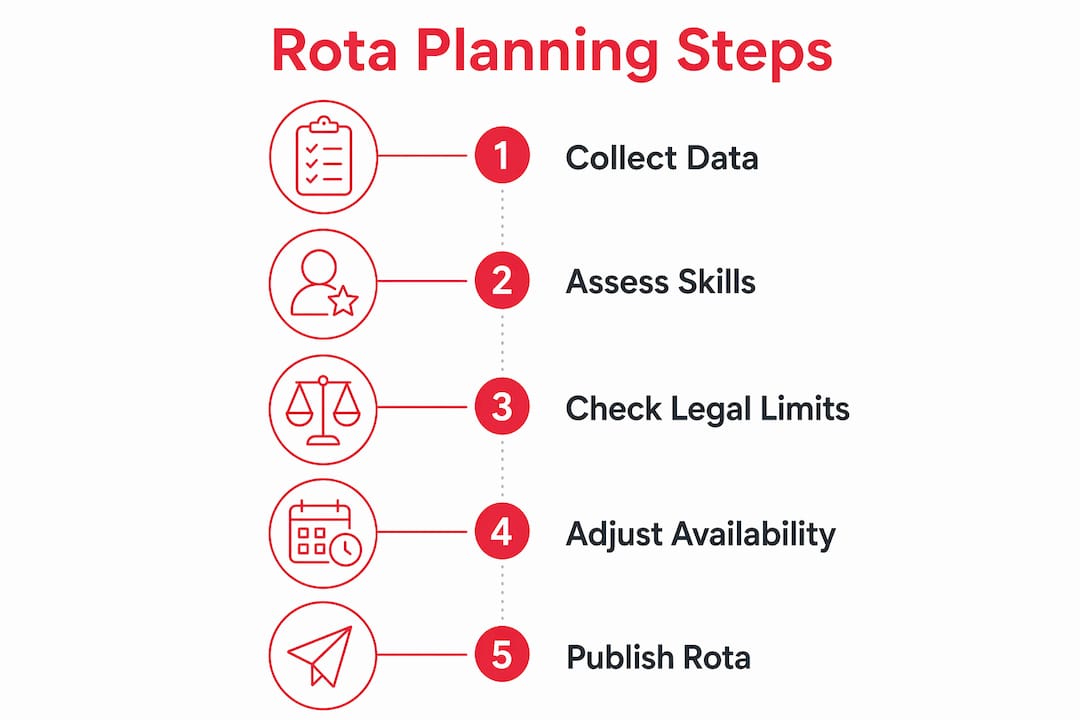
Translating good availability data into a well-functioning rota requires a structured process. The following steps reflect best practice in availability and shift scheduling across care, hospitality, security, and retail.
- Cross-reference availability with assessed need. Start with the operational demand: how many staff, with which competencies, are required at each site and time slot? Then match available staff against that need, applying the usable capacity filters described above.
- Integrate absence records in real time. Digital sickness and absence records linked to rota decisions improve governance and reduce avoidable staffing risks. Platforms that connect absence management to the live rota give managers an accurate picture at all times, not just at the point of publication.
- Publish rotas with adequate notice. Rotas published at least two weeks in advance and aligned with availability improve staff satisfaction and reduce last-minute changes. ACAS recommends reasonable notice in scheduling, with four weeks preferable for rotating shifts.
- Maintain a bank staff pool. A pool of flexible or bank staff, with verified competencies and confirmed availability windows, provides genuine cover capacity without compromising float protection.
- Review and govern regularly. Effective rota governance links absence records, skill mix, and shift coverage decisions. Schedule a weekly review to identify emerging gaps, update availability records, and adjust the rota before problems escalate.
The table below summarises the key data inputs and their function in the planning process.
| Data input | Function in rota planning |
|---|---|
| Standing unavailability records | Prevents recurring shift conflicts before the rota is drafted |
| Competency matrix | Filters available staff by verified skills for each shift type |
| Absence and sickness records | Keeps the live rota accurate as circumstances change |
| Legal hour limits | Prevents Working Time Regulations breaches and fatigue risk |
| Operational demand assessment | Defines how many staff with which skills are needed per slot |
Pro Tip: Integrating digital sickness and absence records with competency-matched rotas can improve skill-mix accuracy from 56% to 93% within four months. That figure represents the difference between a rota that looks complete and one that is genuinely safe.
Key takeaways
Effective rota planning requires converting raw availability into usable capacity by applying skills, legal, and logistical filters before any shift is assigned.
| Point | Details |
|---|---|
| Availability is not usable capacity | Test every available staff member against competency, hour limits, and logistics before assigning a shift. |
| Document standing unavailability formally | Record recurring commitments in writing and store them centrally to prevent last-minute conflicts. |
| Protect float staff reserves | Never absorb float capacity into permanent gaps; reserve it exclusively for unexpected absences. |
| Publish rotas with sufficient notice | Four weeks is preferable for rotating shifts; two weeks is the minimum to reduce last-minute changes. |
| Integrate absence data in real time | Linking sickness records to the live rota keeps coverage decisions accurate and audit-ready. |
What I have learned from years of watching rotas go wrong
The most common mistake I see is not a lack of data. It is a lack of discipline in using the data that already exists. Managers collect availability forms, build the rota, and then override their own records the moment a gap appears. They call the most available person rather than the most suitable one. That shortcut feels efficient in the moment. It creates compliance risks, staff frustration, and a rota that gradually loses the trust of the team it is supposed to serve.
The second thing I have learned is that transparency matters more than perfection. Staff do not expect a flawless rota. They expect to understand why decisions were made. When a manager can point to a competency requirement or a legal hour limit as the reason for an assignment, staff accept it. When the rota appears arbitrary, resentment builds fast.
The managers who get this right share one habit: they treat the rota as a living document governed by clear rules, not a weekly puzzle solved by instinct. They revisit availability records regularly, communicate changes early, and maintain a bank staff pool that is genuinely available rather than theoretically available. The shift planning best practices that separate good schedulers from great ones are not complicated. They are simply applied consistently.
— Michael
How Timeprof supports availability-based rota planning
Managing availability, skills, absences, and compliance across a team is genuinely complex. Timeprof brings all of that into one platform, replacing spreadsheets and disconnected systems with a single, accurate source of information.
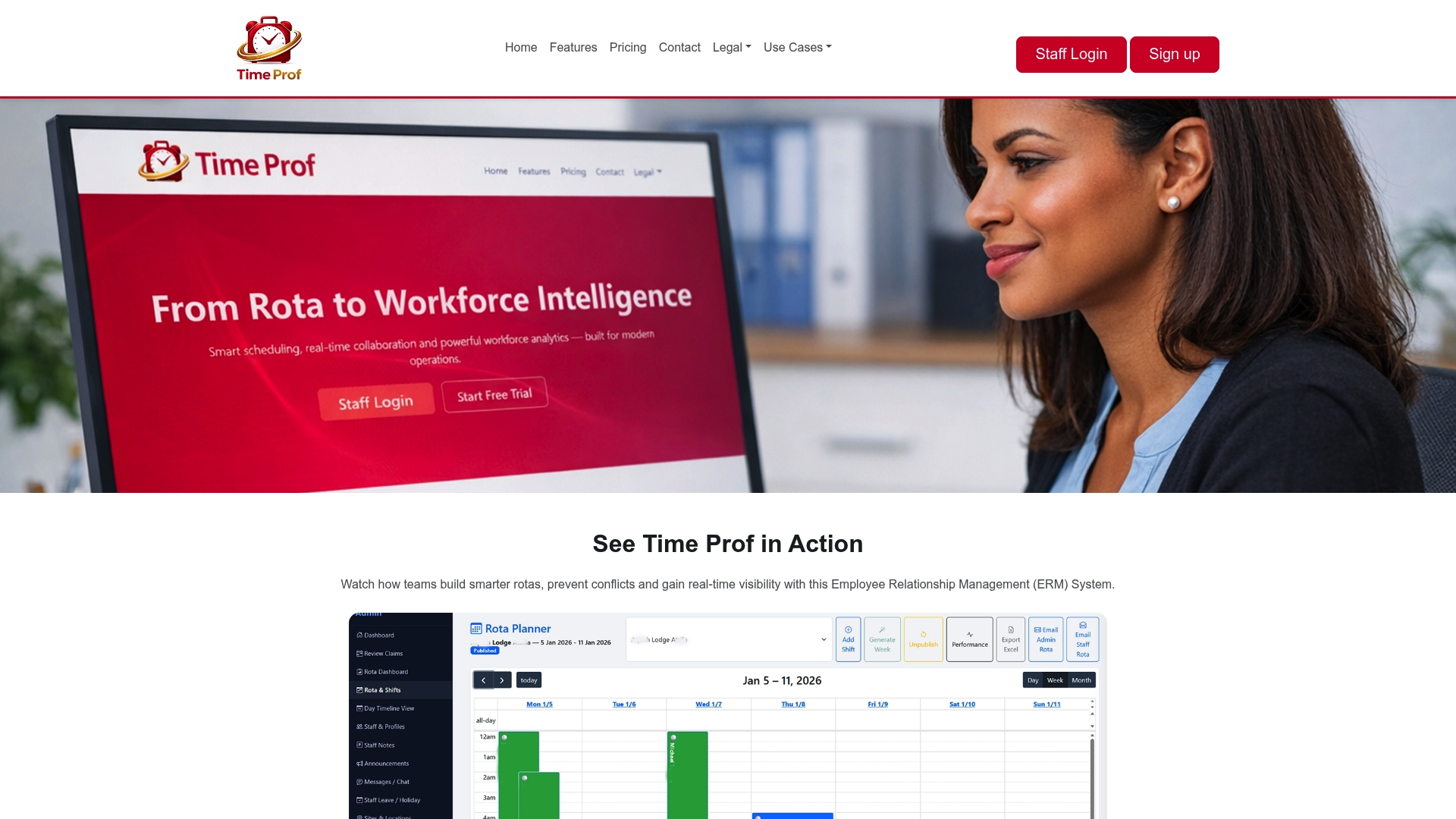
Timeprof connects staff availability records, competency data, absence management, and live rota updates in one place. Managers get real-time visibility across sites and shifts, with geofenced clock-in and audit-ready reporting built in. Staff access their rotas, submit availability, and claim open shifts through a mobile-first portal. The result is fewer scheduling errors, better compliance, and a team that stays better informed. Visit Timeprof to see how workforce intelligence replaces the guesswork of manual rota management.
FAQ
What is the difference between availability and usable capacity?
Availability is when a staff member says they can work. Usable capacity is what remains after applying filters for skills, legal hour limits, and logistical constraints such as travel time.
How often should managers update staff availability records?
Availability records should be updated at least monthly, with a fixed submission deadline. Standing unavailability must be formally documented and reviewed whenever a staff member’s circumstances change.
Why do rotas fail even when all shifts appear covered?
Rotas fail when available staff lack the required competencies for their assigned shifts, or when absence data is not integrated in real time. A rota that looks complete on paper can still leave a service exposed.
What is the float capacity trap?
The float capacity trap occurs when float staff are absorbed into permanent rota gaps, removing the emergency cover buffer. Float resources must be ring-fenced and reserved exclusively for unexpected absences.
How much notice should managers give for rota publication?
ACAS recommends reasonable notice for scheduling. Four weeks is preferable for rotating shifts, and two weeks is the minimum needed to reduce last-minute changes and protect staff satisfaction.