How to manage staff across warehouses: a manager's guide
Learn effective strategies to manage staff across warehouses and streamline operations for a more compliant and efficient multi-site workforce.

Stop firefighting and start running a stable, compliant multi-site warehouse operation. Do that, and the daily scramble for cover largely disappears.
Here is what to do in the first seven days:
- Day 1: Publish or confirm your base rota for the next four weeks across all sites.
- Day 2: Assign skills coverage so every shift has at least one cross-trained worker per zone.
- Day 3: Enable mobile clocking with geofence verification so attendance is confirmed in real time.
- Day 4: Run a Working Time Regulations (WTR) rest-period check on every late-to-early handoff.
- Day 5: Set up one cross-site dashboard showing live attendance and task completion by site.
- Day 6: Identify your flex pool — the workers available for cross-site redeployment at short notice.
- Day 7: Publish an escalation contact list so every supervisor knows who to call and in what order.
Pro Tip: Pin the escalation list inside your team messaging channel and review it at the start of each week. Most cover crises are not caused by a shortage of available workers — they are caused by nobody knowing who to ask.
Key takeaways
Stabilising a multi-site warehouse workforce comes down to three things: a published base rota, task-level visibility, and an orchestration layer that rebalances labour before orders fall behind.
| Point | Details |
|---|---|
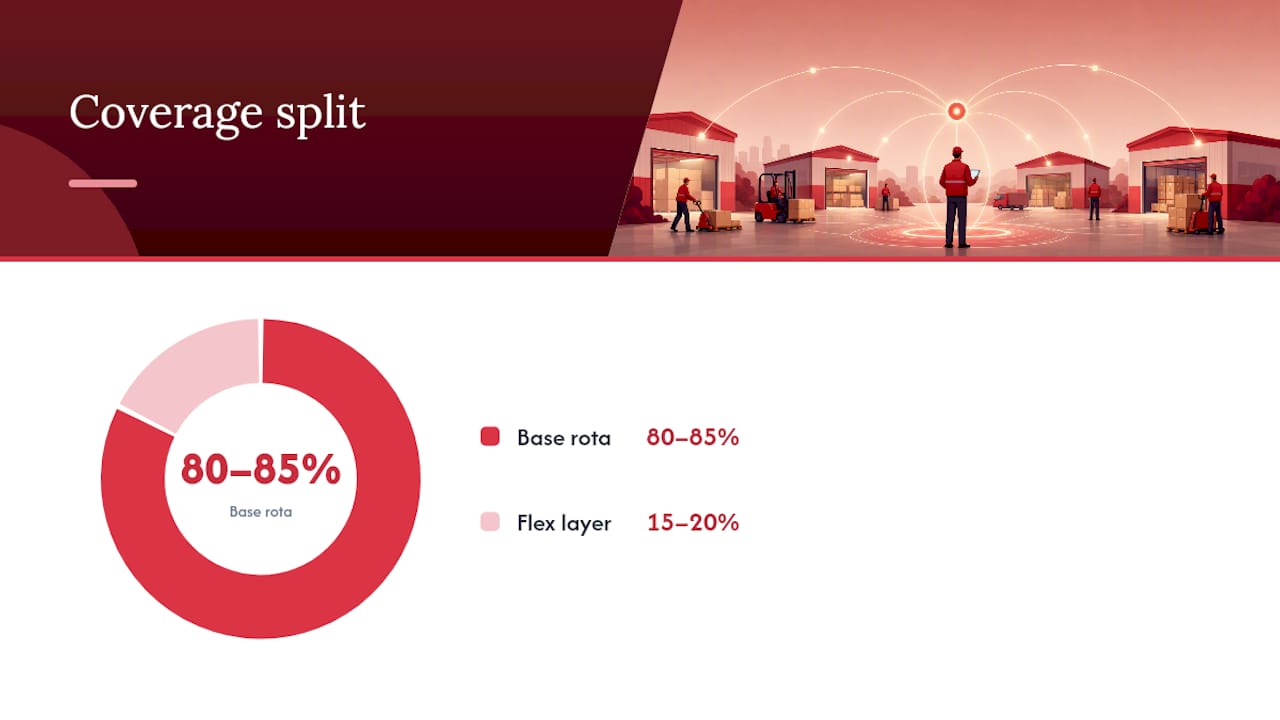
| Publish the base rota early | Aim for 2–4 weeks’ lead time, covering 80–85% of demand with a planned flex layer for the rest. |
| Embed WTR checks before publishing | The 11-hour minimum rest between shifts is the most commonly breached rule; automate the check. |
| Measure at task level | Barcode-confirmed task events by user, zone, and site give you the intraday signals needed to rebalance before orders fall behind. |
| Scheduling integration cuts costs | Integrating activity scheduling with worker assignment produced workforce costs more than 20% lower in 61% of tested instances. |
| Timeprof for multi-site control | Timeprof combines live dashboards, automated WTR checks, geofenced clocking, and skills matching in one platform for warehouse managers. |
Table of Contents
- Seven-point checklist to stabilise staffing across multiple warehouses
- How to build base rotas and stay compliant with UK Working Time Regulations
- What systems do you need for live visibility across sites?
- How to measure labour productivity and rebalance staff in real time
- How do you keep a distributed warehouse team engaged and developing?
- A 90-day plan to stabilise staffing across a warehouse network
- Common problems when you manage staff across warehouses
- What does a stable multi-site operation actually feel like?
- Timeprof gives you one place to manage staff across all your warehouses
- Sources
Seven-point checklist to stabilise staffing across multiple warehouses
Use this as a standing weekly playbook, not a one-off exercise.
- Publish the base rota at least two weeks ahead. Most rotas are filled in on a Thursday for the following week, which means coverage gaps only surface when they become operational problems. Two to four weeks’ lead time gives you room to fill gaps with planned flex rather than emergency agency.
- Target 80–85% base coverage. OperationsEdge recommends building a base rota that covers the majority of demand and planning a flex layer for the remainder. That flex layer should have agreed levers: agency, overtime, and shift extensions in that priority order.
- Define your cover hierarchy. Who do you call first for short-notice cover? Cross-trained in-house workers, then your flex bank, then agency. Write it down and share it with every supervisor.
- Cross-train to a minimum depth. Each zone should have at least two workers capable of covering it from another site. Track this in a skills matrix and review it monthly.
- Run a daily quick-check at shift handover. Five minutes reviewing the live dashboard at the start and end of each shift catches most problems before they escalate.
- Keep one communication channel for operational alerts. A mobile message group for supervisors, plus an on-call rota for out-of-hours cover, removes the guesswork about who is responsible.
- Review exceptions weekly. Track which sites triggered unplanned cover, which zones ran short, and which workers were moved. Patterns in that data tell you where the base rota needs adjusting.
Pro Tip: The one-minute check that prevents the most firefighting is simply opening the attendance dashboard before the shift starts. If someone has not clocked in by five minutes past the hour, you still have time to act.
How to build base rotas and stay compliant with UK Working Time Regulations
Reactive rota building is the single most common reason warehouse managers find themselves managing staff across warehouses by phone at 6 AM. The fix is structural.
Define your operational requirements first
Before you assign anyone to a shift, map the hours of cover each activity needs, the skill dependencies for each zone, and the volume profile across the week. A pick-and-despatch operation running a carrier cut-off at 3 PM has a fundamentally different shape from a goods-in and put-away operation with a morning peak. Get that shape right before you choose shift patterns.
Choose patterns that match the requirement
The main options for UK warehouse operations are fixed days, rotating shifts, continental patterns (four on, four off), day-only with weekend rotation, and annualised hours. Continental patterns give you 24/7 coverage with predictable rest periods. Day-only with weekend rotation suits lower-volume sites. Annualised hours work well where demand is genuinely seasonal. The wrong choice here creates structural overtime and WTR risk regardless of how well you manage the rota.
Build the base rota in four steps
- Assign shift patterns to individuals based on contracted hours and skills.
- Run the full cycle (typically four to twelve weeks) and check hourly cover against the operational requirement.
- Identify gaps and decide whether to fill them with contracted hours, flex, or agency.
- Run an automated WTR check before publishing.
Working Time Regulations: the must-dos
The UK Working Time Regulations set legal minimums that function as design constraints, not optional guidelines. The most commonly breached rule in warehouse operations is the 11-hour minimum rest period between shifts. Late-to-early handoffs — a worker finishing at 11 PM and starting at 6 AM — breach this by default. Check every handoff in the cycle, not just the obvious ones.
Key requirements to embed in every rota:
- Minimum 11 hours’ rest between shifts.
- Maximum 48-hour average working week (over a 17-week reference period, unless opted out).
- Night workers limited to an average of eight hours in any 24-hour period.
- Minimum 20-minute rest break for shifts longer than six hours.
- Minimum one day off per week (or two days per fortnight).
For a detailed compliance walkthrough, the shift scheduling compliance guide covers the specific checks UK managers need to run before publishing.
Pro Tip: Treat the 11-hour rest rule as a hard constraint in your scheduling tool, not a manual check. Automated WTR validation catches late-to-early breaches before they become a legal liability.
Agency and flex workers belong in the base rota as a planned layer, not a last-minute patch. If you know you need agency cover every Friday peak, schedule it. Unplanned agency is consistently more expensive and less reliable than planned agency.
What systems do you need for live visibility across sites?
The capability gap in most multi-site warehouse operations is not automation. It is coordination. Miebach’s analysis of UK warehouses argues that fragmentation across WMS, automation controllers, and labour tools causes instability, and that an execution orchestration layer — one that coordinates real-time work release and rebalancing — stabilises throughput more reliably than further isolated automation investment.
The capability checklist
Before selecting or specifying any system, confirm it covers:
- Live task board showing work in progress by zone and site.
- Cross-site labour dashboards with attendance, task completion, and idle time.
- Skills and site matching so open shifts are filled by qualified workers automatically.
- Automated WTR checks built into the scheduling engine.
- Mobile clocking with geofence verification.
- Exception alerts pushed to supervisors in real time.
- Messaging and announcements within the same platform.
What execution orchestration actually means
Orchestration sits between your WMS, automation controllers (conveyors, AMR fleets, sorters), and labour management tools. It receives event signals from all of them, applies configurable prioritisation rules, and releases or rebalances work in real time. Without it, a bottleneck at a pick station caused by an AMR queue sits invisible to the labour planner until orders are already late. With it, the system flags the imbalance and suggests or triggers a rebalance before the carrier cut-off is at risk.
For multi-site operations, the architectural principle is a real-time event model with vendor-neutral APIs. You want the orchestration layer to consume signals from whatever WMS or automation controller each site runs, not to require a single-vendor stack.
Pro Tip: Start with one real-time KPI and one cross-site alert — for example, picks per hour dropping below threshold at Site B triggers a notification to the Site A supervisor. That single signal, reliably delivered, is worth more than a dashboard nobody checks.
For a practical overview of what a shift management system should include, the linked guide covers the core features and when to adopt them.
How to measure labour productivity and rebalance staff in real time
The measurement approach that works is task-level: capture barcode-confirmed task events and use them to produce productivity by user, zone, and site. XoroWMS describes this as the foundation of labour optimisation — live task boards built from scan events give managers intraday signals they can act on before orders fall behind.
Core KPIs to track
| KPI | What it tells you | Rebalance trigger |
|---|---|---|
| Picks per hour | Individual and zone throughput | Below target for two consecutive hours |
| Units per labour hour | Site-level efficiency | 15% below site average |
| Tasks completed per shift | Shift-level output vs plan | Below 90% of planned volume |
| Idle time by zone | Bottleneck or overstaffing signal | Above 20% in any zone |
| Exceptions per hour | Error rate and rework load | Rising trend over three shifts |
Decision rules for rebalancing
When a KPI trigger fires, the decision should be pre-authorised, not escalated. Define thresholds and who can act on them before the shift starts:
- Picks per hour below threshold for two hours: supervisor authorised to move up to two workers from an adjacent zone.
- Idle time above 20% in a zone: supervisor authorised to reassign to a higher-priority zone or cross-site if travel time permits.
- Site-level units per labour hour 15% below average: operations manager notified; cross-site redeployment or overtime authorised.
Academic modelling published in MDPI found that integrating activity execution scheduling with worker assignment produced workforce costs more than 20% lower in 61% of tested instances. That figure is a useful anchor for business cases when justifying investment in scheduling optimisation.
One important caveat: Harvard Business Review research warns that monitoring without constructive management can increase rule-bending. Pair every KPI with a coaching conversation, not just a performance flag.
Workforce visibility best practices for designing dashboards across sites are covered in the workforce visibility guide.
How do you keep a distributed warehouse team engaged and developing?
Engagement in multi-site warehouse teams drops when workers feel invisible to management and when rotas are unpredictable. The fix is routine, not rhetoric.
Daily and weekly routines that work
- 10-minute shift huddle at the start of each shift: cover plan for the day, any cross-site moves, safety notes.
- End-of-shift handover between outgoing and incoming supervisors: exceptions, incomplete tasks, cover changes.
- Weekly cross-site review (30 minutes, video or in person): KPI trends, skills gaps, upcoming peaks, rota changes.
Gallup’s research on managing remote workers consistently points to cadence and clear expectations as the primary drivers of engagement for distributed teams. The same principle applies to warehouse workers spread across sites.
One-to-one coaching checklist
Monthly one-to-ones with each worker should cover: performance against their personal KPIs, any concerns about shift patterns or workload, one development goal for the next period, and any cross-training interest. Keep it to 20 minutes. The consistency matters more than the length.
Cross-training and skills matching
Build a skills matrix that maps each worker to the zones and tasks they are qualified for, and update it after every completed cross-training session.

Modern labour management solutions that combine visibility, incentives, and development paths increase engagement and reduce unexpected overtime by enabling planners to predict and plan work. Upskilling pathways and transparent rotas are particularly effective for attracting and retaining digitally native workers who expect to see their schedule on a phone, not a noticeboard.
For distributed or managed workforce models, the role of technology in offshore staffing offers a useful parallel on how digital platforms support supervision across dispersed teams.
Pro Tip: Equal access to cross-training is the single most effective engagement lever in warehouse operations. Workers who see a development path stay longer and cover more flexibly. Publish the skills matrix so everyone can see where the opportunities are.
A 90-day plan to stabilise staffing across a warehouse network
Phase 1: Discover (weeks 1–2)
- Audit current rota publication cadence and identify sites with the worst coverage gaps.
- Map WTR compliance status across all shift patterns.
- Baseline current KPIs: picks per hour, idle time, unplanned overtime, agency spend.
- Identify the pilot site: choose one with a motivated supervisor, a mix of shift patterns, and measurable throughput.
Phase 2: Design (weeks 3–4)
- Build the base rota for the pilot site using the four-step process above.
- Define the KPI set and rebalance decision rules.
- Configure the workforce management platform (dashboards, alerts, skills matrix).
- Brief the pilot team: explain what is changing, why, and what they will see differently.
Phase 3: Pilot (weeks 5–10)
- Go live with the new rota, live dashboards, and mobile clocking.
- Run daily quick-checks and weekly cross-site reviews.
- Track pilot metrics against baseline.
| Metric | Baseline target | Pilot target | Cadence |
|---|---|---|---|
| Rota published lead time | Current average | two to four weeks ahead | Weekly |
| WTR rest breaches | Current count | Zero | Weekly |
| Unplanned agency spend | Current £ | 20% reduction | Monthly |
| Picks per hour | Site average | 10% improvement | Daily |
| Staff cross-training coverage | Current % | 10% of workforce | End of pilot |
Phase 4: Evaluate and scale (weeks 11–13)
- Compare pilot metrics against baseline and control sites.
- Present business case to operations director: cost savings, reliability gains, engagement data.
- Agree scale plan and governance: who owns rota sign-off, who approves cross-site moves, who reviews KPIs weekly.
- Roll out to remaining sites in order of coverage risk.
Common pilot risks: WTR breaches discovered during the audit (fix before go-live, not after), staff concern about monitoring (address in the briefing with the HBR caveat in mind), and integration delays with existing WMS (start with manual data entry if needed and automate later).
Common problems when you manage staff across warehouses
Coverage gaps, reactive rota building, engagement drop, and theft or stock-loss risk are the four problems that surface most reliably in multi-site warehouse operations.
Coverage gaps are almost always a rota design problem, not a staffing shortage. When rotas are published late and built reactively, gaps only become visible when they are already operational emergencies. The base rota approach described above addresses this directly.
Reactive rota building compounds every other problem. A rota filled in on Thursday for the following week gives workers less than a week’s notice, makes cross-site redeployment nearly impossible to plan, and pushes agency spend up because there is no time to use cheaper flex options.
Engagement drop in distributed teams is strongly correlated with unpredictable shift patterns and a sense of invisibility. Workers who cannot see their schedule more than a few days ahead, and who rarely interact with a manager from another site, disengage faster. Transparent rota publication and regular cross-site communication routines address both.
Theft and stock-loss risk increases when supervision is thin and accountability is unclear. Geofenced clocking, task-level audit trails, and role-based access controls reduce both opportunity and ambiguity. Knowing that task completion is recorded at the individual level changes behaviour, provided it is paired with fair management rather than punitive monitoring.
What does a stable multi-site operation actually feel like?
The morning handover is the clearest signal. When the system is working, the outgoing supervisor hands over a dashboard, not a list of problems. Attendance is confirmed before the shift starts. The task board shows work released and in progress. Any zone running below target has already triggered an alert, and the incoming supervisor knows about it before they walk through the door.
The orchestration layer earns its keep in the moments you do not notice. A conveyor queue building at one station, an AMR fleet bunching at a pick face, a zone running two workers short because of a late call-in: without orchestration, each of these becomes a supervisor’s problem to solve manually, usually after the damage is done. With it, the system rebalances work release before the bottleneck reaches the carrier cut-off.
Two mis-steps undo this faster than anything else. The first is adding automation without orchestration: more machines running in isolation create more fragmentation, not less. The second is under-publishing rotas. A workforce that does not know its schedule more than a few days ahead cannot plan its life, and workers who cannot plan their lives leave. The rota planning guide covers the practical steps for building repeatable rota templates that give staff the predictability they need.
The floor signal that tells you the approach is working is simpler than any dashboard metric: supervisors stop spending the first hour of every shift on the phone.
Timeprof gives you one place to manage staff across all your warehouses
Spreadsheets and phone calls can manage one warehouse. They cannot manage staff across warehouses at scale without creating the exact coverage gaps, compliance risks, and engagement problems this guide describes.
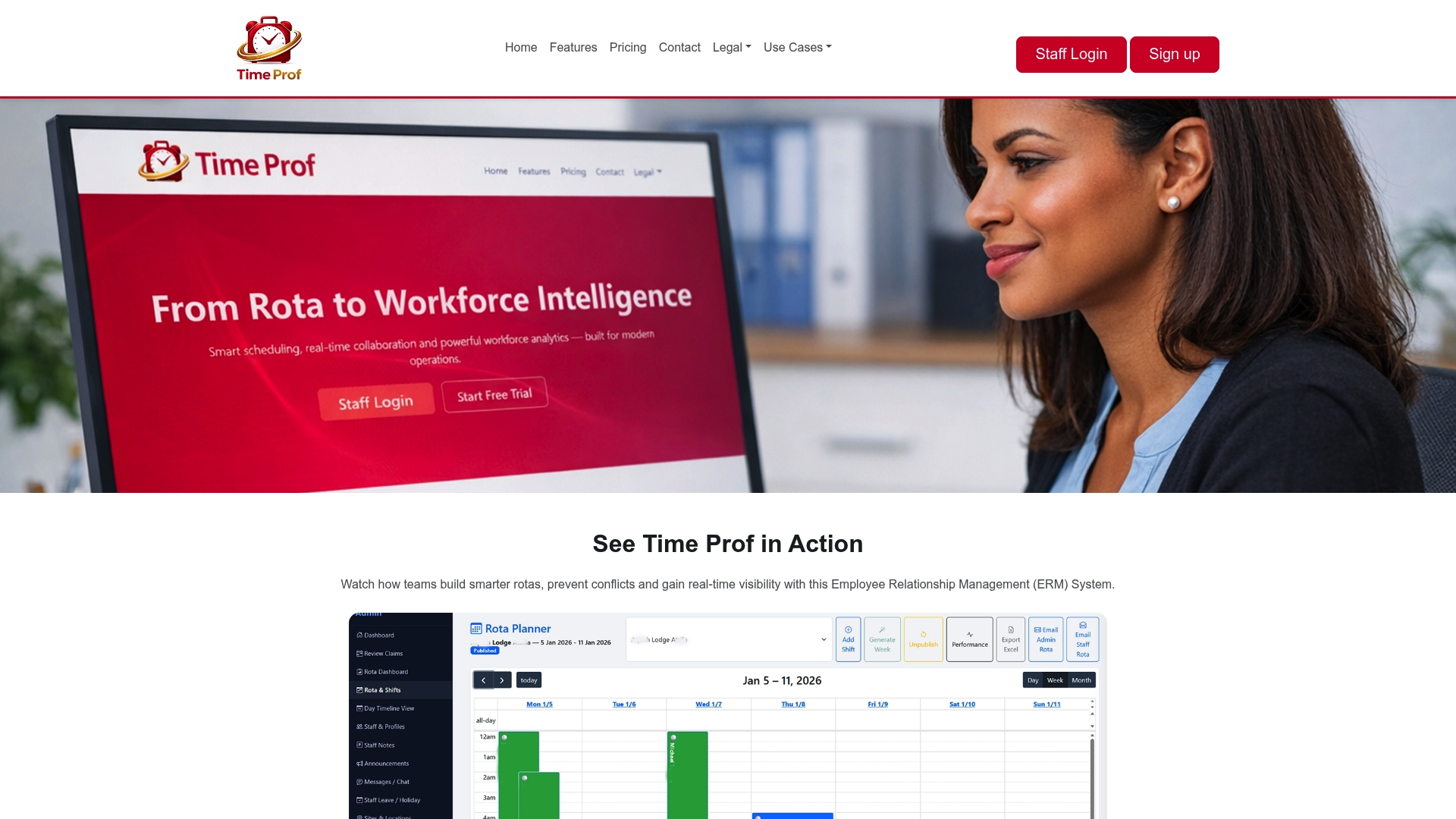
Timeprof maps directly to the capability checklist above. Multi-site dashboards show live attendance and task completion across every location. Automated WTR checks flag rest-period breaches before the rota is published. Geofenced mobile clocking confirms attendance in real time. Skills and site matching fills open shifts with qualified workers automatically. Shift-linked tasks and in-platform messaging keep supervisors and workers coordinated without a separate app.
A manager running three warehouse sites can use Timeprof to publish a four-week base rota, receive an alert when Site B drops below its picks-per-hour threshold, and authorise a cross-site redeployment from the same screen, all before the morning briefing ends.
Book a demo or start a pilot to see how Timeprof performs against your current setup. The pilot measures rota lead time, WTR compliance, unplanned agency spend, and staff cross-training coverage, giving you the data to build a business case for full rollout.
Sources
- How to Build a Warehouse Shift Schedule Plan | OperationsEdge
- Warehouse Labor Optimization Software | XoroWMS
- A New Sustainable Warehouse Management Approach for Workforce and Activities Scheduling | MDPI