What is workforce scalability? A guide for managers
Discover what is workforce scalability and how it helps managers optimize staffing, enhance agility, and respond to changing demands effectively.

Workforce scalability is defined as an organisation’s ability to adjust its labour capacity efficiently in response to changing operational demand, without sacrificing service quality or incurring unnecessary cost. The term sits within the broader discipline of workforce planning, though the industry increasingly uses “workforce elasticity” to describe the measurable, proportionate change in labour relative to demand drivers. Workforce elasticity indicates organisational agility and is tracked through the ratio of contingent to permanent workers alongside the speed of onboarding relative to demand change. For business leaders managing fluctuating staffing needs, understanding what workforce scalability means is the starting point for building an operation that can grow, contract, and recover without crisis.
What is workforce scalability and why does it matter?
Workforce scalability is the capacity to expand or reduce your labour force quickly, in proportion to business demand, while keeping costs and quality in check. It is not simply about hiring more people. It is about designing your organisation so that adding or removing capacity is a controlled, repeatable process rather than a scramble.
75% of business leaders regard flexible, scalable workforce integration as critical to growth. High-performing organisations deploy labour within days, not weeks, by maintaining pre-vetted talent pools and standardised onboarding processes. That speed advantage is most visible in logistics, manufacturing, and care, where demand spikes are sudden and the cost of understaffing is immediate.

The importance of workforce scalability extends beyond peak periods. Organisations that build scalable structures also reduce overhead during quiet periods, avoid the fixed cost of permanent headcount they do not need, and maintain the quality standards their clients expect regardless of volume. Scalability is, at its core, an operational design choice.
What strategies do organisations use to scale their workforce?
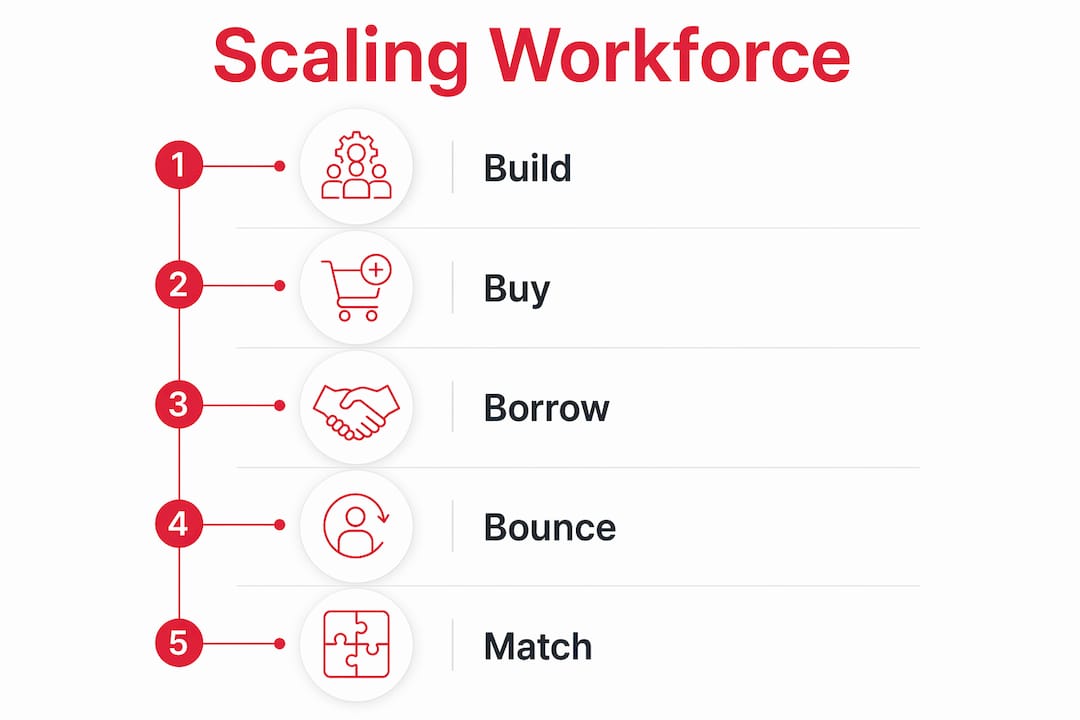
Businesses close capability gaps using four levers, each with a different speed, cost, and flexibility profile. Understanding which lever to pull, and when, is the foundation of any credible workforce scalability strategy.
| Lever | Method | Speed | Cost | Best for |
|---|---|---|---|---|
| Build | Upskill existing staff | Slow | Low per person | Long-term capability gaps |
| Buy | Hire permanent employees | Fast | High | Sustained demand growth |
| Borrow | Use contingent or agency workers | Very fast | Variable | Short-term demand spikes |
| Automate | Replace manual tasks with technology | Medium | High upfront | Repetitive, high-volume work |
The Build and Buy levers sit at opposite ends of the cost and speed spectrum. Buy is the fastest route to new capability but carries the highest ongoing cost. Build is cheapest per person over time but takes months to deliver results. Borrow, through contingent workers, gives you the fastest response to a demand spike without committing to permanent headcount. Automate reduces the volume of labour required altogether, which changes the shape of your workforce rather than simply adding to it.
Pro Tip: Match the lever to your timeframe. If you need capacity within a fortnight, Borrow. If you need it within a year, Build. If demand is permanent, Buy. Mixing levers is normal; the mistake is applying a slow lever to a fast problem.
Choosing the right mix also depends on your sector. A security firm covering a major event needs the Borrow lever activated within days. A care provider expanding into a new region needs Buy and Build running in parallel. Neither can rely on a single approach.
How does workforce scalability improve operational efficiency?
A scalable workforce makes your operation more responsive without making it more expensive. The two goals are not in conflict when the structure is designed correctly.
Scalable workforce solutions must deliver three things simultaneously: people scalability, process scalability, and data scalability. People scalability means you can add or remove workers without the system breaking. Process scalability means your workflows do not generate more admin as headcount grows. Data scalability means your reporting and dashboards remain accurate and useful at any size. Miss one of the three and growth creates overhead rather than output.
The measurable operational improvements a scalable workforce delivers include:
- Faster response to demand peaks without emergency overtime costs
- Maintained service quality during volume surges because roles and processes are pre-defined
- Reduced fixed labour costs during low-demand periods through contingent workforce use
- Shorter onboarding time because standardised training is already in place
- Better staff retention because workloads are managed rather than dumped on permanent employees
- Cleaner compliance records because real-time workforce control tracks attendance and hours automatically
Each of these improvements compounds. Faster onboarding means you can respond to demand in days rather than weeks. Cleaner compliance records reduce audit risk. Lower overtime costs free budget for training. The benefits of workforce scalability are not isolated; they reinforce each other when the underlying structure is sound.
What challenges do organisations face when scaling their workforce?
The most common mistake is treating workforce scaling as a transactional process. A manager spots a gap, raises a requisition, and waits. That model is reactive, slow, and expensive. It also produces inconsistent results because each scaling event starts from scratch.
Balancing overstaffing and understaffing requires combining historical data, market trends, and product or service roadmaps to improve forecasting accuracy. Overstaffing inflates fixed costs and demoralises permanent staff who see their hours cut. Understaffing damages service quality, burns out your core team, and loses clients. Neither extreme is acceptable, and neither is avoidable without data.
Organisations also underestimate how quickly workforce plans become obsolete. A plan built in january may be irrelevant by april if a major contract is won or lost. Monthly and quarterly checkpoints for hiring and upskilling prevent plans from drifting out of alignment with business reality. The two-horizon model, with monthly operational reviews and quarterly strategic replanning, keeps both short-term deployment and long-term capability in view simultaneously.
Pro Tip: Set rule-based demand triggers before you need them. Define the exact conditions, such as a 20% rise in confirmed bookings or a new site opening, that automatically initiate a hiring or contingent worker activation process. Waiting until the pressure is visible means you are already behind.
A further pitfall is neglecting the maturity curve. Organisations progress from reactive, inconsistent scaling methods to standardised, transparent workflows integrated across HR, finance, and operations. Most businesses sit in the middle of that curve, with some processes documented and others still dependent on individual knowledge. Identifying where your organisation sits is the first step to moving forward.
What frameworks support successful workforce scalability?
The most effective framework treats workforce scaling as an operating system, not a one-off project. Workforce capacity expansion models shift focus from headcount counts to labour capacity aligned directly to demand signals, with rule-based deployment built in from the start.
The core components of a capacity expansion model work across three workforce categories:
| Category | Definition | Activation trigger |
|---|---|---|
| Core workforce | Permanent employees covering baseline demand | Always active |
| Flex workforce | Part-time or zero-hours staff on pre-vetted rosters | Demand rises above baseline threshold |
| Surge workforce | Agency or contingent workers for peak events | Demand exceeds flex capacity or speed is critical |
Segmenting your workforce this way means every scaling decision has a pre-defined answer. When demand crosses a threshold, the flex layer activates. When flex is exhausted, surge kicks in. The decision is not made under pressure; it is made in advance and executed through a process.
Standardised onboarding is the mechanism that makes this work in practice. If your flex and surge workers take four weeks to become productive, your response time is four weeks regardless of how fast you activate them. Reducing ramp-up time through structured induction, skills verification, and shift management systems is where most organisations find their biggest efficiency gain.
Platform selection also matters. A workforce management platform must support all three scalability dimensions: people, process, and data. Automation and real-time dashboards facilitate growth without adding administrative burden. Choosing a platform that breaks under volume, or that requires manual workarounds as headcount grows, defeats the purpose of building a scalable structure in the first place.
Key takeaways
Workforce scalability delivers lasting operational advantage only when it is treated as a designed system, not a reactive response to pressure.
| Point | Details |
|---|---|
| Define scalability precisely | Workforce scalability means adjusting labour capacity in proportion to demand, without losing quality or control. |
| Use the four levers deliberately | Build, Buy, Borrow, and Automate each suit different timeframes and cost profiles. Match the lever to the problem. |
| Target three scalability dimensions | People, process, and data scalability must all be present for growth to avoid creating extra overhead. |
| Plan with two horizons | Monthly operational reviews and quarterly strategic replanning keep workforce plans aligned with changing business goals. |
| Segment your workforce in advance | Core, flex, and surge categories with pre-defined activation triggers remove the need for reactive decision-making. |
Scaling workforce: what most guides get wrong
The articles I read on this topic almost always focus on the mechanics of hiring. They list the levers, describe the frameworks, and stop there. What they miss is the cultural shift that makes any of it work.
Workforce scalability fails most often not because the model is wrong, but because managers still treat every scaling event as an exception. They escalate, negotiate, and improvise because the system has not given them permission to act. The frameworks above only function when the rules are agreed in advance and the data to trigger them is visible in real time.
The second thing most guides underplay is the cost of the middle state. Organisations that are partially scalable, with some processes documented and others still in someone’s head, often end up paying the costs of both a rigid and a flexible workforce without the benefits of either. The maturity curve is real. Moving from reactive to standardised is not a technology problem; it is a discipline problem. Technology accelerates the journey, but the discipline has to come first.
My honest advice: audit your current scaling events for the past 12 months. Count how many were triggered by a pre-defined rule versus how many were triggered by a crisis. If the ratio favours crisis, you have your starting point.
— Michael
How Timeprof supports workforce scalability
Timeprof is built for organisations that need real control over their workforce as it grows and changes. The platform brings rota planning, real-time attendance tracking, skills management, and workforce intelligence together in one place, so managers always have an accurate picture of who is available, qualified, and deployed.
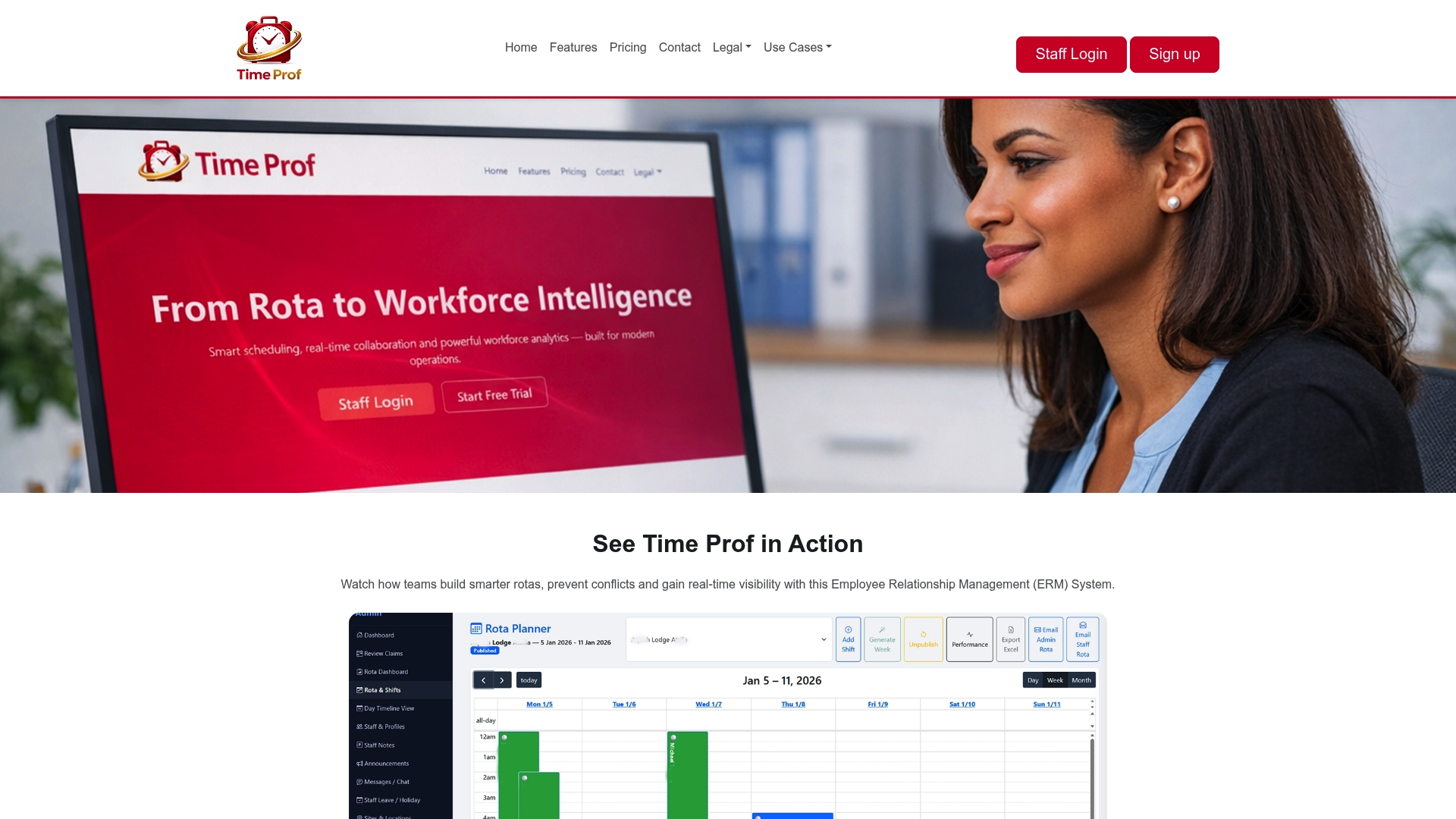
Features like geofenced clock-in, open shift claims, and live multi-site dashboards directly support the core, flex, and surge workforce model described in this article. Standardised onboarding records and audit-ready compliance reporting reduce the administrative burden that typically grows with headcount. Timeprof scales from a single site to a large, complex operation without requiring manual workarounds, making it a practical foundation for any organisation serious about reducing scheduling errors and building a workforce that responds to demand rather than chasing it.
FAQ
What does workforce scalability mean?
Workforce scalability means the ability to increase or decrease your labour capacity in proportion to operational demand, without losing quality or incurring unnecessary cost. It is an organisational design choice, not a one-off hiring decision.
What are the four levers used to scale a workforce?
The four levers are Build (upskilling existing staff), Buy (hiring permanent employees), Borrow (using contingent or agency workers), and Automate (replacing manual tasks with technology). Each lever suits a different timeframe and cost profile.
How do you measure workforce scalability?
Workforce elasticity is measured by the ratio of contingent to permanent workers and the speed of onboarding relative to demand change. Faster onboarding and a higher contingent ratio generally indicate greater scalability.
What is the biggest risk when scaling a workforce?
The biggest risk is reactive scaling, where each event starts from scratch without pre-defined triggers or processes. This leads to overstaffing, understaffing, and inconsistent service quality.
How often should workforce plans be reviewed?
Monthly operational reviews and quarterly strategic replanning sessions keep workforce plans aligned with changing business goals. Plans built without regular checkpoints become obsolete quickly, particularly when contracts or market conditions shift.