Shift-linked task management: benefits for frontline teams
Discover how shift-linked task management enhances accountability, reduces missed duties, and improves handoffs for frontline teams.

Linking tasks directly to shifts rather than to individual staff members measurably improves accountability, cuts missed duties, and makes cross-shift handoffs faster. The practical gains show up quickly: managers typically see cleaner completion records, less chasing, and a shorter gap between “assigned” and “done.”
The core shift-linked task management benefits, at a glance:
- Clear ownership by shift — every duty belongs to a shift, so there is no ambiguity about who is responsible during that window.
- Fewer missed tasks — tasks that are not completed trigger visible gaps rather than silent omissions.
- Faster handoffs — incoming shifts see exactly what was finished, what was skipped, and any notes left by the outgoing team.
- Predictable workload — recurring templates mean staff know what is expected before they clock in.
- Measurable performance — three KPIs to check immediately: task completion rate, missed-task rate, and average time-to-complete per shift.
Key takeaways
Shift-linked task management delivers its strongest returns when tasks are attached to shifts rather than individuals, templates are kept short, and KPIs are tracked from week one of a pilot.
| Point | Details |
|---|---|
| Shift as the assignment unit | Attaching tasks to a shift rather than a person prevents orphaned duties when cover changes. |
| Start with five to ten tasks | Short initial templates drive higher completion rates and faster staff adoption. |
| Track three KPIs from day one | Completion rate, missed-task rate, and manager admin time saved are the clearest early indicators. |
| Research supports the model | A Gap, Inc. RCT found a 5.1% productivity gain from schedule improvements; an ISRTA study confirmed shift-linking scales to 200+ tasks per day. |
| Timeprof for implementation | Timeprof links rota, tasks, verification, and analytics in one platform for a measurable pilot. |
Table of Contents
- What “shift-linked” task management actually means
- The core shift-linked task management benefits managers will see
- Features that make shift-linked task management work in practice
- KPIs to track and how to measure ROI
- A step-by-step checklist for piloting shift-linked tasks
- How shift-linked tasks work across frontline industries
- What the research says about shift-based task models
- When shift-linked task management may not be the right fit
- A manager’s perspective on what actually changes
- Timeprof makes shift-linked task management measurable from day one
- Sources
What “shift-linked” task management actually means
Most task systems assign work to a named person. Shift-linked task management assigns work to a shift slot instead. The shift becomes the unit of accountability: whoever is working that window owns the tasks attached to it, regardless of which individual fills the role.
That distinction matters operationally. When a task belongs to “Tuesday Night Security Round” rather than to “Dave,” it does not fall through the gap if Dave calls in sick. The replacement inherits the full checklist automatically.
| Assignment model | Task owner | What happens when cover changes | Verification method |
|---|---|---|---|
| Individual-based | Named person | Task may be orphaned or manually reassigned | Relies on that person’s records |
| Roster-based | Whoever is rostered | Partial coverage; manager must check manually | Rota cross-reference |
| Shift-linked | The shift itself | Replacement inherits tasks automatically | Timestamped checklist, photo, sign-off |
In practice, a shift-linked task looks like a mobile checklist that appears on a staff member’s device when their shift begins. They work through it, capture photo evidence where required, and sign off each item. The outgoing shift’s completion data feeds directly into the handover note the next team sees. Integrating schedules and tasks in one place surfaces this progress visually and reduces the chance that anything slips between shifts.
The core shift-linked task management benefits managers will see
1. Unambiguous ownership for every shift duty
When a cleaning round, medication check, or opening procedure is attached to a shift rather than a person, the question “whose job is that?” has a clear answer at all times. Managers stop fielding “I thought the last shift did it” conversations. For care homes and security firms especially, this clarity is not just convenient — it is a compliance requirement.

2. Fewer missed tasks and late completions
Tasks that are not signed off by shift end appear as open items in the manager’s dashboard. There is no need to walk the floor or send a message to find out what was skipped. The system flags it. Pair this with automatic escalation rules and a missed medication round or an unchecked fire door triggers an alert rather than a silent gap in the record.
3. Faster, safer cross-shift handoffs
Handover notes attached to shift tasks carry completion metadata: who did what, when, and whether any item was flagged. The incoming team does not need a verbal briefing to know the state of play. In hospitality, this means a breakfast supervisor knows exactly which prep tasks the night porter completed. In a care setting, it means the day team sees which residents had their checks done and which did not.
4. Reduced manager admin through recurring templates
Building a shift task list once and applying it to every equivalent shift across the rota saves significant time. A Monday morning retail opening checklist does not need to be recreated each week. Templates also reduce the volume of ad hoc messages and change requests that pile up when task assignment is informal. Automating shift and coverage management has been shown to cut manual planning work by roughly 90% in operational case studies, with fewer errors and better traceability as a direct result.
5. Stronger compliance and audit readiness
Photo evidence, timestamps, and digital sign-offs create an audit trail that paper checklists cannot match. When a regulator or internal auditor asks whether a specific check was completed on a specific date, the answer is retrievable in seconds rather than hours. This matters in care, food service, and security, where the consequences of a missing record extend well beyond an operational inconvenience.
6. Better staff experience and reduced ambiguity
Staff who start a shift knowing exactly what is expected of them tend to work more confidently. A clear, prioritised task list removes the low-level anxiety of “am I doing the right things?” that often accompanies informal task management. Responsible scheduling practices at Gap, Inc. demonstrated measurable improvements in store productivity when scheduling quality improved, with gains driven by both higher sales and lower labour costs — a signal that schedule clarity feeds directly into frontline execution.
7. Scalability across multiple sites
Once templates are built for a single site, they can be replicated across a portfolio. A cleaning company managing 20 client sites can push a standardised end-of-shift checklist to every location and monitor completion from a central dashboard. The operational logic stays consistent; only site-specific details change.
Features that make shift-linked task management work in practice
The benefits above depend on having the right system features in place. When evaluating platforms, these are the capabilities that actually move the needle.
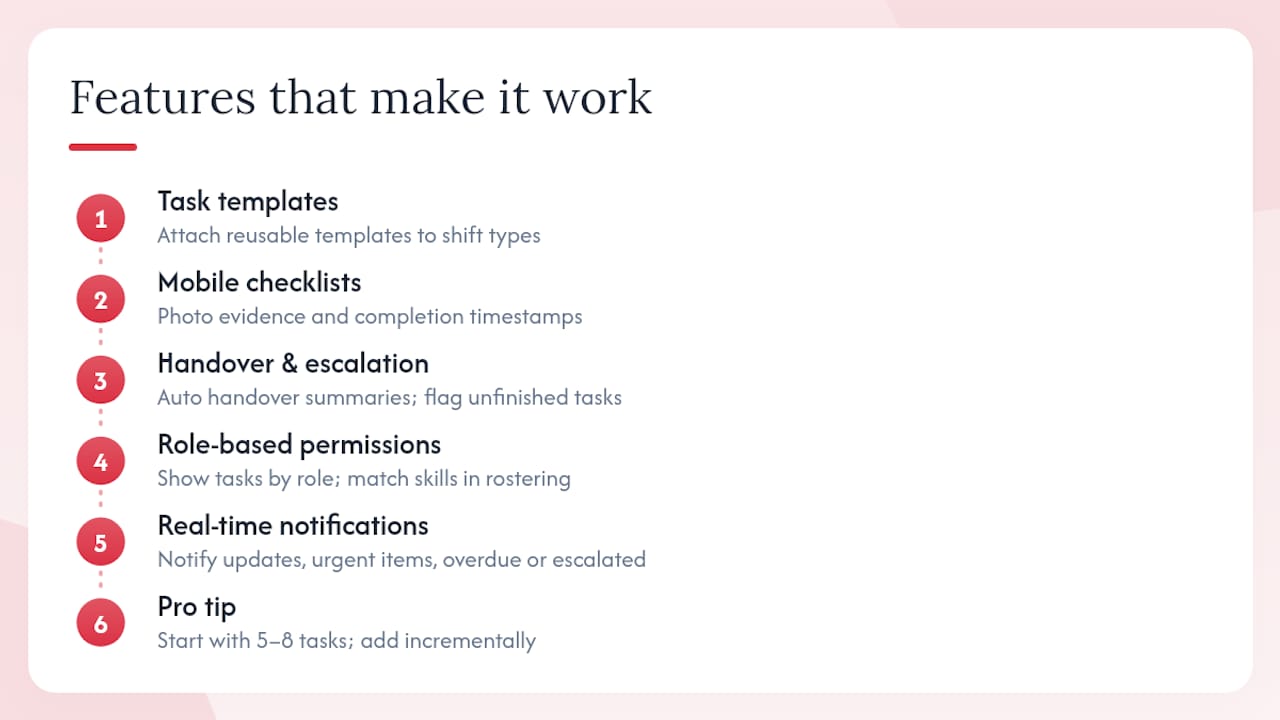
Task templates and recurring assignments. A system that lets you build a task list once and attach it to every instance of a shift type saves hours of weekly setup. Look for the ability to clone, edit, and version templates without disrupting live shifts.
Mobile checklists with photo and timestamp capture. Frontline staff rarely sit at a desk. Tasks need to appear on a mobile device at shift start, support photo evidence for physical checks, and record the exact time of completion. Without this, verification relies on trust rather than data.
Cross-shift handover notes and escalation flags. Completion data should flow automatically into a handover summary the next shift can read. Unfinished tasks should be flaggable for escalation rather than simply rolling over silently.
Role-based permissions and skills matching. Not every task is appropriate for every staff member. A system that surfaces only the tasks relevant to a staff member’s role and qualifications reduces confusion and prevents unqualified staff from being assigned duties they should not perform. Skills-based matching in rostering is a practical extension of this principle.
Real-time notifications. Staff should receive a notification when their shift task list is updated or when an urgent item is added mid-shift. Managers should be alerted when a task is overdue or escalated.
Pro Tip: Keep the initial task list short. Pilots that start with five to eight tasks per shift see faster adoption than those that launch with twenty. Add tasks incrementally once the habit is established.
A shift management system that integrates all of these features in one place removes the friction of switching between apps and keeps both managers and staff working from a single source of truth.
KPIs to track and how to measure ROI
Shift-linked task management produces measurable outcomes, but only if you define what you are measuring before the pilot starts.
Priority KPIs
- Task completion rate — percentage of shift tasks signed off before shift end. Measure weekly; target above 90% within four weeks of go-live.
- Missed-task rate — number of tasks left open at shift end, expressed as a percentage of total tasks assigned. Track per shift type to identify patterns.
- Average time-to-complete — how long tasks take from assignment to sign-off. Useful for spotting bottlenecks and unrealistic task loads.
- Rework events — tasks that were marked complete but required follow-up action. A high rework rate often signals unclear task descriptions rather than staff performance issues.
- Manager admin hours saved — time spent on manual task assignment, chasing completions, and building handover notes before versus after the pilot.
Simple before-and-after calculation
| KPI | Pre-pilot baseline | Post-pilot target | How to measure |
|---|---|---|---|
| Task completion rate | Record manually for two weeks | 90%+ | System dashboard |
| Missed-task rate | Count open items at shift end | Below 5% | Shift close report |
| Manager admin time | Log hours spent on task admin | Reduce by 30%+ | Manager time log |
| Rework events | Count follow-up actions per week | Reduce by half | Incident or rework log |
At a typical UK supervisory hourly rate, that translates directly into recoverable labour cost, before accounting for the value of fewer missed duties and reduced compliance risk.
A step-by-step checklist for piloting shift-linked tasks
- Map your core shift duties. List every recurring task for each shift type at your pilot site. Aim for five to ten tasks per shift to start.
- Build task templates. Create a template for each shift type. Include task name, description, verification method (photo, sign-off, or both), and priority level.
- Configure verification settings. Decide which tasks require photo evidence and which need a simple sign-off. Set escalation rules for tasks not completed within a defined window.
- Set role-based permissions. Assign tasks only to the roles qualified to complete them. Check that skills filters are active for any regulated duties.
- Brief your pilot team. Run a short session (30 minutes is enough) explaining the new process. Nominate a shift champion on each team to answer peer questions.
- Run a four to eight week pilot. Collect baseline KPIs in week one, then track weekly. Avoid changing templates mid-pilot unless a task is genuinely unworkable.
- Review KPIs and gather feedback. At week four and week eight, compare completion rates, missed-task rates, and manager time logs against your baseline. Ask staff what is working and what is not.
- Iterate and expand. Refine templates based on feedback, then roll out to additional sites or shift types.
Pro Tip: Involve frontline staff in the template design stage. Staff who helped write the checklist are far more likely to follow it consistently than those who had it handed down to them.
Governance matters too. Agree upfront on who can add or edit tasks, how often templates are reviewed, and what triggers an escalation. Without these rules, template creep sets in quickly. Shift planning best practices covers the governance principles that prevent this.
How shift-linked tasks work across frontline industries
Retail. An opening shift checklist covers till float checks, display replenishment, and safety walkthrough. Each item is signed off on a mobile device; the store manager sees completion status before the first customer arrives. KPI affected: missed-task rate.
Care homes. Medication rounds, personal care checks, and meal assistance are attached to specific shift windows. Photo evidence and timestamps create a care record that satisfies CQC inspection requirements. Mobile checklists for care staff reduce the gap between care delivery and documentation. KPI affected: completion rate and audit trail completeness.
Hospitality. Night porter tasks (room checks, lobby clean, breakfast prep) feed into a handover note the morning team reads at 6 AM. Nothing is communicated verbally; the record speaks for itself. KPI affected: rework events.
Cleaning services. A cleaning company managing multiple client sites uses a standardised end-of-shift checklist with photo capture. Clients receive a completion report automatically. KPI affected: client-facing completion rate.
Security. Patrol rounds are logged with timestamped sign-offs at each checkpoint. Any missed patrol triggers an escalation alert to the duty manager within minutes. KPI affected: missed-task rate and escalation response time.
Warehousing. Picking zone checks, equipment inspections, and end-of-shift stock counts are attached to shift types. Discrepancies are flagged before the next shift begins rather than discovered hours later. KPI affected: rework events and time-to-complete.
For multi-site operations, centralise templates at the organisation level and allow site managers to add site-specific tasks within a defined scope. This keeps standards consistent without removing local flexibility.
What the research says about shift-based task models
The operational case for shift-linked task management is backed by a growing body of academic and practitioner evidence.
A peer-reviewed study published in the European Journal of Operational Research found that a shift-based ISRTA model outperformed both task-based and roster-based approaches for integrated staff rostering and task assignment, reducing the number of variables and constraints required, handling large real-world instances with many tasks and staff. The practical implication: shift-linking is not just a management preference — it is computationally more tractable at scale, which means it holds up as organisations grow.
A randomised field experiment at Gap, Inc. found that responsible scheduling interventions raised store productivity, driven by increased sales and reduced labour costs. The mechanism was schedule predictability and employee control — the same conditions that shift-linked task management creates at the task level.
On the operational side, a reported automation success story found that centralising shift and coverage management reduced manual planning work by roughly 90%, with improved traceability and fewer planning errors as direct outcomes.
Key implications for a pilot:
- Start with a shift type that has high task volume and clear verification criteria (care rounds, security patrols, retail opening checks).
- Use the pilot to establish a baseline before claiming productivity gains.
- The research supports a four to eight week measurement window as sufficient to see meaningful movement in completion and missed-task rates.
When shift-linked task management may not be the right fit
Shift-linked tasking is not universally the best model. Knowing where it struggles helps you avoid a failed pilot.
Over-fragmentation. Breaking complex duties into too many micro-tasks creates checklist fatigue. Staff spend more time ticking boxes than doing the work. Keep tasks at a meaningful level of granularity: “complete medication round for Bay A” rather than fifteen individual sub-steps.
Too many templates too soon. Launching with a full library of templates across every shift type overwhelms both staff and managers. Start with one shift type at one site. Common scheduling challenges often stem from over-engineering the initial setup.
Contractual and working-time constraints. Attaching tasks to shifts must not create implied obligations that conflict with employment contracts or Working Time Regulations 1998. Tasks should reflect duties already within the role, not add uncompensated work. Check with HR or a legal adviser before attaching new duties to existing shift patterns.
Skills mismatches. Assigning a regulated task to a staff member without the required qualification is a compliance risk. Use skills filters and role-based permissions to prevent this from happening automatically.
Change resistance. Frontline staff who have managed their own task lists informally for years may resist a structured checklist. Involve them in template design, explain the “why” clearly, and frame the change as removing ambiguity rather than adding surveillance.
Pro Tip: Run a brief anonymous survey after the first two weeks of a pilot. Staff who feel heard early are significantly less likely to disengage from the process later.
A manager’s perspective on what actually changes
The gap between a well-designed shift-linked task system and a mediocre one usually comes down to a single decision made at the start: whether the manager treats the task list as a monitoring tool or as a communication tool.
Pilots that succeed tend to frame tasks as the shift’s shared contract — here is what this window of work is responsible for, here is how we know it was done, here is what the next team needs to know. That framing changes how staff interact with the checklist. They are not being watched; they are handing over.
The most common adjustment managers make after the first four weeks is simplification. Initial templates are almost always too long. The data does not lie: shorter, clearer task lists get done.
Timeprof’s platform is built around this principle. The shift-linked task feature sits inside the same system as the rota, attendance, and reporting tools, so the feedback loop between scheduling and task performance is visible in one place rather than spread across three separate applications. Managers who can see completion rates alongside attendance data make better decisions about staffing levels and task loads.
Timeprof makes shift-linked task management measurable from day one
Fewer missed duties, cleaner handoffs, and a real audit trail — that is what shift-linked task management delivers when the system behind it is built for frontline teams. Timeprof connects rota planning, shift-linked tasks, mobile checklists, photo verification, and operational analytics in one platform, so you are not stitching together separate tools to get a complete picture.
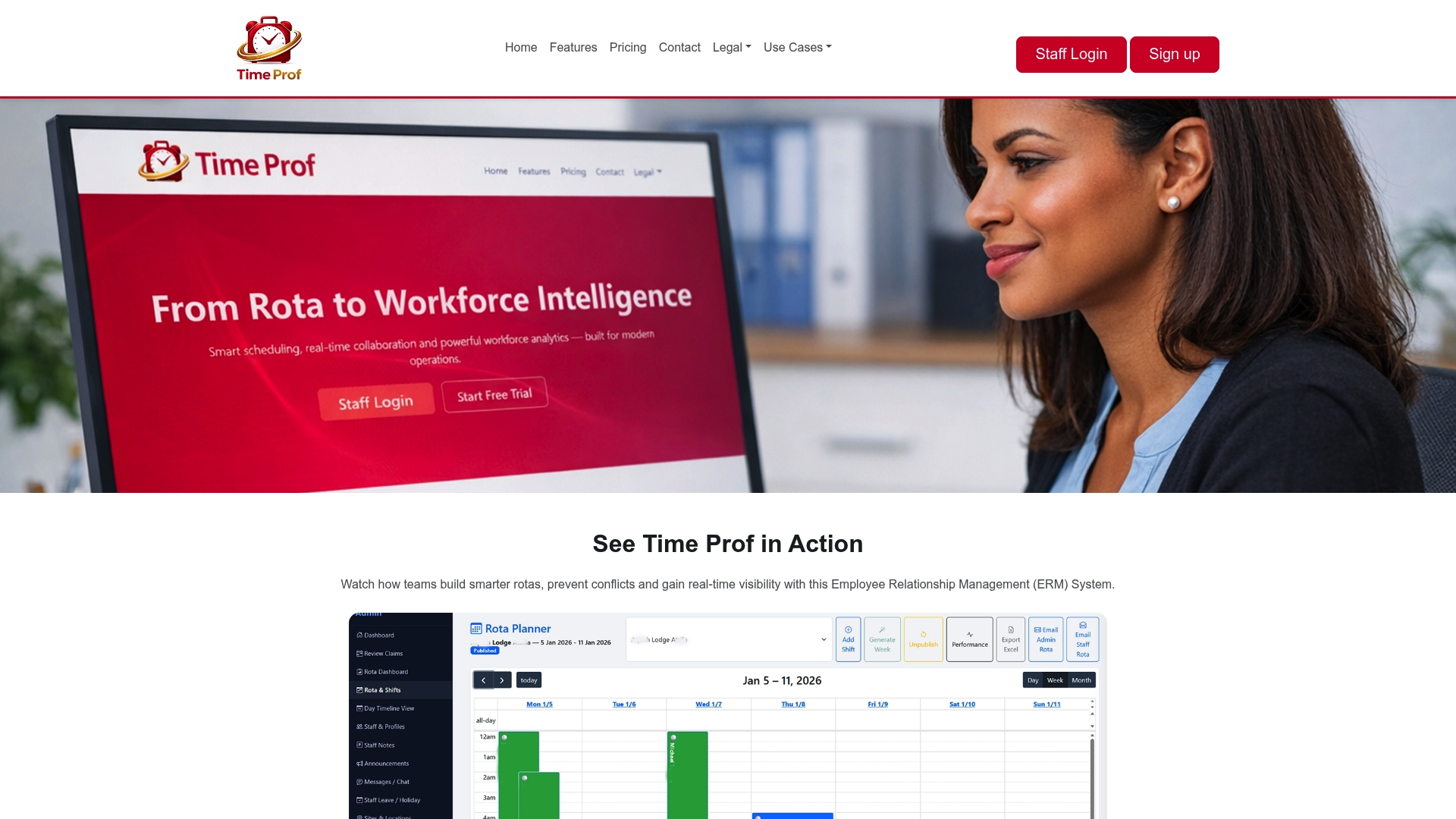
Managers running a pilot with Timeprof can configure task templates, set verification rules, and track completion rates without touching a spreadsheet. The mobile-first design means frontline staff see their task list the moment their shift begins, and managers see real-time progress from any device. Role-based permissions and skills filters keep regulated tasks in the right hands automatically.
Book a demo or start a free trial at Timeprof to see how shift-linked task management works in practice for your team.
Sources
- How to automate shift management: success story
- Doing Well by Doing Good: Improving retail store performance with responsible scheduling practices at the Gap, Inc.
- Task management with Microsoft Shifts and Planner