The role of skills matching in rostering: 2026 guide
Discover the role of skills matching in rostering in this 2026 guide. Improve service quality, staff utilization, and operational compliance.

Skills matching in rostering is defined as the process of aligning each employee’s verified competencies with the specific requirements of a shift or task before a rota is published. Get this wrong and you create what scheduling professionals call “phantom capacity”: a roster that looks fully staffed on paper but fails operationally because the wrong people are in the wrong roles. Get it right and you unlock measurable gains in service quality, staff utilisation, and compliance. This guide gives workforce managers and HR professionals the evidence, frameworks, and practical steps to take exactly that.
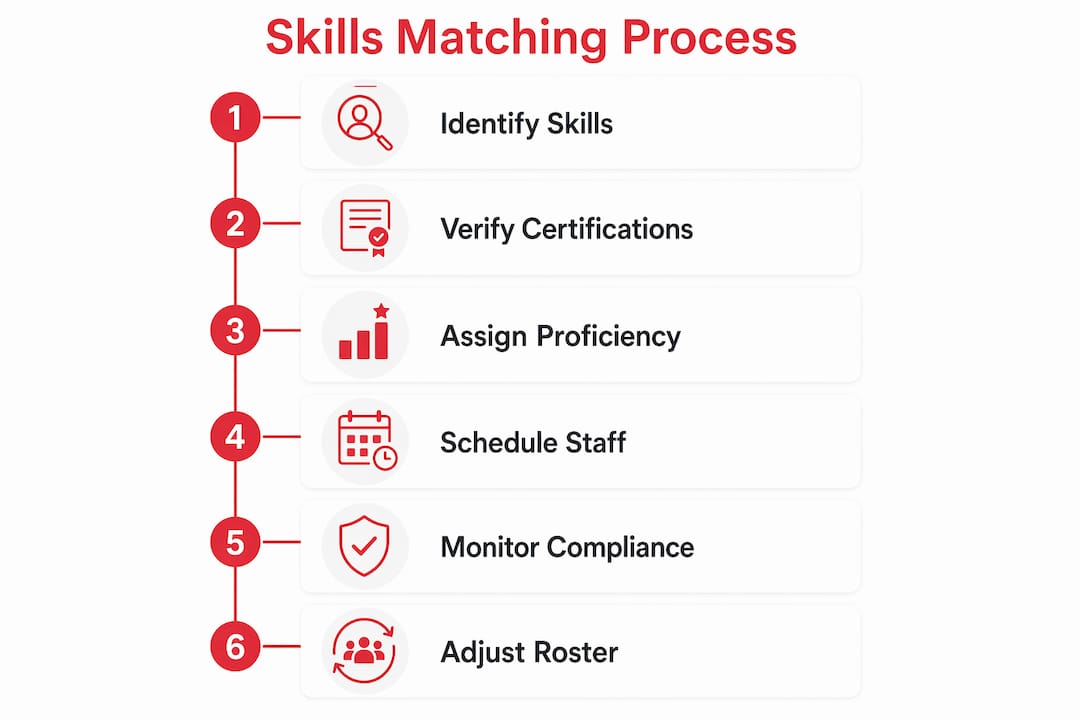
What is the role of skills matching in rostering?
Skills matching in rostering is the discipline of treating each worker as a resource with specific, finite capabilities rather than an interchangeable headcount. Dynamic skill-aware scheduling treats each operator as a resource with specific capabilities, enabling executable and optimised plans. That distinction matters enormously. A security officer with a valid SIA licence is not the same resource as one whose licence expired last month, even if both appear on a headcount report.
The importance of skills matching has grown sharply in 2026. About 1 in 10 job vacancies in advanced economies now require at least one new skill, according to IMF research. That figure means your rota can become outdated faster than your review cycle if skills data is not embedded directly into the scheduling system.

Skills alignment in scheduling also connects directly to compliance. Sectors such as care, healthcare, and security carry legal obligations around who can perform certain tasks. A skills-aware rota enforces those obligations automatically rather than relying on a manager’s memory.
How does skills matching affect rostering outcomes?
The evidence linking skill-aware scheduling to operational performance is specific and compelling. Research on urban rail station scheduling shows that incorporating multi-personnel skill factors into scheduling optimises skill utilisation and enhances resilience, improving service quality and adaptability to demand. That finding translates directly to any multi-site operation: retail, hospitality, cleaning, or care.
The mechanism is straightforward. When a rostering system knows which staff members hold which competencies, it can respond to sudden demand shifts by redeploying qualified people rather than pulling in anyone available. That adaptability is the difference between a service that absorbs disruption and one that collapses under it.
Skills compatibility in scheduling also reduces idle time. Ignoring labour constraints and treating workers as interchangeable leads to phantom capacity and delays. Advanced Planning and Scheduling (APS) systems that model skill levels avoid assigning tasks to unqualified operators, cutting idle time and quality risks simultaneously.
Pro Tip: Build a simple “skills heat map” for each site showing which shifts carry the highest risk of a skills gap. Review it weekly, not monthly. Gaps compound quickly when certification expirations are not tracked in real time.
What challenges exist in implementing skills-based rostering?
Skills-based rostering is not simply a matter of adding a skills column to a spreadsheet. The challenges are structural, and most organisations encounter the same set of them.
The most common problems include:
- Stale skills data. Certifications expire. Staff complete new training. Without a live skills register embedded in the rostering system, managers work from outdated information and create schedules that look valid but are not.
- Headcount-only thinking. Traditional scheduling fills shifts by numbers. Treating workers as interchangeable in scheduling produces phantom capacity, where a shift appears covered but lacks the competencies the role demands.
- Certified bottlenecks. Some tasks require a single certified operator. If that person is absent, the task cannot proceed. Advanced scheduling systems embed dynamic skill matrices to prevent assigning unqualified workers and to manage certification expirations automatically. Without that automation, bottlenecks are invisible until they cause a failure.
- Generic skills mapping. Focusing only on generic skills rather than task-based competency mapping causes significant productivity loss. Working backwards from task profiles to specific competencies produces far better workforce utilisation.
- Compliance versus demand trade-offs. Perfect demand fit ignoring constraints leads to operational failure. Perfect constraint compliance ignoring demand produces static, ineffective rosters. The tension between the two is the central challenge of skills-based rostering.
Pro Tip: Audit your current rota against your skills register once a quarter. Count how many shifts were filled by staff whose recorded skills did not match the role requirement. That number is your baseline for improvement.
How does technology support skills matching in workforce scheduling?
Modern scheduling technology addresses the challenges above by embedding skills logic directly into the rostering engine. The difference between manual and automated skills-based scheduling is not just speed. It is the quality and reliability of the output.
Manual versus automated skills-based scheduling
| Approach | Skills data management | Certification tracking | Demand response |
|---|---|---|---|
| Manual (spreadsheets) | Static, updated infrequently | Relies on manager memory | Slow, reactive |
| Automated scheduling system | Live skill matrices, updated in real time | Automatic expiry alerts and blocks | Fast, rule-driven |
The table above shows why common staff scheduling challenges persist in organisations that rely on spreadsheets. The system simply cannot hold the complexity of skills data, certification dates, and demand forecasts simultaneously.
Skill matching algorithms work by assigning a proficiency tier to each worker for each relevant skill. Skill matrices that categorise operator proficiency levels as trainee, qualified, or expert improve scheduling accuracy by adjusting job durations realistically. A trainee takes longer to complete a task than an expert. A rota that ignores that difference produces unreliable shift plans.
Automatic skill extraction is a newer capability. AI-powered platforms can read job descriptions, training records, and performance data to suggest skill assignments rather than requiring managers to enter everything manually. Timeprof uses this approach to keep skills profiles current without creating administrative overhead for managers.
Real-time workforce control adds a further layer. When a qualified worker calls in sick, a skills-aware system immediately identifies available replacements who hold the required competencies, rather than simply flagging a gap and leaving the manager to search manually.
Practical strategies for optimising skills matching in rostering
The following steps give workforce managers a clear path from generic headcount scheduling to genuine skills-based rostering.
-
Build a live skill matrix. Record every relevant skill, certification, and proficiency level for each staff member. Assign expiry dates to certifications and set automatic alerts at 30 and 60 days before expiry. A static spreadsheet will not hold this reliably. Use a platform that maintains the matrix as a live record.
-
Map tasks, not just roles. Working backwards from task profiles to competencies ensures better workforce utilisation than mapping generic job titles. Define what each shift actually requires at the task level, then match staff accordingly.
-
Incorporate proficiency tiers into scheduling logic. Do not treat a trainee and an expert as equivalent resources. Build proficiency tiers into your rostering rules so that job durations and task assignments reflect actual capability. This prevents the unreliable schedule plans that arise when skill level is ignored.
-
Balance demand fit with compliance constraints. The art of demand-driven rostering involves balancing workload forecasts by role, skill, and time with compliance constraints such as fatigue management and certifications. Neither side of that balance can be ignored. Build scenario plans that test both extremes so you understand where your rota is most vulnerable.
-
Invest in cross-skilling. Certified bottlenecks are the single greatest risk in skills-based rostering. If only one person holds a critical certification, that person’s absence shuts down a function. Cross-skilling two or three staff members for each critical competency removes that single point of failure.
-
Plan for new skill demands. Demand and supply imbalances in new skills, particularly in AI and IT-related competencies, have created challenges for workforce planners. Build a skills pipeline that anticipates what your operation will need in 12 months, not just what it needs today.
Pro Tip: When introducing skills-based rostering for the first time, start with your highest-risk shifts, those where a skills gap has caused a problem in the past. Prove the model there before rolling it out across the full rota.
Key takeaways
Skills-based rostering requires live skills data, proficiency tiers, and compliance logic working together. Without all three, the rota produces phantom capacity rather than genuine operational cover.
| Point | Details |
|---|---|
| Define skills at task level | Map competencies to specific tasks, not generic job titles, for accurate shift coverage. |
| Maintain a live skill matrix | Update certifications and proficiency levels in real time to prevent stale data and bottlenecks. |
| Use proficiency tiers | Assign trainee, qualified, or expert levels to adjust job durations and scheduling accuracy. |
| Balance demand and compliance | Neither demand fit nor constraint compliance alone produces a reliable rota. Both must be managed together. |
| Cross-skill for resilience | Train multiple staff members in critical competencies to eliminate single points of failure in the rota. |
Why skills alignment is the most underrated part of rostering
Most workforce managers I speak with understand that skills matter. Where the thinking tends to fall short is in treating skills as a one-time data entry exercise rather than a live operational variable. A skills register that was accurate six months ago is not the same thing as a skills register that is accurate today.
The organisations that get this right share one characteristic. They treat the skill matrix as infrastructure, not administration. They update it when a certification is renewed, not when a problem surfaces. They build cross-skilling into their annual training plan, not as a reaction to a gap but as a deliberate hedge against disruption.
The 2026 labour market adds urgency to this. New competency requirements, particularly around AI-adjacent roles, are entering job descriptions faster than most rostering systems can absorb them. The gap between what a rota assumes and what a shift actually needs is widening in sectors that are not paying attention.
My recommendation is direct. If your current rostering system cannot tell you, in real time, which staff members hold a specific certification and when it expires, you are already operating with phantom capacity. The question is not whether that will cause a problem. It is when.
— Michael
How Timeprof supports skills-based rostering
Timeprof is built to give workforce managers the skills visibility and scheduling control that manual systems cannot provide.
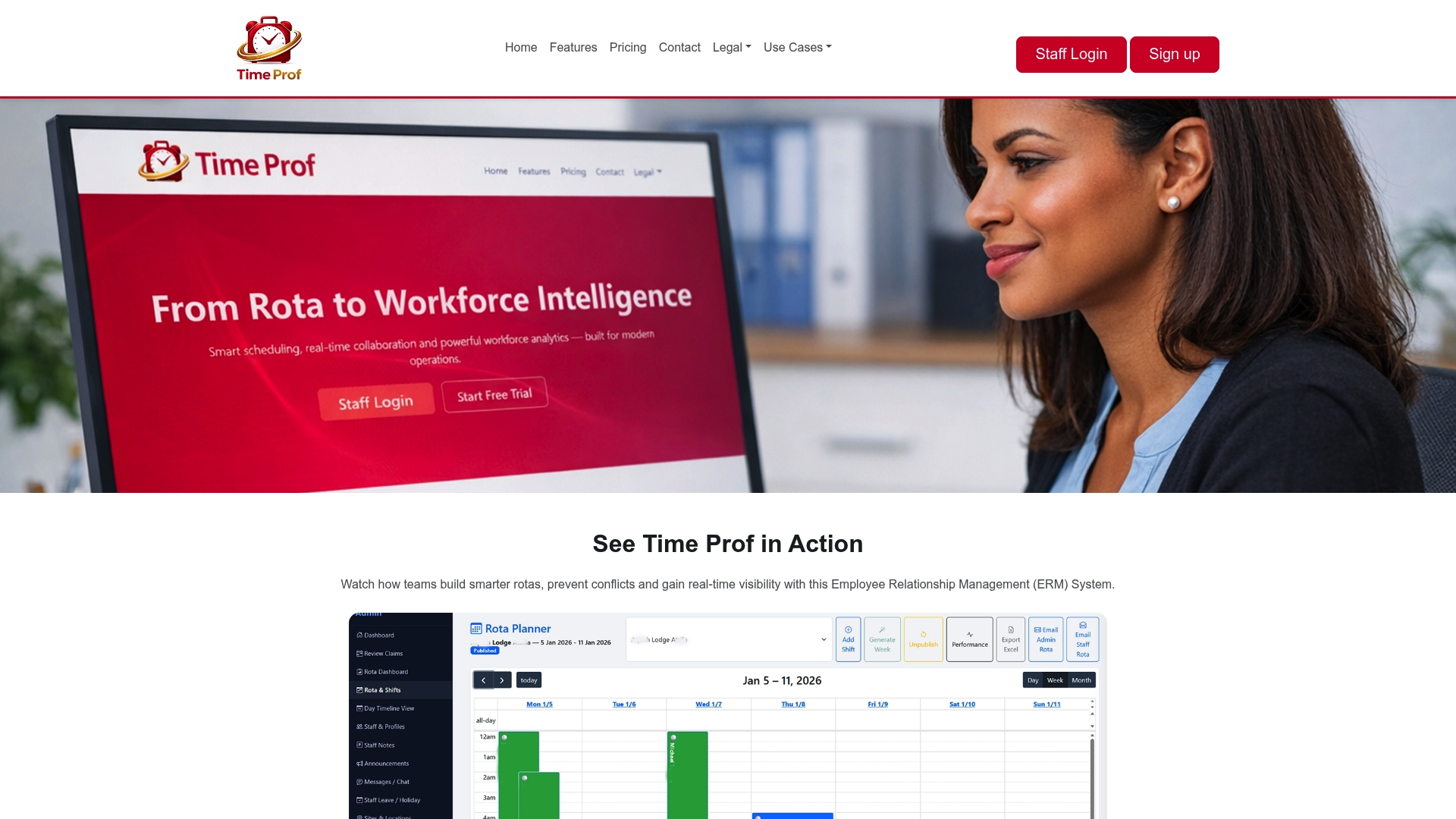
The platform holds a live skills and certifications register for every staff member, linked directly to the rostering engine. When you build a rota, Timeprof checks skills requirements against staff profiles automatically, blocking assignments where a qualification is missing or expired. Managers get real-time alerts before gaps become operational failures. For organisations in care, security, hospitality, and retail, that means fewer compliance risks and more reliable shift cover. Explore how Timeprof’s workforce intelligence platform can replace your fragmented scheduling process with a single, skills-aware system.
FAQ
What is skills matching in rostering?
Skills matching in rostering is the process of aligning each employee’s verified competencies with the specific requirements of a shift before the rota is published. It treats workers as skill-constrained resources rather than interchangeable headcount.
Why does skills alignment improve operational performance?
Research on urban rail scheduling shows that skill-aware rostering improves service quality and adaptability to demand. The same principle applies across care, security, hospitality, and retail operations.
What is a certified bottleneck in scheduling?
A certified bottleneck occurs when only one staff member holds a qualification required for a specific task. If that person is absent, the task cannot be covered. Cross-skilling two or more staff members in critical competencies removes this risk.
How do proficiency tiers improve rostering accuracy?
Proficiency tiers, such as trainee, qualified, and expert, allow scheduling systems to assign realistic job durations based on actual capability. Ignoring proficiency levels produces schedules that look complete but fail in practice.
How can workforce managers reduce scheduling errors through skills matching?
Managers can reduce scheduling errors by maintaining a live skill matrix, setting automatic certification expiry alerts, and using a scheduling system that blocks unqualified assignments before the rota is published.