Benefits of automated shift scheduling for managers
Discover the benefits of automated shift scheduling. Save time, cut costs, and enhance staff satisfaction with effective solutions for managers.

Automated shift scheduling is the process by which software creates, adjusts, and communicates employee rosters based on real-time data and predefined rules. The benefits of automated shift scheduling extend well beyond saving time. They include tighter cost control, stronger compliance, and measurably higher staff satisfaction. Yet only 11% of managers currently use AI scheduling tools, which means the competitive advantage for early adopters is still wide open. This article covers the most impactful advantages, backed by 2026 case studies and practical guidance for managers ready to move beyond spreadsheets.
1. How automated shift scheduling saves time
Administrative time is the first and most visible casualty of manual rostering. Managers who switch to automated scheduling report saving 50 to 80 hours of administrative work per month. That figure represents weeks of productive capacity returned to managers every year.
The time savings come from eliminating repetitive tasks that accumulate silently:
- Manual data entry for each shift and staff member
- Phone calls and messages to confirm availability
- Last-minute roster adjustments when staff call in sick
- Cross-checking leave requests against existing rotas
- Recalculating hours to meet contractual obligations
Integration with live HR data removes the need for manual updates entirely. When a staff member updates their availability or a leave request is approved, the schedule adjusts automatically. This is particularly relevant in care and healthcare settings, where the role of care plans in shift scheduling means rosters must reflect individual client needs in real time.
Pro Tip: Connect your scheduling platform directly to your HR and payroll systems from day one. Disconnected tools force manual reconciliation and cancel out the time savings automation is supposed to deliver.

2. Cost control: reducing labour expenses and overtime
Labour is typically the largest operating cost for shift-based businesses. Automated scheduling addresses this directly by aligning staffing levels to actual demand rather than habit or guesswork.
Demand forecasting in automated systems schedules just enough staff for the expected workload, reducing idle wage hours and unnecessary overtime. The financial impact compounds quickly across multiple sites or departments.
Key cost-saving features built into most automated scheduling platforms include:
- Demand-based rostering: Staffing levels follow predicted workload, not fixed patterns.
- Overtime alerts: The system flags when a shift assignment would trigger overtime pay before the rota is published.
- Compliance cost avoidance: Automated compliance checks prevent illegal rosters that carry financial penalties.
- Shift forecasting: Historical data informs future staffing needs, reducing both over-staffing and under-staffing.
- Budget visibility: Managers see projected labour costs before confirming a rota, not after payroll runs.
Budget predictability is the underrated benefit here. When managers can see projected labour costs before publishing a rota, they make better decisions. That visibility alone changes how finance and operations teams work together.
3. Enhancing employee satisfaction and fairness
Staff turnover is expensive. Replacing a single frontline worker costs a business significantly in recruitment, onboarding, and lost productivity. Perceived unfairness in shift allocation is one of the most common reasons staff disengage or leave.
Automated scheduling addresses this directly. AI-enabled scheduling systems make the rationale behind shift assignments visible and open to discussion, turning rostering from a manager’s private decision into a shared organisational process. That transparency reduces fairness disputes and builds trust.
“AI-generated draft rosters balance individual requests with organisational needs transparently, with the algorithm supporting negotiation and shared rules for shift swaps and compensations.” — AI-mediated shift scheduling research, 2026
The practical benefits for staff include:
- Predictable schedules published further in advance
- Equitable distribution of desirable and less desirable shifts
- Self-service shift swapping within manager-set rules
- Preference input that the system genuinely factors in
- Reduced last-minute changes that disrupt work-life balance
When staff trust the process, they engage with it. Engagement reduces no-shows, improves punctuality, and lowers the management overhead that comes with a disengaged workforce.
4. Stronger compliance and reduced legal risk
Employment law governs rest periods, maximum weekly hours, and minimum notice for shift changes. Breaching these rules exposes businesses to financial penalties and reputational damage. Manual scheduling makes compliance a matter of individual vigilance. Automated scheduling makes it structural.
Compliance flags built into scheduling software prevent illegal rosters from being published in the first place. The system checks every proposed shift against working time regulations, contractual obligations, and site-specific rules before the rota goes live. Managers do not need to memorise every rule. The platform enforces them automatically.
Audit-ready reporting adds a second layer of protection. When an employment dispute arises, managers need a clear record of who worked when and why. Automated systems generate that record as a by-product of normal operations, with no additional administrative effort.
5. Real-time communication and fewer no-shows
A published rota is only useful if staff actually receive and read it. Manual scheduling often relies on notice boards, group chats, or email chains that staff miss or ignore. Automated scheduling solves this with direct, instant delivery.
Automated shift notifications send schedule updates directly to each staff member’s mobile device the moment a rota is published or changed. Staff confirm receipt, reducing the ambiguity that leads to no-shows. This is especially valuable for frontline teams in retail, hospitality, and security, where last-minute absences have an immediate operational impact.
Real-time communication also reduces the volume of inbound queries to managers. When staff can check their schedule, request a swap, or flag unavailability through a self-service portal, managers spend less time fielding individual messages. That reduction in interruptions is a genuine quality-of-life improvement for busy managers.
6. Key features that make shift automation work
Not all scheduling platforms deliver the same results. The features below separate genuinely useful automation from basic digital rotas.
| Feature category | What it does | Why it matters |
|---|---|---|
| Live HR integration | Pulls real-time staff data into the schedule | Eliminates manual updates and data errors |
| AI scheduling algorithms | Balances skills, availability, and demand automatically | Reduces manager decision fatigue |
| Conflict detection | Flags double-bookings and rule breaches instantly | Prevents costly errors before publication |
| Self-service portal | Lets staff input preferences and swap shifts | Reduces manager workload and improves fairness |
| Geofenced clock-in | Verifies attendance at the correct location | Reduces time fraud and improves payroll accuracy |
| Compliance reporting | Generates audit-ready records automatically | Protects against employment disputes |
| Multi-site dashboards | Shows all sites in one view | Gives managers real-time operational control |
Scheduling algorithms that integrate with live HR data are the foundation of accurate automation. Without that integration, managers still face manual reconciliation between systems, which reintroduces the errors automation is supposed to prevent.
Pro Tip: When evaluating any scheduling platform, test the HR integration before anything else. A platform that cannot pull live staff data will require manual updates, and manual updates are where errors and time losses creep back in.
7. How to implement automated scheduling for maximum benefit
Implementation determines whether automation delivers its promised benefits or creates new frustrations. A phased approach consistently outperforms a full cutover.
- Audit your current process. Map every manual step in your existing rostering workflow. Identify where time is lost and where errors most commonly occur.
- Prioritise integration. Connect the scheduling platform to your HR, payroll, and operational systems before going live. This is the single most important technical step.
- Involve staff early. Show teams how the new system works and what it means for them. Staff who understand the algorithm trust it more and dispute it less.
- Run a parallel period. Operate the automated system alongside your existing process for two to four weeks. Compare outputs and resolve discrepancies before switching fully.
- Set clear governance rules. Define who can approve shift swaps, override the algorithm, and publish rotas. Clear rules prevent the system from being bypassed under pressure.
- Review and refine. Automated scheduling improves with data. Review outputs monthly for the first quarter and adjust rules based on what the data shows.
Pro Tip: The biggest implementation failure is treating automation as a technology project rather than a people project. Staff acceptance drives adoption. Adoption drives results. Invest time in communication before you invest time in configuration.
Key takeaways
Automated shift scheduling delivers measurable gains in time, cost, compliance, and staff satisfaction when implemented with proper HR integration and staff involvement.
| Point | Details |
|---|---|
| Time savings are substantial | Automation saves 50–80 administrative hours per month in documented case studies. |
| Cost control is structural | Demand-based rostering and overtime alerts reduce labour costs before payroll runs. |
| Fairness builds retention | Transparent AI-generated rosters reduce disputes and improve staff trust. |
| Compliance becomes automatic | Built-in rules prevent illegal rosters and generate audit records without extra effort. |
| Integration is non-negotiable | Live HR integration is the foundation of accurate, low-maintenance automation. |
Why automation is really about trust, not just efficiency
I have worked with managers across care, hospitality, and retail who approached automated scheduling as a cost-cutting exercise. Most of them were right about the savings. What surprised them was the cultural shift that came with it.
The research is clear that AI scheduling works best as a participatory tool that increases transparency, rather than a black box that hands down decisions. The managers who got the most from automation were the ones who showed their teams how the algorithm worked and invited staff to contribute their preferences. That openness changed the dynamic. Disputes about shift fairness dropped. Voluntary shift coverage improved. Staff stopped feeling that the rota was something done to them.
The efficiency gains are real and they are significant. But the deeper benefit is that automation forces a business to articulate its scheduling rules explicitly. When rules are explicit, they can be debated, refined, and trusted. That process builds a healthier workforce culture than any spreadsheet ever could.
The managers who struggle with automation are usually the ones who treat it as a replacement for management judgement. It is not. It is a tool that handles the mechanical work so that managers can focus on the decisions that actually require human insight. That distinction matters enormously in practice.
— Michael
Timeprof: workforce management built for the real world
Timeprof is an AI-powered workforce intelligence platform designed for managers who need more than a digital rota. It brings together shift planning and workforce management into a single mobile-friendly platform, covering everything from automated rostering and geofenced clock-in to compliance reporting and staff self-service.
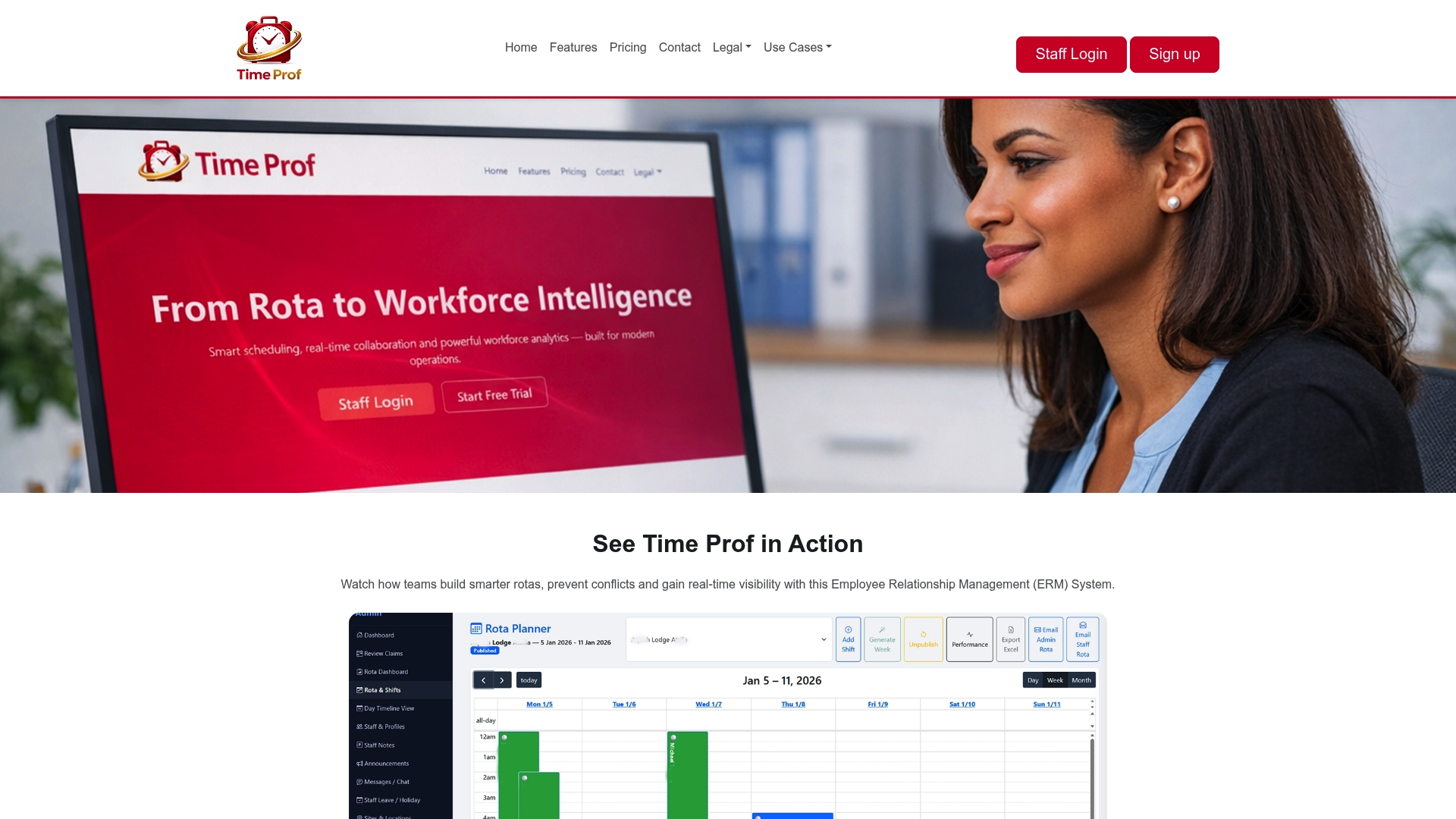
Transitioning from spreadsheets and disconnected systems to a single source of truth does not require a lengthy IT project. Timeprof is built to get businesses operational quickly, with structured onboarding, role-based access, and real-time dashboards that give managers visibility across every site from day one. If you are ready to move beyond manual rostering, Timeprof gives you the tools to do it without the guesswork that typically comes with change.
FAQ
What are the main benefits of automated shift scheduling?
Automated shift scheduling saves managers up to 80 administrative hours per month, reduces overtime costs through demand-based rostering, and improves staff satisfaction by making shift allocation transparent and fair.
How does AI improve shift scheduling accuracy?
AI scheduling algorithms cross-reference staff availability, skills, contractual rules, and demand forecasts simultaneously. This eliminates the double-bookings and compliance breaches that manual rostering regularly produces.
What is the role of care plans in shift scheduling?
In care and healthcare settings, care plans define the specific skills and staffing levels required for each client. Automated scheduling reads those requirements directly and builds rosters that meet them, reducing the risk of under-qualified cover.
How long does it take to implement automated scheduling?
Most businesses complete a phased implementation in four to eight weeks, starting with HR integration and running a parallel period before fully switching over. The timeline depends on the complexity of existing systems and the number of sites involved.
Why do so few managers currently use AI scheduling tools?
Only 11% of managers used AI scheduling tools as of 2025, largely due to unfamiliarity with the technology and concerns about staff acceptance. That low adoption rate means businesses that implement now gain a significant operational advantage over those that wait.