Start Hiring 6–12 Weeks Early: Peak Hours Staffing That Follows Demand
Map hourly demand to staggered shifts, core and flex teams, and temp onboarding. Automate open shifts, attendance checks and live dashboards to stop peak...

The most reliable way to cover peak hours is to staff to a demand curve, not the clock, using staggered shifts, a core-and-flex workforce and realtime tools to catch what forecasts miss. Start by pulling several weeks of hourly demand data, mapping it into a staff-to-demand curve, and building staggered shifts with clear contingency rules around it. ONS labour market data helps you judge how tight the hiring market will be, and a platform like Time Prof turns the plan into something your team can actually run day to day.
TL;DR:
- Staffing should be based on hourly demand data rather than fixed shifts, with a focus on cleaning, replenishment, and queue management signals.
- Use staggered, split, and overlapping shifts to align staffing with demand peaks and avoid unnecessary idle time or undercoverage.
- Start recruitment 6 to 12 weeks ahead of the peak season, prioritizing core staff for critical roles and building a seasonal talent pool for cost efficiency.
- Implement micro-training and buddy systems for temporary staff to accelerate productivity, and utilize workforce platforms for real-time visibility and shift management.
- Establish clear policies for last-minute coverage and overtime, and regularly measure performance metrics like coverage accuracy and customer wait times to optimize staffing strategies.
Table of Contents
- How do you forecast peak hours staffing needs?
- Building schedules that follow the demand curve
- When should you hire, contract or redeploy staff for peaks?
- Getting temporary staff productive fast
- What should a workforce platform do during peak periods?
- Policies for last-minute coverage and overtime control
- How do you measure and improve peak staffing performance?
- What actually works vs what sounds good on paper
- Get peak hours staffing running properly with Time Prof
- Sources
How do you forecast peak hours staffing needs?
Demand-based staffing starts with data, and most managers use too little of it. Pull hourly sales, footfall, transaction counts, bookings and call volumes for several weeks. That window is long enough to smooth out one-off blips but short enough to still reflect current trading conditions, current promotions, and current staffing norms.
Demand-based scheduling works by averaging that hourly demand across every comparable week, then converting it into a staff-to-demand curve. It’s a simple concept: for every hour of the trading day, you know roughly how much work is coming through the door, and you can size your rota to match it rather than defaulting to whatever shift pattern is easiest to write.
Before you trust the numbers, clean them up:
- Strip out anomalies. A power cut, a one-off local event or a system outage skews an hourly average badly if you leave it in.
- Adjust for promotions and closures. A half-price weekend or an early bank holiday shut isn’t a normal Tuesday, so flag it and either exclude it or model it separately.
- Normalise weekdays against weekends. Averaging a Saturday into your Wednesday forecast will wreck both.
Once the data’s clean, pick a coverage unit, the smallest block of time you’ll staff against. Most retail and hospitality operations use 15 or 30 minute intervals; call centres often go tighter. Divide expected transactions or contacts per interval by what one competent staff member can realistically handle in that interval, and you get a staff-needed number for every slot of the day.
The mistake managers make most often is staffing purely to sales. Sales data misses deliveries, replenishment, cleaning, queue management and the customer who needs 20 minutes of advice but buys nothing. Non-sales workload signals, things like door counters, Wi-Fi pings or a simple manager tally sheet, catch busy periods that a till report alone will never show you. The second most common error is averaging too few weeks, which leaves your curve at the mercy of one unusually quiet or unusually mad week that happened to fall in your sample.
Building schedules that follow the demand curve
Fixed 8-hour shifts are the default in most rotas because they’re easy to write, not because they match demand. A curve that peaks hard between midday and 2pm, and again from 5pm to 7pm, doesn’t need six people arriving at 9am and leaving at 5pm. It needs staff arriving in waves that track the actual rise and fall of the day.
Staffing to the volume curve rather than the clock closes the gaps where customer experience suffers most, the ten minutes before lunch when the queue builds and nobody extra has arrived yet. The same discipline cuts paid idle time in the quiet mid-morning lull, when a full crew is standing around with nothing to do.
Three patterns do most of the heavy lifting:
- Staggered starts. Instead of one start time, stagger arrivals across the build-up to a peak, so headcount climbs in step with demand rather than in one lump.
- Split shifts. For operations with two distinct peaks (breakfast and lunch, or lunch and evening), a split shift covers both without paying for the dead hours between.
- Overlapping windows. Schedule the outgoing shift to leave slightly after the incoming shift arrives, so there’s a handover buffer rather than a cliff-edge changeover mid-peak.
The sequencing rule that matters most: staff should arrive before the demand build starts, not when it starts, and leave after it tapers, not the moment it peaks. Arriving on time for the peak means arriving late for the queue that’s already forming.
Pro Tip: Build your rota backwards from the peak. Identify the hour demand is highest, work out who needs to already be on the floor by then, and schedule their start time to allow for a 10 to 15-minute settle-in period beforehand.
Variable shifts only work if they’re fair and don’t quietly become an overtime problem. Rotate who gets the desirable late-morning starts and who gets the early or late edges of the day, publish the rota far enough ahead that people can plan around it, and cap voluntary overtime with a clear weekly ceiling rather than leaving it open-ended. A rota that looks efficient on paper but burns out the same three people every peak isn’t a demand-based schedule, it’s a rota that’s found a new way to be unfair.
When should you hire, contract or redeploy staff for peaks?
Recruitment for peak periods needs a longer runway than most managers give it. Guidance across retail and warehousing consistently points to starting 6 to 12 weeks before your peak begins, and earlier planning with contingency buffers built in tends to outperform reactive hiring every time. Leave it to the last fortnight and you’re competing for the same shrinking pool of available candidates as everyone else in your sector.
Not every role belongs on a temp contract. Keep as core staff anything that requires deep product knowledge, judgement calls, or trust with cash and stock, supervisors, keyholders, senior sales advisors. Roles suited to temporary or agency staff are the ones with a short, teachable task: replenishment, queue marshalling, basic till operation, warehouse picking, event stewarding.
If you’re using an agency, brief them properly rather than just handing over a headcount number:
- Give them the exact skills mix you need, not just “10 people for Saturday”.
- Share your peak hours and coverage unit so their shift lengths actually match your curve.
- Ask what proportion of their pool has worked your sector before, general labour agencies and specialist hospitality or retail agencies perform very differently.
The most cost-effective long-term move is building a returning seasonal talent pool. Staff who worked your last peak already know your systems, your layout and your customers, which cuts training time dramatically. A modest incentive, a small loyalty bonus, first refusal on next season’s hours, priority booking for shifts, usually costs far less than fully retraining a stranger from scratch.
Getting temporary staff productive fast
A rushed induction is the single biggest cause of a shaky first week during peak. Keep it tight but complete: health and safety basics, a clear brief on the actual role they’ll be doing, a named point of contact for questions, and how timekeeping and clocking in work on day one, before anything else.
- Run micro-training in short bursts. Fifteen-minute sessions on one task at a time beat a two-hour induction that nobody retains past lunch.
- Give them a quick reference card. A laminated sheet or a phone-accessible guide for the five things they’ll be asked most often removes the need to interrupt a supervisor constantly.
- Buddy new starters with an experienced staff member for their first shift or two, rather than leaving them to work it out alone.
Build ramp-up time into your forecast rather than assuming a new temp performs at full capacity on hour one. Realistic productivity assumptions for temporary staff usually mean planning for reduced output in the first few shifts and adjusting headcount slightly upward to compensate, rather than discovering the shortfall mid-peak.
Pro Tip: Rotate supervisory cover across your permanent team rather than loading it onto one person. A single supervisor fielding every new starter’s questions during a peak week burns out fast and becomes your actual bottleneck.
What should a workforce platform do during peak periods?
Spreadsheets and group chats fall apart exactly when you need them most, during the week demand spikes and three people call in sick on the same morning. A platform built for this needs to do more than hold a rota; it needs to give you and your team live visibility over who’s where, who’s available, and what’s about to go wrong.
The features that earn their place during a genuine peak:
- Demand forecasting built from historical data, so the staff-to-demand curve isn’t a spreadsheet you rebuild manually every quarter.
- Availability and skills capture, so you know instantly who can cover a specialist shift, not just who’s free.
- Open-shift offers and shift claims, so a last-minute gap goes to the whole eligible pool rather than one frantic phone call.
- Geofenced clock-in, so attendance exceptions surface in real time instead of at payroll reconciliation three weeks later.
- Live multi-site dashboards, so a manager covering four locations can see coverage gaps before they become customer complaints.
- Compliance and operational reporting, so overtime, rest breaks and fill rate are visible daily, not discovered in a monthly audit.
Each of these maps directly onto the steps already covered: forecasting feeds the curve, the curve drives the schedule, open shifts patch the schedule when hiring falls short, and dashboards let you catch the gap between plan and reality while there’s still time to fix it. Time Prof brings these together in one platform rather than four disconnected tools, giving managers a single source of truth instead of a rota in one app, availability in a group chat, and attendance on a paper sheet. Businesses already using automated shift scheduling report fewer last-minute scrambles precisely because the system flags a gap before the shift starts, not after someone’s failed to show.
Policies for last-minute coverage and overtime control
A written policy beats a judgement call made at 7am with a queue forming. Set the rules before you need them, not during the crisis.
- Open-shift selection order: offer first to staff with matching skills and availability, then rotate fairly among the rest rather than defaulting to whoever answers the phone fastest.
- Overtime ceilings: cap voluntary overtime per person per week, and require sign-off above that threshold rather than letting it drift upward unchecked.
- Rest and fatigue rules: build in minimum rest breaks between shifts, particularly for staff picking up back-to-back cover, since fatigue-driven mistakes cost more than the coverage gap they were meant to solve.
- Escalation thresholds: define exactly when a site manager calls in agency support rather than stretching the existing team further, and who has authority to temporarily reduce service levels if coverage genuinely can’t be filled.
Publish these rules somewhere every manager can see them, and train new supervisors on applying them consistently. A policy that lives in one manager’s head isn’t a policy, it’s a habit that disappears the day they’re on leave.
How do you measure and improve peak staffing performance?
Track fill rate, coverage variance against your staff-to-demand curve, average customer wait time, overtime hours and temp retention rate through every peak. These five numbers tell you almost everything about whether the plan worked.
Run a short daily huddle during the peak itself, five minutes to flag what’s not matching the forecast, and a formal debrief within two weeks of the peak ending, while the detail is still fresh.
A short post-peak checklist keeps the lessons from evaporating:
- Where did coverage variance run highest, and why?
- Which shift patterns produced the most overtime relative to coverage gained?
- Which temporary staff would you rehire, and did the induction process actually work?
- What does the actual hourly demand data say that your forecast got wrong?
Feed every answer back into next season’s staff-to-demand curve rather than starting from scratch each time.
What actually works vs what sounds good on paper
Most managers already know they should forecast demand properly. Almost none actually do it, because building a staff-to-demand curve from scratch feels like a project rather than a Tuesday afternoon task, and the spreadsheet gets abandoned after week one.
Pilot the approach on a single site or a single day before rolling it out everywhere. Pick your worst peak, build one proper curve for it, run it once, and measure what changed. That single data point does more to win over sceptical supervisors than any policy document, because they see their own gap close, not someone else’s case study.
— Michael
Get peak hours staffing running properly with Time Prof
Everything covered here, the demand curve, the staggered shifts, the temp onboarding, the escalation rules, lives on paper or in someone’s memory at most businesses. Time Prof turns it into one system your whole team actually uses, so the plan survives contact with a genuinely busy Saturday.
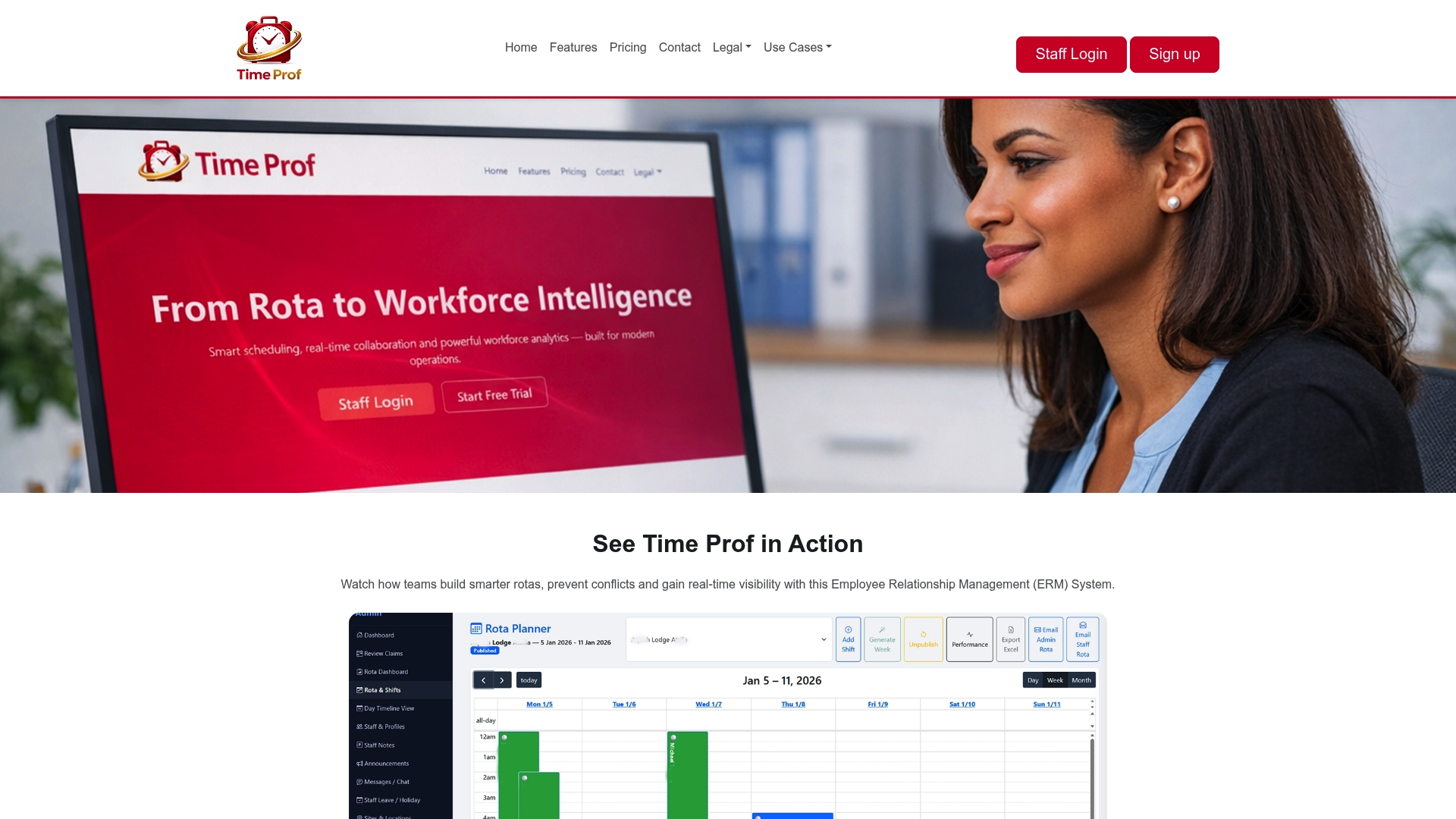
Forecasting features build your staff-to-demand curve from historical rota and attendance data instead of guesswork. Open shifts get offered to the right people automatically when someone calls in sick, geofenced clock-in flags a no-show the moment it happens rather than at month-end payroll, and live dashboards give you coverage visibility across every site from one screen. If you’re managing multiple locations, the workforce management tools checklist is worth reviewing alongside a demo to see exactly which features match your current gaps.
Businesses handling seasonal customer service spikes sometimes pair this with outsourced support cover from partners like Workanova during the sharpest peaks, while keeping core scheduling in one place. Request a demo through Time Prof to see how your own historical data would look mapped onto a staff-to-demand curve, and ask about case studies from businesses running similar peak patterns to yours.
Sources
Further reading: ONS labour market data, demand-based scheduling guide, and common scheduling challenges.
- UK labour market
- Demand-based scheduling: how to match staffing to hourly demand
- Staff to your volume curve, not the clock
- How to manage staff planning in a warehouse during peak periods?