Workforce management tools checklist: 2026 guide for HR
Discover the ultimate workforce management tools checklist. Ensure you select the right software for your HR needs with our expert guide.

A workforce management tools checklist is a structured set of criteria that helps managers and HR professionals select software covering the functions their organisation actually needs. Industry experts recommend evaluating tools against 11 core feature categories to achieve comprehensive coverage. Those categories span time and attendance tracking, scheduling automation, leave management, compliance support, mobile access, and reporting. Getting this selection right matters because the wrong tool creates more administration, not less. This guide gives you a practical checklist, a prioritisation method, and the evaluation questions that separate genuinely useful platforms from expensive ones.
What are the essential workforce management features to include in your checklist?
Every credible workforce management tool must cover eight foundational feature areas. Miss any one of them and you will find yourself patching the gap with spreadsheets or separate applications.
Time and attendance tracking

Time tracking is the backbone of workforce management. Look for multiple clock-in methods including mobile, web, and physical terminals. Automatic attendance logging from device activity eliminates manual entries and improves accuracy. The system must also capture overtime, breaks, and absence patterns in real time.
Scheduling automation
Manual rota building is slow and error-prone. Good employee scheduling software accounts for staff availability, skills, and fatigue risk when generating shifts. Automated rule enforcement prevents managers from accidentally scheduling staff beyond legal limits. That is a compliance benefit, not just a convenience.
Leave and absence management
Leave requests, approvals, and balances must live in the same system as the rota. When they do not, managers approve leave without seeing shift coverage gaps. The tool should handle annual leave, sick leave, and custom absence types, with automatic balance calculations.
Labour planning and forecasting
Demand-driven scheduling reduces both overstaffing and understaffing. Look for tools that let you model headcount against expected workload, whether that is patient numbers, footfall, or production targets.
Reporting and analytics
Team performance metrics must be visible without manual data exports. The platform should generate attendance summaries, absence trends, overtime costs, and compliance reports on demand. Audit-ready reporting is non-negotiable for regulated industries.
Mobile access and employee self-service
Staff need to view rotas, request leave, and clock in from a mobile device. Without this, HR fields avoidable phone calls and messages all day.
Compliance management
Automated compliance enforcement blocks scheduling decisions that would breach working time regulations before they happen. Reactive reporting after a violation is far less valuable than prevention.
Payroll and HRIS integration
Payroll integration is non-negotiable. Attendance, overtime, and leave data must flow automatically to your payroll software. Manual data re-entry between systems introduces errors and creates dissatisfaction across HR and finance teams.
Pro Tip: Build your checklist as a spreadsheet with each feature category in a separate row. Score every vendor against each row during demos. This prevents the common mistake of making decisions based on the most impressive demo feature rather than the most important one.
How to prioritise features for your organisation’s needs
Many organisations fail to distinguish must-have features from nice-to-have ones, which leads to scope creep during vendor evaluation. The result is a drawn-out selection process that ends with either an over-engineered platform or a tool that misses critical requirements.
The right approach is to create a tiered priority list before you speak to any vendor. Tier one contains features your operation cannot function without. Tier two holds features that would improve efficiency but are not blockers. Tier three is your future roadmap, features you may need as the organisation grows.
Industry context changes everything. Feature priorities differ significantly by sector. Hospitality operations prioritise scheduling automation because shift patterns change daily and last-minute cover is a constant pressure. Manufacturing environments prioritise compliance and fatigue management because safety regulations carry legal weight. Care and healthcare settings need both, plus audit-ready records for regulatory inspections.
Ask these questions to build your tier-one list:
- Which manual processes cost your team the most time each week?
- Where do errors currently occur, and what is the downstream impact?
- Which compliance obligations carry the highest risk if breached?
- What do your staff complain about most in the current system?
Pro Tip: Involve at least one frontline manager and one employee representative in your evaluation. They will surface usability issues that HR and IT teams miss entirely.
Avoid treating every feature in a vendor’s marketing brochure as equally important. Vendors list features to impress, not to match your specific context. A tiered priority list created early keeps your evaluation focused and prevents wasted time on demos that showcase irrelevant capabilities.
Practical evaluation questions to ask every vendor
Once your priority list is set, use structured questions during vendor conversations to test whether the platform genuinely delivers.
Integration and data flow
- Does attendance and leave data sync automatically to our payroll system, or does it require manual export?
- Which HRIS platforms does the tool integrate with natively, and what does a custom integration require?
- How does the system handle data conflicts when two platforms update the same record?
Multi-location and variable workforce support
- Can managers at different sites see only their own staff, or does the platform support role-based access across locations?
- How does the tool handle zero-hours contracts, variable shift patterns, and agency workers?
- Does the mobile app support geofenced clock-in to verify location at the point of attendance?
Compliance and audit readiness
- Does the system block non-compliant scheduling decisions in real time, or does it flag them after the fact?
- How are working time regulation updates applied, and who is responsible for maintaining compliance rules?
- What audit trail does the platform produce, and in what format can records be exported for inspection?
User experience across roles
- User experience must work for admins, managers, and employees separately. Ask to see the interface from each perspective during the demo.
- What does the onboarding process look like, and what ongoing support is included in the contract?
Scalability
- How does pricing change as headcount grows, and are there limits on the number of sites or managers?
Understanding workforce management ROI before committing to a platform helps you set clear success metrics and justify the investment to senior stakeholders.
How mobile access and self-service features affect workforce effectiveness
Mobile access is not a bonus feature. For frontline, remote, and multi-site workforces, it is the primary interface between staff and the organisation. A platform that requires desktop access to view a rota or submit a leave request will see low adoption and high HR workload.
Mobile self-service features including one-tap clock-in, shift swap requests, and leave approvals directly reduce the volume of calls and messages HR teams handle each day. That reduction translates into measurable time savings and higher employee satisfaction. Staff who can manage their own schedules feel more in control, which reduces frustration and turnover.
The specific mobile features worth checking on your HR management checklist include:
- Mobile clock-in with optional geofence verification to confirm location
- Real-time rota visibility so staff always know their upcoming shifts
- Shift claim functionality for open shifts, reducing manager workload
- Leave request and approval workflows that notify both parties instantly
- In-app messaging for shift-related communication, replacing informal channels like WhatsApp
Without these capabilities, managers spend significant time on coordination that the platform should handle automatically. The absence of mobile self-service also creates an information gap. Staff who cannot access their own data rely on managers for basic queries, which pulls managers away from higher-value work.
Real-time workforce control depends on staff and managers both having live access to the same data. When only one side has visibility, decisions get made on outdated information.
Key takeaways
A workforce management tools checklist built around tiered priorities, structured evaluation questions, and mobile-first requirements gives managers and HR professionals the best chance of selecting a platform that delivers lasting operational value.
| Point | Details |
|---|---|
| Use 11 feature categories | Evaluate every tool against time tracking, scheduling, leave, compliance, mobile access, and reporting as a minimum. |
| Build a tiered priority list | Separate must-have features from nice-to-have ones before speaking to any vendor to avoid scope creep. |
| Match priorities to your sector | Hospitality needs scheduling automation; manufacturing and care need compliance and fatigue management. |
| Require payroll integration | Attendance and leave data must flow automatically to payroll to prevent errors and HR inefficiency. |
| Test mobile from the employee view | Ask to see the staff-facing mobile interface during every demo, not just the admin dashboard. |
Why most tool selections go wrong before the demo even starts
The most common mistake I see managers and HR teams make is starting the vendor search before they have agreed internally on what the tool must do. They book demos, sit through impressive presentations, and then spend weeks debating features they never needed in the first place.
The checklist approach works precisely because it forces that internal conversation first. When you have a tier-one list agreed by HR, operations, and at least one frontline manager, vendor demos become a test rather than a discovery session. You are checking whether the platform passes your requirements, not letting the vendor define what your requirements should be.
The other pattern I have seen repeatedly is organisations underweighting mobile and self-service during evaluation because the people doing the evaluation sit at desks. The frontline workers who will clock in from a car park or check their rota on a Saturday morning are rarely in the room. Build their perspective into your checklist explicitly, or you will buy a platform that works beautifully for HR and frustrates everyone else.
Finally, do not treat integration as a future problem. Payroll integration in particular should be on your tier-one list regardless of industry. The cost of manual data re-entry, both in time and in payroll errors, compounds quickly. A platform that does not connect to your existing systems is not a workforce management tool. It is another silo.
— Michael
How Timeprof supports your workforce management checklist
Timeprof is built to cover the features that matter most on any serious workforce management checklist. The platform brings together intelligent shift planning, real-time attendance tracking with geofenced clock-in, leave and availability management, shift-linked tasks, and audit-ready compliance reporting in one mobile-first platform.
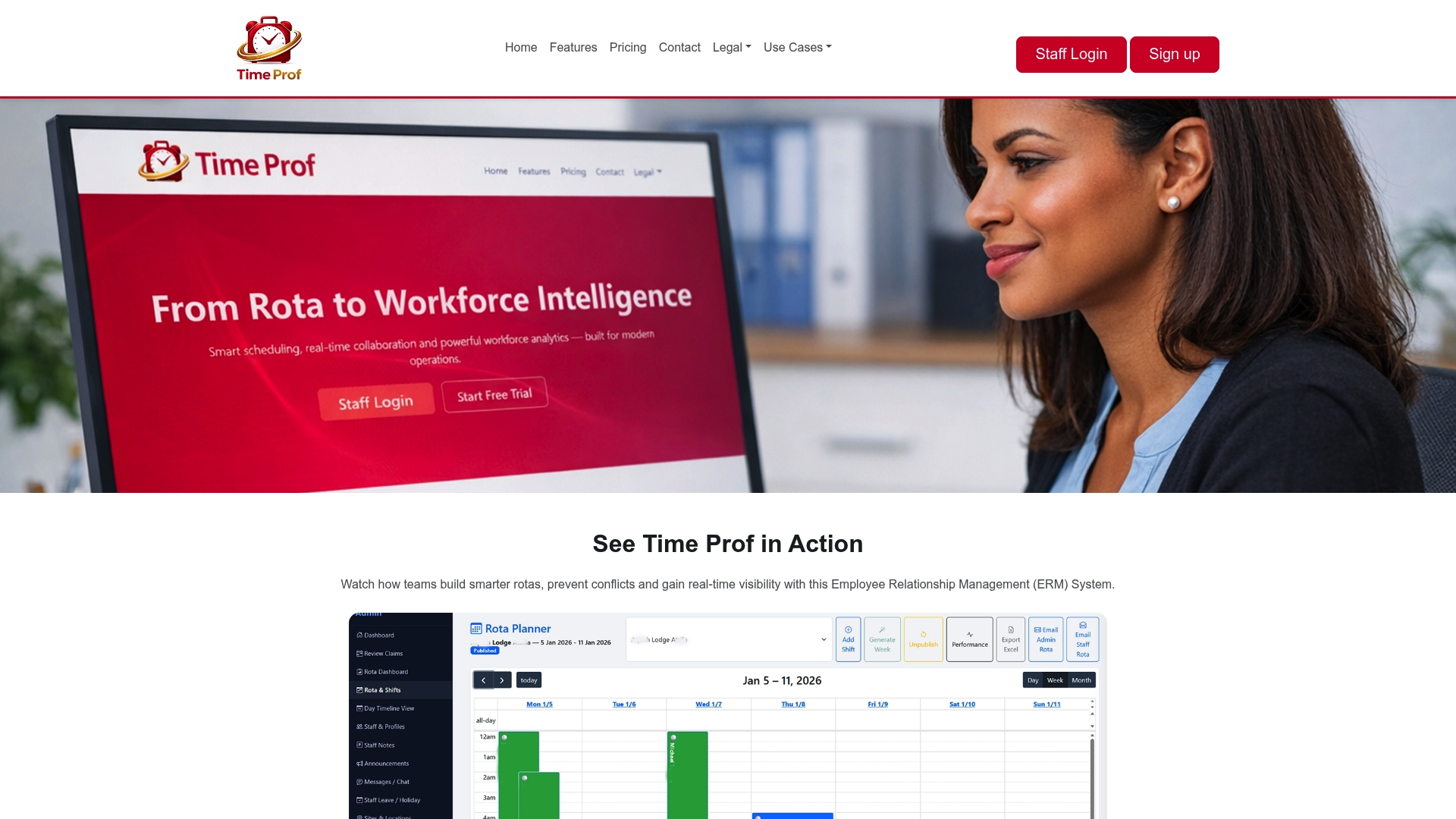
Managers get live multi-site dashboards and role-based access. Staff get a self-service portal where they can view rotas, claim open shifts, request leave, and receive real-time notifications. Timeprof also handles structured onboarding, two-factor authentication, and secure messaging, replacing the disconnected mix of spreadsheets and messaging apps that most teams still rely on. Visit Timeprof to see how the platform maps to your checklist requirements or to request a demo.
FAQ
What is a workforce management tools checklist?
A workforce management tools checklist is a structured list of feature requirements used to evaluate and compare workforce management software. It typically covers time tracking, scheduling, leave management, compliance, mobile access, and payroll integration.
How many features should a workforce management tool cover?
Industry experts recommend evaluating tools against 11 core feature categories, including scheduling automation, compliance management, and reporting. Not every feature will be a priority for every organisation, which is why a tiered list is the most effective approach.
Why does payroll integration matter so much?
Manual data entry between attendance systems and payroll software introduces errors that affect staff pay and create significant HR workload. Automatic data flow between the two systems removes that risk entirely.
How do I prioritise features for my industry?
Start by identifying your highest-risk compliance obligations and your most time-consuming manual processes. Hospitality and retail typically prioritise scheduling automation, while care, healthcare, and manufacturing prioritise compliance enforcement and fatigue management.
What should I look for in mobile workforce management features?
Look for mobile clock-in with geofence verification, real-time rota access, shift swap and leave request workflows, and in-app messaging. These features directly reduce HR workload and improve staff adoption of the platform.