Management tips for new managers: practical guide
New to management? Discover essential tips to succeed in your first week. Learn the five critical actions to avoid common mistakes.

Your first week as a manager sets more patterns than you realise. Before you read anything else, here are five actions to take immediately.
- Book one-on-ones with every direct report. You learn more in 20 minutes of honest conversation than in a week of observation. Send the calendar invite today.
- Clarify your team’s top three priorities. Ask your own manager: “What does success look like in 90 days?” Write the answer down and share it.
- Delegate one real task before Friday. Not a trivial errand. Something with a clear outcome. It signals trust and frees your attention.
- Schedule a weekly team meeting with a stated purpose. Not a catch-up. A standing agenda: blockers, priorities, decisions needed.
- Write down what you don’t yet know. The questions you can’t answer yet are your development plan in rough form.
These five actions won’t make you a great manager overnight, but they will stop you making the most common early mistakes. The rest of this guide explains why each one matters and how to build on them.
Key takeaways
New managers who build consistent one-on-ones, delegate outcomes rather than tasks, and create psychological safety will outperform those who rely on technical skill alone.
| Point | Details |
|---|---|
| Start with five immediate actions | Book one-on-ones, clarify priorities, delegate one task, schedule a team meeting, and note your gaps. |
| Delegate outcomes, not tasks | Write a brief covering the result, constraints and autonomy level before handing anything over. |
| Feedback works best when frequent | Use the behaviour-impact-change format within 24 hours; small and regular beats large and occasional. |
| Follow a 30/60/90 structure | Listen in month one, coach and delegate in month two, calibrate and build safety in month three. |
| Timeprof reduces scheduling admin | Automated rotas, real-time oversight and built-in messaging free manager time for people-focused work. |
Table of Contents
- What are the core management tips every new manager needs?
- What mistakes do new managers commonly make?
- How do you build management habits that actually stick?
- A research-backed 30/60/90-day plan for new managers
- What I’ve learnt about managing people for the first time
- Cut the admin load with smarter workforce tools
- Sources
What are the core management tips every new manager needs?
Leadership development research from Harvard Business School identifies emotional intelligence, delegation, feedback and aligning work to strategy as the core learnable capabilities that separate effective managers from struggling ones. None of them require natural talent. All of them require practice.
Delegate properly, not partially
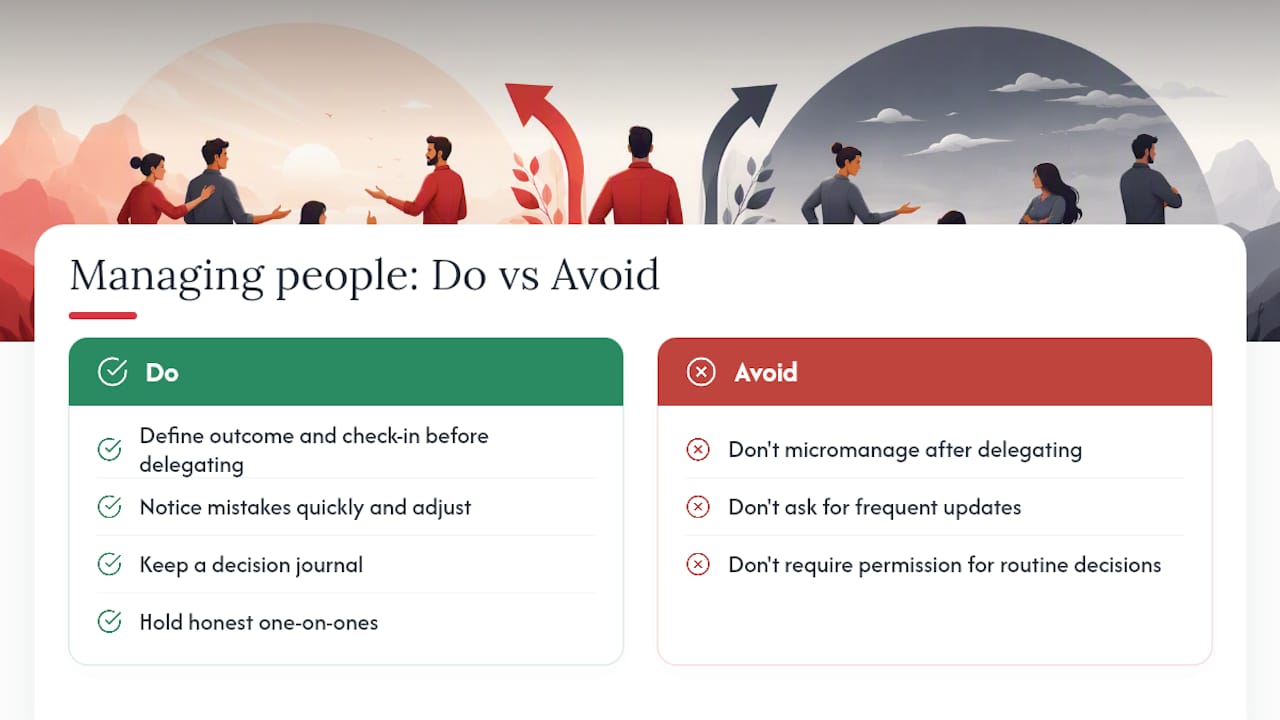
Delegation is the skill new managers most often get wrong. The typical failure mode: you hand someone a task but keep checking in so frequently that you’re effectively doing it yourself. That’s micromanagement dressed up as delegation.

Effective delegation means transferring ownership of an outcome, not just a task. Before you delegate, define the result you want, the constraints (budget, deadline, quality bar), and the level of autonomy you’re granting. Then step back.
A useful delegation brief takes under five minutes to write:
- What outcome do we need, and by when?
- What decisions can you make without checking with me?
- What would make you come back to me before proceeding?
Pro Tip: Match the task to the person’s strengths, not just their availability. Gallup’s research shows that aligning roles to individual strengths is one of the highest-leverage moves a manager can make.
Communicate clearly and listen actively
Most communication problems in teams aren’t caused by too little information. They’re caused by information that’s vague, inconsistent, or delivered without checking for understanding. FranklinCovey identifies active listening as a high-leverage management skill that increases trust, engagement and problem detection when made a deliberate routine.
After giving direction, ask: “What’s your understanding of what we’re trying to achieve here?” That one question surfaces misalignment before it becomes a problem.
Give feedback early and often
New managers often delay feedback because it feels confrontational. The result is that small issues compound into larger ones, and the eventual conversation is harder than it needed to be.
Specific, timely feedback is far more useful than a vague annual review. The format is simple: describe the behaviour, state the impact, suggest the change.
“When you sent the report without the summary section, the client had to ask for clarification twice. Next time, include a three-line summary at the top.”
That’s it. No drama, no build-up. Zenger Folkman’s evidence shows that frequent, specific recognition is more effective than rare gestures at raising discretionary effort and reducing intent to quit. The same principle applies to corrective feedback: small and regular beats large and occasional.
Build trust and psychological safety
Google’s Project Oxygen and Project Aristotle found that teams with clear goals, open communication and psychological safety are rated effective roughly twice as often as other teams. Psychological safety doesn’t mean avoiding difficult conversations. It means people feel safe enough to raise problems, admit mistakes and disagree without fear of punishment.
You build it through consistency: showing up to one-on-ones, following through on commitments, and responding to bad news with curiosity rather than blame. One phrase that helps: “Thanks for flagging that early. What do you think we should do?”
Set clear priorities and goals
Ambiguity about priorities is one of the most common causes of team underperformance. When people don’t know what matters most, they default to what’s easiest or most visible, not what’s most important.
Use OKRs (Objectives and Key Results) or a simple “top three priorities this week” format. Write them down. Share them. Revisit them in your weekly meeting. The act of writing priorities down and reviewing them regularly is what makes them real.
Coach and develop your people
Your job as a manager is no longer to be the best individual performer. It’s to make your team collectively better than you could be alone. That requires coaching conversations, not just task assignments.
A simple coaching question to use in one-on-ones: “What’s one thing that would make your work easier or more effective?” Then listen. Then act on what you hear, or explain honestly why you can’t.
Avoid micromanagement
The transition from individual contributor to manager is where micromanagement is born. You were promoted because you were good at doing the work. Now your instinct is to stay close to the work. That instinct will undermine your team’s confidence and your own capacity.
A peer-reviewed synthesis of leadership behaviours identifies humility and delegation as two of the most consistently effective leadership behaviours across sectors. Trusting people to do the work is not a soft skill. It’s a strategic choice.
Handle difficult conversations without delay
Avoiding a difficult conversation doesn’t make the problem go away. It makes it worse and signals to the rest of the team that you’ll tolerate underperformance.
A simple structure for a difficult conversation:
- State the specific behaviour you’ve observed.
- Describe the impact on the team or the work.
- Ask for the other person’s perspective.
- Agree a specific change and a review date.
Keep it factual. Keep it private. Keep it focused on behaviour, not character.
Run meetings that are worth attending
A meeting without a clear purpose is a tax on everyone’s time. Before scheduling any meeting, ask: could this be an email? If the answer is yes, send the email.
For meetings that do need to happen, share the agenda in advance, start on time, assign actions with owners and deadlines, and end five minutes early. That last habit alone will make you popular.
Manage your own time and set boundaries
New managers often absorb every interruption and say yes to every request. Within weeks, they’re working evenings and weekends and wondering why they feel behind. Scheduling challenges compound quickly when managers don’t protect time for planning and thinking.
Block 30 minutes each morning for your own priorities before opening your inbox. Protect your one-on-ones. Say no to meetings where you’re not needed. Your capacity is finite; guard it deliberately.
Adapt your leadership style
Different people need different things from a manager. A new team member needs more direction and reassurance. An experienced one needs autonomy and challenge. Reading what each person needs and adjusting accordingly is what separates a good manager from a merely consistent one.
What mistakes do new managers commonly make?
Most early management mistakes follow predictable patterns. Recognising them early is half the fix.
| Behavioural sign | Likely consequence | Immediate corrective step |
|---|---|---|
| Checking in on every task daily | Team loses confidence; manager loses time | Define clear outcomes upfront; check in at agreed milestones only |
| Cancelling one-on-ones when busy | Trust erodes; problems surface late | Treat one-on-ones as non-negotiable; reschedule promptly |
| Giving only vague or positive feedback | Performance issues grow unaddressed | Use the behaviour-impact-change format within 24 hours of the event |
| Setting too many priorities | Team is scattered; nothing gets finished | Limit team priorities to three per week; write them down publicly |
| Delegating tasks, not outcomes | Work bounces back; manager stays overloaded | Write a one-paragraph delegation brief for every significant task |
| Skipping personal development time | Skills plateau; confidence drops | Block 30 minutes weekly for reading, reflection or a peer conversation |
Red flags to watch for in yourself:
- You’re doing work your team should be doing.
- You haven’t had a genuine development conversation with anyone in two weeks.
- Your one-on-ones have become status updates rather than conversations.
- You’ve been avoiding a difficult conversation for more than a week.
- You feel indispensable to every decision.
If two or more of those apply, pick one and fix it this week. Not next month.
How do you build management habits that actually stick?
Reading about management is easy. Changing your daily behaviour is harder. The gap between knowing and doing is where most new managers stall.
The Harvard Business research on leadership development is clear that structured programmes and peer learning are the most reliable routes to sustained behaviour change. That doesn’t mean you need a formal course. It means you need a system.
Four routines worth building
Weekly one-on-ones. Thirty minutes, employee-led agenda, same time each week. This single habit does more for trust and performance than almost anything else. Protect it.
Daily 30-minute prioritisation block. Before your inbox, before Slack, before anything else. Write your top three priorities for the day. This takes four minutes and prevents the reactive spiral that consumes most managers’ mornings.
A decision journal. After any significant decision, write two sentences: what you decided and why. Review it monthly. Patterns emerge quickly, and you’ll spot your own blind spots before they become problems.
A feedback loop. Ask your team once a month: “What’s one thing I could do differently that would make your work easier?” The CIPD’s evidence reviews for people managers consistently highlight feedback-seeking behaviour as one of the strongest predictors of managerial effectiveness in the UK context.
How to measure your own progress
You don’t need a complex dashboard. Three simple metrics tell you most of what you need to know:
- One-on-one consistency rate: Did you hold every scheduled one-on-one this week? Aim for 100%.
- Delegation completion rate: Of the outcomes you delegated this month, what percentage were completed without you needing to step back in?
- Team clarity score: Ask your team to rate, on a scale of 1–5, how clear they are on this week’s priorities. Track the average over time.
A spreadsheet with three columns and a weekly row is enough. The point isn’t precision; it’s the habit of looking.
UK-relevant learning resources
- CIPD evidence reviews — the most rigorous UK-specific resource on people management behaviours. Free to access online.
- HBS Online leadership materials — short, evidence-based modules on delegation, feedback and emotional intelligence.
- Timeprof blog — practical guides on real-time staff oversight, skills matching in rostering, and shift planning for busy managers.
- A peer group or mentor. The Quartz reporting on first-time managers describes the loneliness of early management as one of its least-discussed realities. A peer group of other new managers, even an informal one, is one of the most effective correctives.
A research-backed 30/60/90-day plan for new managers
The first 90 days as a manager are not about proving yourself. They’re about understanding your team, establishing trust, and building the habits that will define your style.
Days 1–30: listen, learn, and establish routines
Actions:
- Hold a one-on-one with every direct report. Ask: what’s working, what isn’t, and what do they need from you?
- Clarify your team’s top priorities with your own manager. Write them down.
- Schedule weekly one-on-ones and a standing team meeting.
- Identify one task to delegate with a clear brief.
- Observe before changing anything significant.
Metrics to watch: One-on-one consistency rate; team clarity score (baseline).
Minimal dashboard: A shared document with names, one-on-one dates, and a one-line note on each person’s current priority.
Days 31–60: start coaching, give feedback, and delegate more
Actions:
- Begin coaching conversations in one-on-ones. Ask about development, not just tasks.
- Give at least one piece of specific, timely feedback per person this period.
- Increase the number of delegated outcomes. Aim for at least three significant tasks fully owned by team members.
- Identify any performance issues and address them directly using the behaviour-impact-change format.
- Gallup’s guidance on strength alignment suggests this is the right moment to map each person’s strengths to their role and adjust where possible.
Metrics to watch: Delegation completion rate; number of feedback conversations held.
Template: one-on-one agenda (employee-led)
Days 61–90: calibrate, build safety, and measure
Actions:
- Run a brief team retrospective: what’s working, what should change?
- Ask for feedback on your own management. Use the monthly question: “What’s one thing I could do differently?”
- Review your delegation completion rate and one-on-one consistency. Adjust where needed.
- Google’s Project Aristotle research shows that teams with psychological safety and clear goals are rated effective roughly twice as often. By day 90, you should be able to name specific actions you’ve taken to build both.
- Identify one person on your team for a development conversation about their longer-term goals.
Metrics to watch: Team clarity score (compare to baseline); delegation completion rate trend.
Template: delegation brief
Zenger Folkman’s research on recognition and psychological safety shows that small, frequent recognition raises discretionary effort more reliably than annual gestures. Build recognition into your weekly rhythm from day one, not as a performance at the 90-day mark.
What I’ve learnt about managing people for the first time
The mistake I made earliest, and most predictably, was staying too close to the work. I’d delegated a task on paper but kept asking for updates so frequently that the person doing it eventually asked, quite reasonably, whether I’d rather just do it myself. They were right.
The correction wasn’t a management course or a framework. It was writing down, before delegating anything, exactly what outcome I needed and when I’d check in. That small habit changed the dynamic almost immediately. The team started making decisions without waiting for permission. Problems got solved faster. My own calendar opened up.
What I’ve found most useful, and what the research consistently supports, is that managing is a practised craft. You will make mistakes in your first 90 days. The ones who improve fastest are not the ones who make the fewest mistakes; they’re the ones who notice them quickly and adjust. A decision journal, honest one-on-ones, and one peer you can speak frankly with will do more for your development than most formal training.
The CIPD’s people manager evidence reviews and the PMC synthesis of leadership behaviours both point to the same conclusion: humility, consistency and a genuine interest in your team’s success are the behaviours that compound over time. The technical skills matter, but they’re learnable. The willingness to keep learning is what separates the managers people remember from the ones they endure.
Cut the admin load with smarter workforce tools
Managing people is demanding enough without spending hours on rotas, leave requests and shift communications. The administrative side of management, the scheduling, the chasing, the last-minute cover, eats into the time you need for the work that actually develops your team.
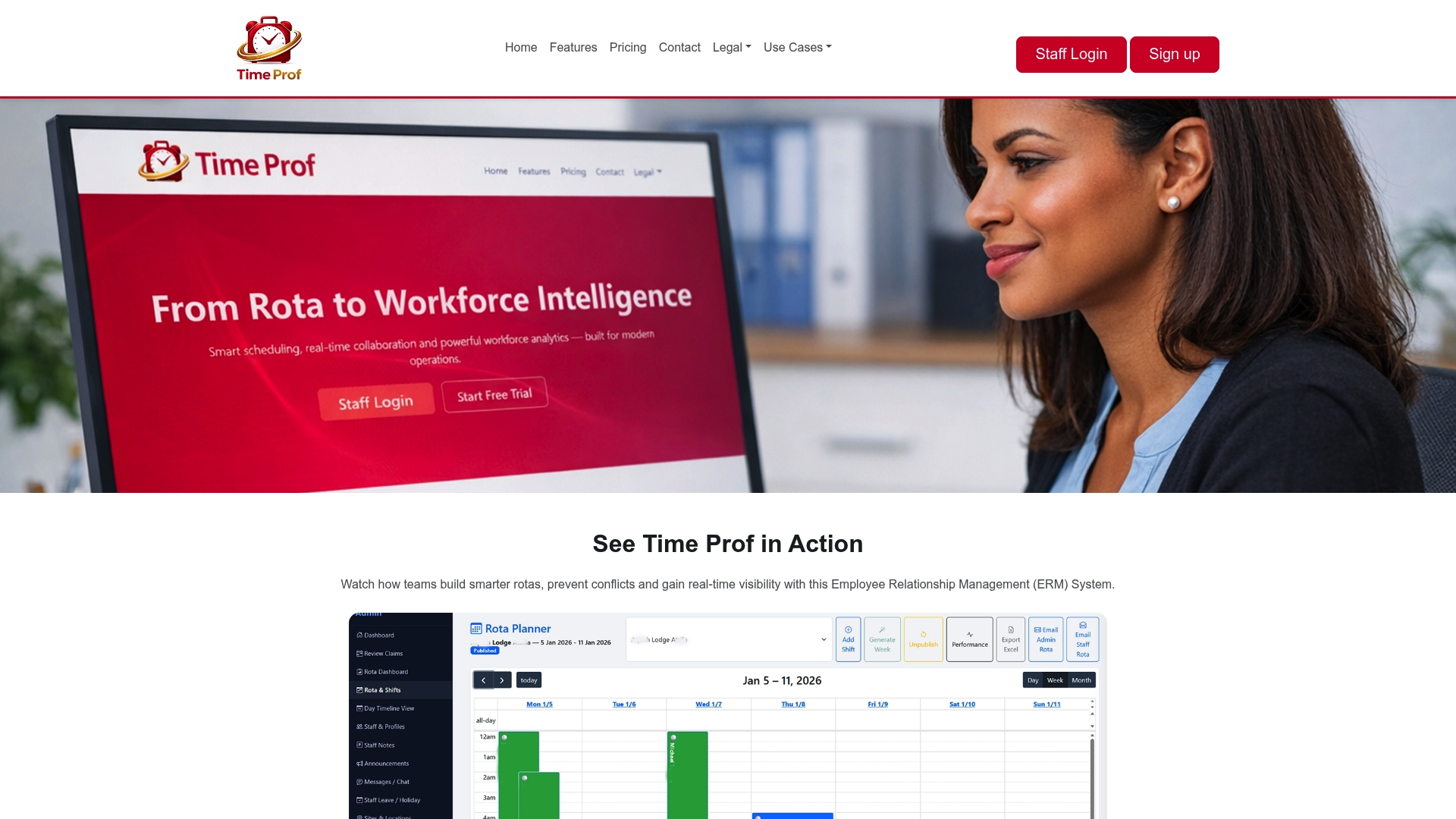
Timeprof is built to take that burden off managers. Where most teams still rely on spreadsheets and group chats to manage shifts and availability, Timeprof brings everything into one place:
- Automated rota planning with skills matching and availability built in, so the right people are scheduled for the right shifts without manual cross-referencing.
- Real-time staff oversight across sites, with geofenced clock-in and live attendance data, so you always know who’s in and where.
- Built-in messaging, announcements and task management, so shift-linked communications don’t get lost across three different apps.
If you’re a new manager in care, hospitality, security, retail or any shift-based environment, reducing scheduling admin directly frees time for the one-on-ones, coaching conversations and feedback that this guide is built around. See how Timeprof works and start a free trial to find out how much time your team could reclaim.
Sources
- Following the data: The research behind great managers - Google re:Work
- How to be a better leader | Gallup CliftonStrengths
- PMC article: leadership rules and observations
- Leadership Skills 2026 Report - Zenger Folkman (extract)
- Leadership communication skills | FranklinCovey
- People managers | Evidence reviews | CIPD
- First-time manager tips: 20 realities of leading a team nobody warns you about