Why staff announcements improve alignment: a manager's guide
Discover why staff announcements improve alignment and reduce confusion. Enhance clarity and buy-in in your organization today!

Regular staff announcements measurably improve operational alignment by giving people the “why” as well as the “what” — and the gap between those two things is where most workplace confusion lives. According to the Axios HQ internal communications report, only one in six employees feels entirely aligned with organisational goals, showing large-scale misalignment. Misalignment drove nearly twice as many missed deadlines in 2026 as in 2025. That is not a communication volume problem. Most organisations are sending more messages than ever. It is a clarity and context problem.
The mechanisms that make announcements work are straightforward:
- Clarity — a well-structured announcement tells people exactly what has changed and what they need to do differently
- Timeliness — receiving information before a shift starts, not after, means staff can act on it
- Context (the “why”) — explaining the reasoning behind a decision converts information into understanding and genuine buy-in
- Acknowledgement — confirmation that a message has been read closes the loop between sending and alignment
Pro Tip: Treat every operational announcement as a single source of truth. Publish it in one place, link back to it in follow-up messages, and never allow a parallel version to circulate via group chat or word of mouth.
Table of Contents
- Why do staff announcements actually change behaviour?
- What types of announcements suit which situations?
- What does good announcement practice actually look like?
- How do you measure whether announcements are improving alignment?
- How does an integrated platform make announcements reliable?
- What goes wrong, and how do you fix it quickly?
- Key takeaways
- The announcement habit most managers skip
- Timeprof puts your announcements where your staff actually are
- Useful sources and further reading
Why do staff announcements actually change behaviour?
Announcements shift behaviour when they address the right person, at the right moment, with enough context to make a decision. Without that combination, information sits unread or gets misinterpreted.
Clarity of role and expectation is the first lever. When a policy changes and the announcement spells out precisely who is affected and what they must do by when, there is no room for “I didn’t know that applied to me.” Vague, organisation-wide broadcasts produce exactly that ambiguity.
Timeliness matters differently depending on the situation. A safety update needs to interrupt whatever is happening right now. A rota change for next week can wait for a scheduled send. Getting that judgement wrong in either direction erodes trust — either staff feel bombarded, or they feel left behind.
Single source of truth is where many organisations quietly fail. Communication volume is up but clarity is down; when the same update appears in three different channels with slightly different wording, staff default to whichever version their manager told them verbally. That is how rumours start.
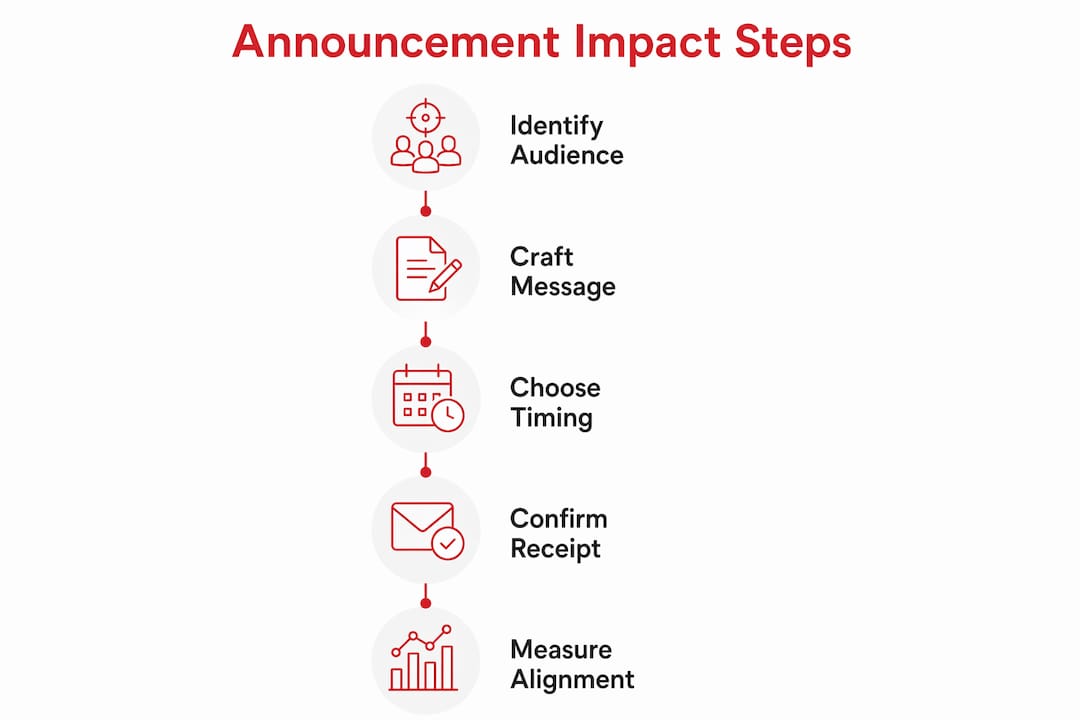
Acknowledgement tracking closes the loop. Without evidence of receipt, you cannot reliably claim alignment. A message sent is not a message understood.
Consider the difference between two approaches to a shift-pattern change. A broadcast email says: “New rotas are live from Monday.” A targeted announcement, sent via mobile to affected staff on Friday afternoon, says: “Your rota changes from Monday because we have added a second team to cover the evening peak. Your new hours are listed below. Your manager will confirm at your next briefing.” The second version answers the questions staff would otherwise ask their manager, their colleagues, or nobody at all.
What types of announcements suit which situations?
Matching the announcement type to the situation is half the work. Here are the five categories managers use most, with a timing rule and audience note for each.
-
Policy updates — objective: ensure compliance and reduce errors. Send at least five working days before the change takes effect. Audience: all staff affected by the policy, segmented by role or site. Example: “Our updated absence reporting procedure takes effect on 1 July. Please read and confirm receipt by Friday.”
-
Operational/shift updates — objective: prevent no-shows and confusion. Send as early as possible; for same-day changes, push a mobile notification immediately. Audience: the specific shift team or site. Example: “Tonight’s closing team: the car park gate will be locked at 10 PM, not 11 PM. Please adjust your finish time accordingly.”
-
Recognition announcements — objective: build morale and reinforce desired behaviours. Send promptly after the achievement; delay kills the impact. Audience: the relevant team or organisation-wide for significant milestones. Staff who receive recognition are, on average, four times as engaged as those who do not.
-
Safety and incident alerts — objective: protect staff and ensure compliance. Send immediately, with no delay for formatting or approval chains. Audience: everyone on site or affected by the hazard. Example: “Wet floor in the main corridor — use the side entrance until further notice.”
-
Strategic and culture updates — objective: connect daily work to organisational direction. Send on a regular cadence, not reactively. Audience: organisation-wide, with manager briefing first. Example: “Here is how last quarter’s results affect our priorities for the next three months.”
For frontline and non-desk staff, mobile-first, shift-aware delivery is not optional. Email and intranet reach people who sit at desks. A care worker or security officer mid-shift needs a push notification, not an inbox they check twice a week.
What does good announcement practice actually look like?
The single biggest predictor of whether an announcement produces alignment is whether it was designed for the recipient, not the sender. Strategic segmentation — sending only relevant messages to relevant audiences — reduces noise and raises the chance that important updates get actioned.
Before sending, run through this checklist:
- Audience — who specifically needs this, and who does not?
- Objective — what behaviour or decision should change as a result?
- Context — have you explained why this is happening?
- Action — is the required next step explicit and time-bound?
- Owner — who is the named contact for questions?
- Timing — does this land before the relevant shift or deadline?
- Acknowledgement — will you know who has and has not read it?
A simple announcement template that works:
[Headline: one sentence, what is changing] Why this is happening: [one sentence]. What changes: [bullet or short paragraph]. Who is affected: [named roles/sites/teams]. What you need to do: [specific action + deadline]. Questions: contact [name/role].
Consistent HR-led messaging builds trust and reduces confusion — but only when the message is owned and governed, not just distributed. Assign a named owner to every announcement type.
Pro Tip: Brief managers before the announcement goes to staff. Bypassing the frontline manager — sending directly from HQ to the team — undermines manager authority and creates confusion when staff ask questions their manager cannot answer. Brief first, then send.

Keep announcements short. If it needs more than 150 words, it probably needs to be split into two messages or supplemented with a briefing.
How do you measure whether announcements are improving alignment?
Clicks and views are poor proxies for alignment — focus on behavioural and operational measures instead. A message with a 90% open rate that produces no change in behaviour has not aligned anyone.
A practical dashboard for managers covers five metrics:
- Acknowledgement/read-receipt rate — target above 85% for operational announcements within 24 hours
- Time-to-action — how quickly staff complete the required step (shift confirmation, form submission, policy sign-off) after an announcement
- Policy adherence rate — measured before and after a policy-change announcement
- Change-related missed deadlines — track whether missed deadlines rise after major announcements (a red flag from the Axios HQ data)
- Recognition engagement — participation rates in recognition-linked announcements as a morale indicator
When testing cadence or channel changes, compare one variable at a time. Send the same announcement type via two channels to matched audience segments and compare acknowledgement rates and time-to-action. That tells you whether the channel is the problem, not the message.
How does an integrated platform make announcements reliable?
A platform that centralises rotas, messaging, and acknowledgement tracking makes announcements reliable because it removes the gap between “sent” and “seen.” When the announcement system sits inside the same platform as the rota, staff receive shift-aware notifications at the right moment, on the device they already use for work.
Features to look for, and why each one matters for alignment:
- Mobile-first push notifications — reaches frontline staff during shifts, not just at desks
- Audience segmentation — sends only to the relevant site, role, or shift group, reducing noise
- Read receipts and acknowledgement tracking — gives managers evidence of receipt, not just delivery
- Shift-aware scheduling — times the send to land before the relevant shift starts
- Message templates — enforces consistent structure across managers and sites
- Audit reporting — provides a compliance record of who was informed and when
Timeprof brings all of this into one platform alongside rotas, leave, tasks, and attendance. The announcement system sits within the same environment managers use to build rotas and track attendance, so shift-aware targeting is automatic rather than manual. For organisations managing multiple sites, the real-time oversight features mean managers can see acknowledgement rates across locations from a single dashboard.
A suggested implementation timeline:
- Days 1–10: Audit your current announcement types and channels. Identify gaps (no acknowledgement tracking, no segmentation).
- Days 11–30: Configure audience segments by site, role, and shift group. Set up read receipts for operational announcements.
- Days 31–60: Pilot one announcement type (rota changes or policy updates) with the new structure. Measure acknowledgement rate and time-to-action.
- Days 61–90: Expand to all announcement types. Review dashboard metrics and adjust cadence or channel based on data.
For businesses managing enterprise automation across multiple workflows, integrating announcements into the same operational platform removes the manual step of switching between systems.
What goes wrong, and how do you fix it quickly?
Most announcement failures come down to five recurring problems: too frequent, too generic, no context, bypassing managers, and no acknowledgement tracking.
- Information overload — staff stop reading when every message feels urgent. Remedy: reduce scope, segment audiences, and reserve push notifications for genuinely time-sensitive updates.
- Broadcast-only sending — no way to know who has read what. Remedy: add acknowledgement tracking to all operational announcements immediately.
- Diagonal communication — HQ sends directly to frontline staff, bypassing the site manager. Remedy: brief managers 24 hours before any organisation-wide send.
- Timing mismatch — announcements land at 9 AM for staff who start at 6 AM or 10 PM. Remedy: use shift-aware scheduling so sends align with the recipient’s working pattern.
- No context — the “what” without the “why” generates questions, rumours, and resistance. Remedy: add one sentence explaining the reason behind every operational change.
Red flags on your dashboard: falling read rates over consecutive weeks, rising missed deadlines after major announcements, and an increase in manager queries about information staff should already have received.
Key takeaways
Staff announcements improve alignment when they deliver the right message, to the right people, at the right time, with enough context to drive action — and when acknowledgement tracking closes the loop between sending and understanding.
| Point | Details |
|---|---|
| Context drives alignment | Explaining the “why” behind a change converts information into understanding and reduces resistance. |
| Segmentation reduces noise | Sending only relevant messages to relevant audiences raises the chance that important updates are actioned. |
| Acknowledgement tracking is non-negotiable | Without read receipts, you cannot reliably claim staff are aligned — only that a message was sent. |
| Measure behaviour, not views | Track time-to-action, policy adherence, and missed deadlines — not open rates alone. |
| Timeprof centralises the process | Timeprof combines shift-aware announcements, segmentation, read receipts, and audit reporting in one platform. |
The announcement habit most managers skip
The experiment worth running is simpler than most managers expect. Pick one operational announcement type — rota changes are a good starting point — and for 30 days, add three things you probably are not doing now: a one-sentence “why,” a named contact for questions, and a read receipt. Brief the relevant site managers the day before each send.
After 30 days, compare the number of manager queries about that announcement type against the previous month. In most teams, it drops noticeably. That is the signal. The habit to keep is briefing managers first and requiring acknowledgement on anything operational. The metric to track is time-to-action: how quickly staff complete the required step after the announcement lands.
Timeprof puts your announcements where your staff actually are
Fragmented communication — a rota in one system, announcements in another, acknowledgements tracked nowhere — is the root cause of most alignment failures. Timeprof solves that by putting shift-aware announcements, segmentation, read receipts, and audit reporting inside the same platform managers already use for rotas, leave, and attendance.
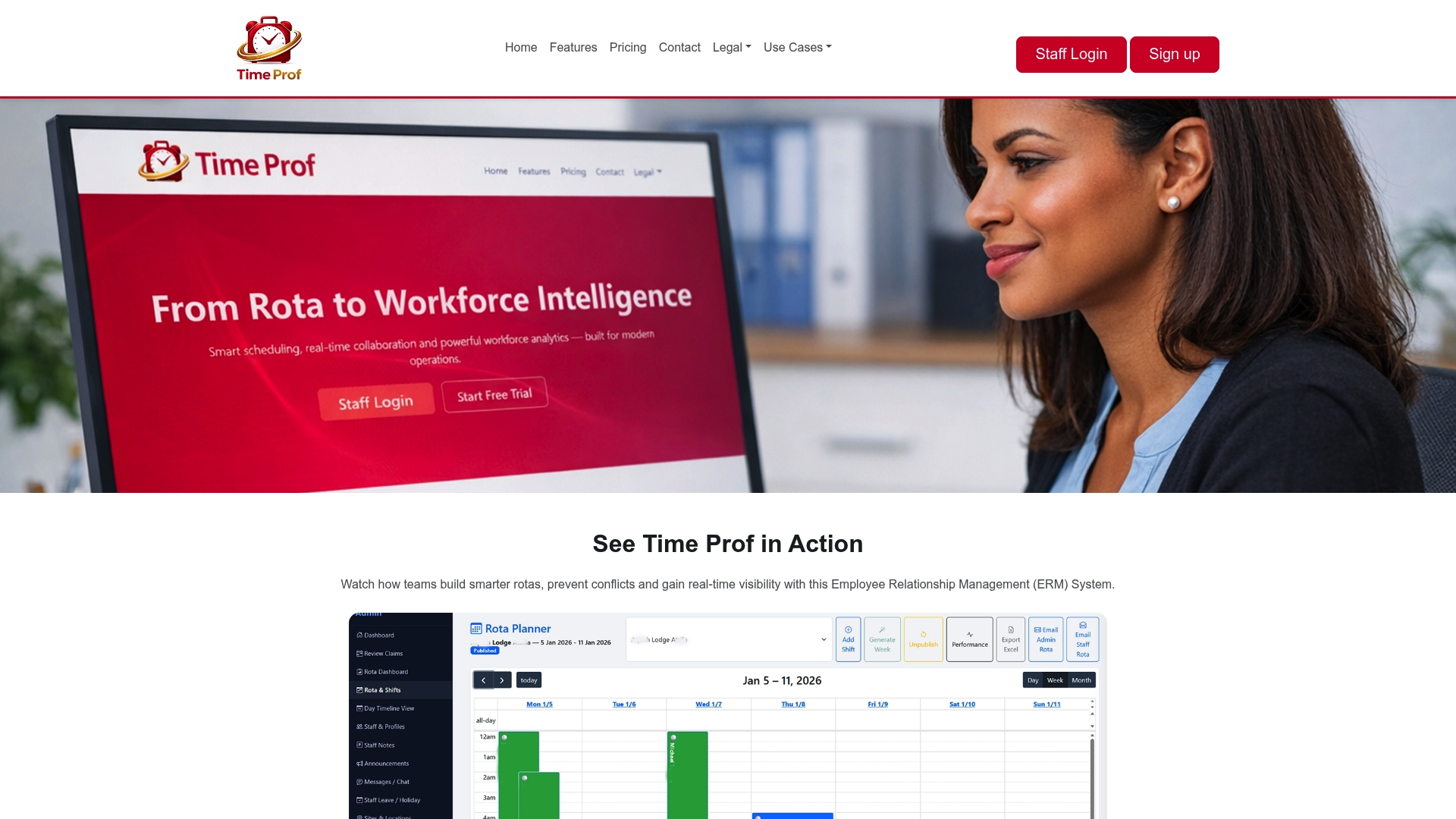
The practical payoff: managers stop chasing confirmation that staff have seen critical updates, and staff stop missing information because it arrived on a channel they rarely check. Segmentation means a care worker in Manchester sees only what is relevant to their site and shift, not a wall of organisation-wide noise.
If you manage frontline or multi-site teams and your current announcement process relies on group chats, email chains, or verbal briefings with no audit trail, the gap between what you send and what staff act on is almost certainly larger than you think. Explore Timeprof’s workforce platform and see how the announcement and acknowledgement features work in practice — or book a demo to walk through a configuration that fits your team structure.
Useful sources and further reading
- Axios HQ Internal Communications Report — primary source for the alignment and missed-deadline statistics cited throughout this guide; essential reading for any manager making the case for structured comms investment.
- Zoho Workplace: Organisational Announcements Guide — practical guidance on why context and the “why” matter; useful for drafting announcement templates.
- Connected Company: Guide to Segmented Employee Announcements — the clearest practitioner resource on audience segmentation and acknowledgement tracking.
- Xenia: Internal Communication and Frontline Teams — focused on non-desk and shift-based staff; covers mobile-first delivery and the diagonal-communication pitfall.
- Staffbase: 2025 Employee Communication Impact Study — US-based study on measuring communication impact; the KPI framework translates directly to UK operations.
- Leapsome: Promotion Announcements Tips and Examples — source for the recognition engagement statistic; useful context for building recognition into your announcement cadence.
- Amazing Workplaces: Why Consistent HR Communication Matters — covers governance and ownership of messaging; practical for HR teams setting up announcement frameworks.