Why managers need real-time staff oversight in 2026
Discover why managers need real-time staff oversight in 2026. Improve efficiency and reduce costly downtime with live data monitoring.

Real-time staff oversight is the continuous monitoring of employee work activity and progress through live data, enabling managers to intervene promptly and make informed decisions. Managers across care, security, hospitality, retail, and cleaning now track multiple visibility layers simultaneously, including work progress, hours, and system activity. That breadth of responsibility makes manual check-ins and spreadsheets structurally inadequate. The case for why managers need real-time staff oversight is no longer theoretical. It is operational, measurable, and urgent.
Why real-time staff oversight improves operational efficiency
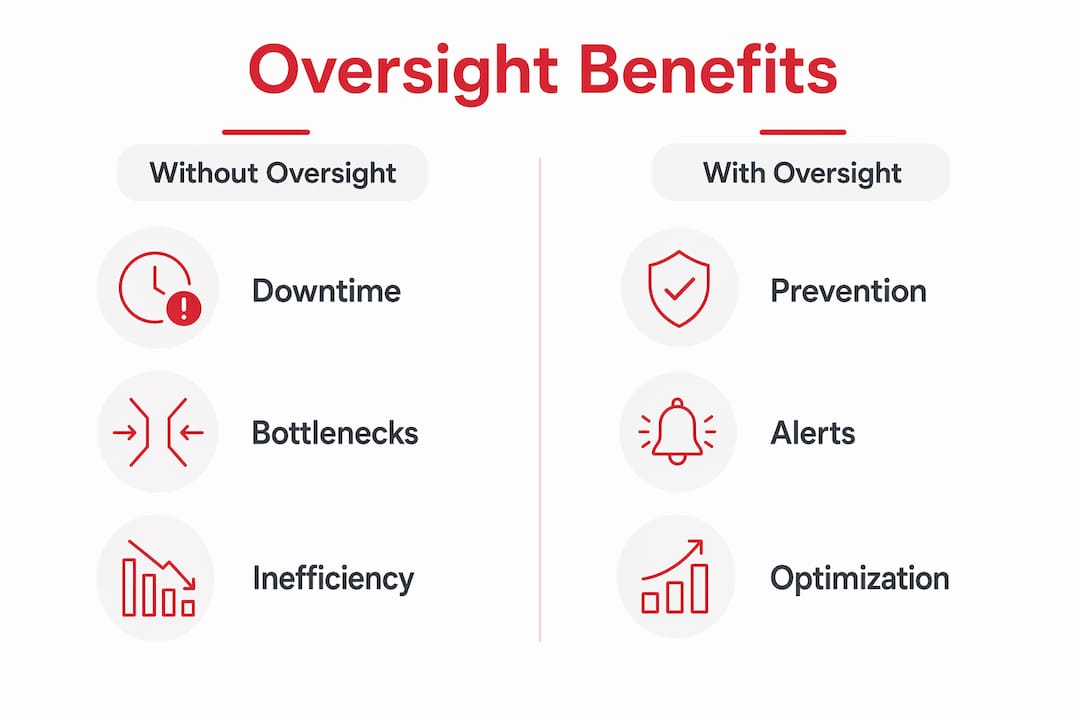
Operational downtime is one of the most expensive problems a manager can fail to prevent. Downtime costs average £5,600 per minute in enterprise environments. That figure makes early anomaly detection not a luxury but a financial necessity.
Real-time monitoring surfaces bottlenecks before they compound. When a manager can see that one team is overloaded while another is underutilised, they can rebalance workloads in minutes rather than discovering the problem at the end of a shift. Monitoring patterns rather than individual activities gives managers the operational intelligence to act on trends, not just incidents.

The difference in outcomes between reactive and proactive oversight is significant. A manager relying on end-of-day reports will always be responding to problems that have already cost time and money. A manager with live dashboards can catch a staffing gap, a missed clock-in, or a task falling behind before it affects the customer.
Pro Tip: Set threshold-based alerts rather than monitoring every data point manually. This keeps your attention on what matters without creating noise that leads to alert fatigue.
| Scenario | Without real-time monitoring | With real-time monitoring |
|---|---|---|
| Staffing gap detected | End of shift or via complaint | Within minutes of occurrence |
| Workload imbalance spotted | Weekly review meeting | Live dashboard view |
| Task falling behind schedule | After deadline missed | Mid-shift, while correctable |
| Anomalous attendance pattern | Monthly report | Same day, automated alert |
How do you balance oversight with trust?
Visibility becomes a liability when it tips into surveillance. 43% of employees feel frequent status checks are excessive, and 42% find detailed activity monitoring intrusive. Those numbers point to a clear tipping point where oversight stops improving performance and starts eroding it.
The distinction between accountability and surveillance is not philosophical. It is practical. Managers who monitor outputs and patterns build trust. Managers who monitor keystrokes and minute-by-minute activity breed resentment. The goal of staff supervision is to support performance, not to demonstrate authority.
Transparent monitoring policies increase staff willingness to engage and trust management despite oversight. When people understand what is being tracked and why, they are far less likely to interpret monitoring as a sign of distrust. Communication is the mechanism that converts data collection into a productive relationship.
Best practices for maintaining the balance between visibility and trust:
- Share what you monitor and explain the operational reason for each metric.
- Focus alerts on outcomes and patterns, not individual activity logs.
- Use monitoring data to support staff, not to build cases against them.
- Give staff access to their own data through self-service tools so oversight feels mutual.
- Review monitoring scope regularly and remove metrics that no longer serve a clear purpose.
Pro Tip: Before adding a new monitoring metric, ask one question: does this help me support my team better, or does it just give me more data to review? If the answer is the latter, leave it out.
How does real-time oversight help manage remote and hybrid teams?
Remote and hybrid working has fundamentally changed the role of managers in staff supervision. Physical presence was never a reliable proxy for productivity, but it did provide a passive stream of information. Without it, managers face a genuine visibility gap in dispersed teams that real-time data is uniquely positioned to fill.
40% of employees would seek new jobs if flexible working was revoked. That statistic means managers cannot solve the visibility problem by pulling people back into offices. They must build oversight systems that work across locations, shifts, and time zones.
Real-time oversight replaces the informal signals of physical presence with structured, data-driven insight. A manager overseeing a multi-site cleaning or security operation, for example, can see who has clocked in, where they are located, and whether assigned tasks are progressing, all without a single phone call. That is not surveillance. That is operational clarity.
Key areas where real-time monitoring addresses remote management challenges:
- Attendance and location verification. Geofenced clock-in confirms staff are where they need to be without requiring manual check-ins.
- Workload visibility. Live dashboards reveal when a remote team member is carrying a disproportionate share of tasks before burnout becomes a risk.
- Psychosocial risk signals. Effective supervision recognises early signs of burnout and stress, not just errors. Real-time data on hours worked and task completion rates can flag these patterns early.
- Communication continuity. Real-time notifications and messaging tools replace the corridor conversation that remote work eliminates.
The shift from physical presence to systemic oversight controls is not a compromise. For managers running dispersed teams, it is a more reliable model than anything a shared office ever provided.
How can managers implement real-time oversight effectively?
The most common mistake managers make is equating frequent manual check-ins with oversight. Automated alerts and dashboards offer a more scalable and less intrusive solution. The goal is to design a system that surfaces the right information at the right moment, not to monitor everything continuously.
Outcome-focused monitoring is the standard that separates effective oversight from micromanagement. A manager who tracks whether tasks are completed on time, whether shifts are covered, and whether attendance patterns are consistent has everything they need. A manager who tracks how many minutes each person spent on each sub-task has created a compliance burden for everyone, including themselves.
Setting clear expectations before monitoring begins is non-negotiable. Staff who understand what metrics matter and how those metrics connect to team goals are far more likely to engage positively with oversight. This is where scheduling challenges and oversight intersect. When rotas are unclear or shift assignments are inconsistent, even good monitoring data becomes difficult to interpret.
| Monitoring approach | Focus | Staff impact | Manager workload |
|---|---|---|---|
| Activity surveillance | Keystrokes, screen time, minute-by-minute logs | High friction, trust erosion | High, constant review required |
| Pattern-based oversight | Attendance trends, task completion, shift coverage | Low friction, supports autonomy | Low, alert-driven and exception-based |
| Outcome monitoring | Deliverables, shift fulfilment, compliance records | Neutral to positive | Moderate, periodic review |
Pattern-based oversight is the model that scales. It works for a five-person team and a five-hundred-person operation. The real-time workforce control guide from Timeprof outlines how managers can structure this approach across multi-site operations without creating administrative overhead.
Good supervisory leadership combines judgement with systems thinking. Knowing when to act on an alert, when to investigate further, and when to adjust the monitoring parameters is a skill. The technology provides the data. The manager provides the interpretation.
Key takeaways
Real-time staff oversight is most effective when it focuses on patterns and outcomes rather than minute-by-minute activity, giving managers the visibility to act early without eroding staff trust.
| Point | Details |
|---|---|
| Downtime prevention | Real-time anomaly detection prevents costly operational gaps before they escalate. |
| Trust and transparency | Sharing what is monitored and why increases staff engagement and reduces friction. |
| Remote team visibility | Geofenced attendance and live dashboards replace physical presence with reliable data. |
| Pattern over activity | Monitoring trends and outcomes is more effective and less intrusive than activity logs. |
| Automated alerts | Threshold-based alerts reduce manager workload and prevent alert fatigue. |
What I have learned about oversight as a management tool
The managers I have seen struggle most with real-time oversight are not the ones who ignore it. They are the ones who treat it as a control mechanism rather than a support system. They build dashboards that track everything and end up acting on nothing, because the volume of data makes it impossible to distinguish signal from noise.
The most effective approach I have encountered is deceptively simple. Define three to five metrics that directly reflect whether your operation is running well. Build alerts around those metrics only. Review everything else weekly, not daily. That discipline forces you to think clearly about what oversight is actually for.
Automated, pattern-based alerts prevent the redundant communication burden that kills manager productivity. I have seen operations where managers spent more time responding to monitoring notifications than they did managing people. That is the opposite of what oversight is meant to achieve.
The other thing worth saying plainly: oversight is a relationship tool as much as an operational one. When a manager uses real-time data to spot that a team member is consistently working late or picking up extra shifts, and then has a conversation about it, that is supervision done well. The data creates the opportunity. The conversation creates the trust. Neither works without the other.
— Michael
How Timeprof supports managers with real-time workforce intelligence
Timeprof is built for managers who need live visibility across their workforce without the administrative weight of manual tracking.
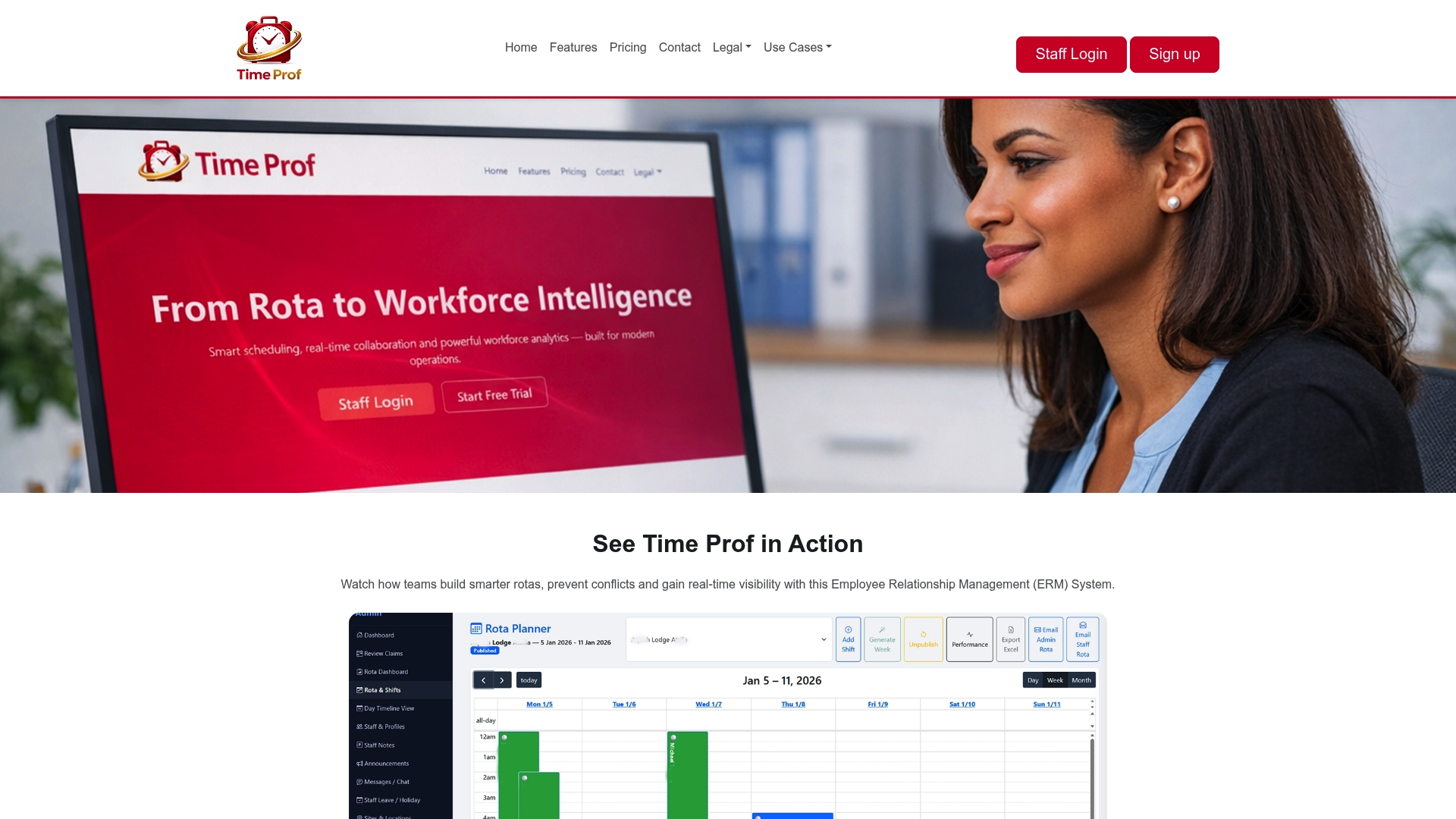
The platform brings together real-time attendance tracking, geofenced clock-in, live multi-site dashboards, shift-linked tasks, and automated notifications in one place. Managers in care, security, hospitality, cleaning, and retail use Timeprof to replace disconnected spreadsheets and phone calls with a single, reliable source of operational truth. Whether you are managing five staff across one site or hundreds across many locations, Timeprof gives you the oversight you need without the friction your team does not.
FAQ
What is real-time staff oversight?
Real-time staff oversight is the continuous monitoring of employee attendance, task progress, and work patterns through live data, enabling managers to respond to issues as they occur rather than after the fact.
Why does real-time tracking matter for remote teams?
Remote teams remove the passive visibility that physical presence provides. Real-time tracking replaces that with structured data on attendance, location, and task completion, giving managers reliable insight without requiring constant check-ins.
How does oversight affect staff productivity?
Oversight improves productivity when it focuses on outcomes and patterns. Excessive activity monitoring, however, erodes trust and can reduce performance, with research showing 43% of employees find frequent status checks excessive.
What is the difference between oversight and micromanagement?
Oversight monitors patterns and outcomes to support performance. Micromanagement monitors individual activities continuously and signals distrust. The distinction lies in what is tracked and how the data is used.
How can managers avoid alert fatigue in real-time monitoring?
Managers avoid alert fatigue by setting threshold-based alerts on a small number of high-impact metrics rather than monitoring all available data points. Automated, exception-based systems surface only what requires attention.