Common rota scheduling mistakes: 10 fixes for UK managers
Discover solutions to common rota scheduling mistakes. Improve staff planning and eliminate conflicts with these essential fixes for UK managers.

The most damaging common rota scheduling mistakes are publishing too late, ignoring approved leave and availability, relying on fragmented spreadsheets, and failing to staff peaks correctly. Fix them by moving to a single scheduling system and publishing confirmed rotas with sufficient advance notice before shifts start.
Top mistakes at a glance:
- Publishing too late: Staff cannot plan childcare or transport. Fix: publish a draft well in advance, with the confirmed rota published several days before shifts begin.
- Ignoring availability and leave: Creates no-shows and perceived unfairness. Fix: sync leave approvals into the rota before building it.
- Fragmented spreadsheets: Multiple disconnected files cause double bookings and version conflicts. Fix: consolidate into one system.
- Poor change communication: Last-minute shift changes go unread. Fix: push mobile notifications the moment a change is confirmed.
- Understaffing peaks: Service drops and reactive overtime. Fix: map demand data to headcount before publishing.
- Excessive overtime: Fatigue risk and cost overrun. Fix: set overtime caps and flag breaches before the rota goes live.
Quick wins to measure this pay period: overtime percentage, fill rate (planned vs. staffed), and the number of days a rota was published late.
Table of Contents
- What are the most common rota scheduling mistakes?
- How far in advance should you publish a rota?
- Pre-publish checklist: what to check before the rota goes live
- Which metrics should you track to stop mistakes repeating?
- When should you move off spreadsheets?
- How Timeprof maps directly to these scheduling problems
- Are you complying with UK working time rules?
- Why ignoring shift preferences damages retention
- Key takeaways
- The trade-off experienced rota managers actually make
- Timeprof replaces the spreadsheets, calls, and guesswork
- Useful sources
What are the most common rota scheduling mistakes?
Scheduling errors rarely happen in isolation. They tend to cluster: a late-published rota triggers a wave of last-minute calls, which forces unplanned overtime, which exhausts staff, which drives turnover. Understanding the chain matters as much as fixing individual links.
1. Publishing the rota too late Late publication is consistently ranked the number one scheduling error. Staff with caring responsibilities, second jobs, or long commutes need advance notice to commit reliably. Impact: higher no-show rates, last-minute cover requests, and avoidable overtime spend. Fix operationally by setting a hard publish deadline on your calendar. Fix systematically by using a platform that enforces a publish date and notifies staff automatically.
2. Ignoring approved leave and availability Building a rota without checking approved leave first is the scheduling equivalent of double-booking a meeting room. Ignoring employee availability and preferences is also a leading cause of perceived unfairness and increased turnover risk. Fix: pull leave and availability data before you place a single shift. If that data lives in a separate system, you will miss something.

3. Relying on multiple spreadsheets Version conflicts, overwritten cells, and manual double-entry are unavoidable when scheduling lives across several files. Fragmented tools create resource conflicts and human error at scale. Fix: move to a single source of truth where every manager works from the same live data.

4. Poor communication of changes A rota update buried in an email thread or a WhatsApp group is not a communication plan. Staff miss it; managers assume it was read. Fix: any change to a published rota should trigger an immediate, direct notification to the affected person, with a read-receipt or acknowledgement mechanism.
5. Understaffing peaks, overstaffing troughs Guessing headcount for a busy Saturday or a bank holiday weekend is how service failures happen. The fix is demand-led scheduling: use sales data, footfall counts, or historical booking patterns to set minimum headcount by shift before you start filling names.
6. Excessive overtime and long continuous shifts Poor scheduling raises direct labour costs and creates fatigue risk that compounds over consecutive shifts. Research links extended shift patterns to increased error rates and staff health impacts. Fix: set overtime limits per person, build in minimum rest windows between shifts, and flag any breach before the rota is published.
7. Failing to match skills to shifts Putting an unqualified team member in a role that requires a specific licence, certification, or site clearance is a compliance risk, not just an operational one. Fix: tag each shift with required skills and only assign staff who hold them. For care and security operations, this is non-negotiable.
8. Unmanaged shift swaps and missing handovers Informal swaps agreed over text, with no manager approval, create gaps nobody owns. Equally, a shift with no handover notes leaves the incoming person without critical context. Fix: all swaps go through an approval workflow; all shifts carry a brief handover checklist.
9. Not tracking attendance against the rota A rota that is never reconciled against actual attendance is a fiction. You cannot spot patterns, manage costs, or address persistent lateness without comparing planned versus actual. Fix: clock-in data should feed back into the rota automatically, with exceptions flagged for review.
10. No contingency plan for absences Reactive, costly last-minute cover is the direct result of having no standby list or escalation route. Fix: maintain a named standby roster for each site, with a clear escalation order (team lead, then deputy manager, then agency contact) so the first call is never a guess.
Pro Tip: Publish a draft rota two to three weeks ahead so staff can flag conflicts early, then lock the confirmed version seven days before shifts start. This two-stage approach cuts last-minute changes by giving everyone a window to raise issues before the schedule is final.
How far in advance should you publish a rota?
The short answer for most UK operations: draft rota with ample lead time, confirmed and locked about a week or more before shifts begin. That cadence gives staff enough notice to arrange childcare and transport, and gives managers time to resolve conflicts before they become emergencies.
Sector variations matter:
- Care and healthcare: Minimum two weeks’ notice is widely expected, and many care providers aim for four weeks given the complexity of care plans and staff skill requirements.
- Hospitality and retail: Two weeks is the practical standard, though peak trading periods (Christmas, bank holidays) warrant four to six weeks of forward planning.
- Security: Site-specific licence requirements mean rotas often need to be confirmed three weeks ahead to allow compliance checks.
Sample publishing timeline for a weekly rota:
| Stage | Timing | Responsible |
|---|---|---|
| Draft rota circulated well in advance before week start | Operations manager | |
| Staff flag conflicts | Within 48 hours of draft | All staff |
| Confirmed rota published several days before week start | Rota planner | |
| Final lock (no further swaps without approval) shortly before first shift | Site manager |
Pro Tip: Block a recurring calendar slot each week for rota building. Treat it like a payroll deadline, not a task you fit around other work. Managers who schedule rota time consistently publish earlier and field fewer last-minute calls.
Pre-publish checklist: what to check before the rota goes live
Run through this before every rota publish. It takes under fifteen minutes and catches the errors that generate the most reactive work.
Pre-publish verification checklist:
- [ ] All approved leave and unavailability loaded and cross-checked
- [ ] Minimum headcount met for every peak shift
- [ ] Required skills and certifications matched to each shift
- [ ] No individual exceeds the weekly overtime cap
- [ ] Minimum rest periods observed between consecutive shifts
- [ ] Handover notes or task lists attached to complex shifts
- [ ] Standby contacts confirmed for each site
- [ ] Communication method confirmed (push notification, not just email)
Five manager questions to ask before publishing:
- Does every shift have a named, qualified person assigned?
- Have I checked this against the approved leave calendar, not just memory?
- Are there any back-to-back long shifts that breach rest requirements?
- Do I have a standby contact if someone calls in sick on the busiest shift?
- Will every affected staff member receive a direct notification, not just a shared document update?
For handling scheduling conflicts, the fastest resolution method is a centralised availability check before confirming any swap, followed by a brief written record of the agreed change.
Which metrics should you track to stop mistakes repeating?
Tracking the right numbers turns rota management from reactive firefighting into a process you can actually improve. You do not need a dashboard full of KPIs. You need five that tell you the truth quickly.
| Metric | What it tells you | Sample target | Review cadence |
|---|---|---|---|
| Overtime % | Whether demand planning is working | Under 5% of total hours | Weekly |
| Fill rate (planned vs. staffed) | Whether rotas are realistic | — | Weekly |
| Late-publish days | Whether the process is disciplined | Zero | Weekly |
| No-show rate | Whether availability data is accurate | Under 3% | Weekly |
| Swap approval rate | Whether informal swaps are being managed | 100% through approval | Monthly |
Review operational metrics weekly with the site or operations manager. Run a monthly trend analysis with HR to spot patterns in no-shows, overtime clusters, or persistent late publishing. Capacity-based scheduling that accounts for realistic buffers reduces overcommitment and the overtime that follows.
When should you move off spreadsheets?
Spreadsheets are not a scheduling system. They are a workaround that becomes more expensive the longer you use them.
Decision signals that it is time to upgrade:
- More than one person maintains separate scheduling files
- Double bookings occur more than once a month
- You cannot see live attendance against the rota in real time
- Overtime is consistently above target because rules cannot be enforced automatically
- Overlapping rotations and manual edits cause update failures or lost entries
- Staff find out about changes too late, too often
Features that prevent the most common errors:
- Single live rota all managers work from simultaneously
- Rule-based auto-assignment that checks availability and skills before placing a shift
- Leave and availability sync so conflicts surface before publishing
- Swap approval workflow with audit trail
- Mobile push notifications for every change
- Attendance reconciliation against the published rota
- Overtime and rest-period alerts before the rota is confirmed
The cost of delaying an upgrade is not just overtime spend. It includes the recruitment and onboarding costs that follow turnover driven by unpredictable schedules, and the service failures that happen when peaks are understaffed. Automated scheduling removes the manual steps where most of these errors enter the process.
How Timeprof maps directly to these scheduling problems
Every mistake in this list has a direct feature response in Timeprof. The platform was built specifically to replace the fragmented spreadsheets, phone calls, and disconnected systems that cause these errors in the first place.
| Common mistake | Timeprof feature that prevents it |
|---|---|
| Publishing too late | Publish deadlines with automated staff notifications |
| Ignoring leave and availability | Live leave and availability sync before shift assignment |
| Fragmented spreadsheets | Single platform: one rota, one source of truth |
| Poor change communication | Real-time push notifications and read confirmations |
| Understaffing peaks | Demand-led open shifts and shift claim workflows |
| Excessive overtime | Automated overtime caps and fatigue-risk flagging |
| Skills mismatches | Skills and certification tagging per shift |
| Unmanaged swaps | Swap approval workflow with full audit trail |
| No attendance reconciliation | Geofenced clock-in matched against published rota |
| No contingency plan | Standby lists and escalation routes built into the platform |
Timeprof supports operations across care, hospitality, security, and retail. In care settings, skills tagging and compliance reporting mean every shift is covered by a qualified person, with an audit record for inspection. In security, geofenced clock-in confirms staff are on site, not just clocked in from a car park. For hospitality, open-shift claims let managers fill gaps quickly without a single phone call.
For rota scheduling best practices and how to reduce errors with the right tools, the Timeprof resource library covers both in depth.
Are you complying with UK working time rules?
The Working Time Regulations 1998 set the legal floor for UK scheduling. Breaching them is not a process problem; it is a legal liability.
Key requirements every rota must respect:
- 48-hour weekly limit: Workers cannot be required to work more than 48 hours per week on average (calculated over a 17-week reference period), unless they have signed a valid opt-out agreement.
- 11-hour rest: A minimum of 11 consecutive hours’ rest between working days.
- 24-hour rest: At least one uninterrupted 24-hour rest period per week, or 48 hours per fortnight.
- Rest breaks: A 20-minute uninterrupted break when a shift exceeds six hours.
- Night worker limits: Night workers average no more than eight hours per 24-hour period.
Young workers (under 18) have stricter limits: no more than eight hours per day and 40 hours per week, with no night work between 10 PM and 6 AM in most cases.
Rotas built without automated rule checks routinely breach these limits, particularly for staff working across multiple sites or picking up additional shifts informally. An audit trail of published rotas and actual hours worked is your first line of defence in any enforcement action.
This article provides general information, not legal advice. Confirm current Working Time Regulations requirements with the relevant primary source or a qualified employment law adviser for your specific situation.
Why ignoring shift preferences damages retention
Fairness in shift allocation is not a soft issue. Ignoring employee preferences and distributing unpopular shifts unevenly are consistently cited as drivers of dissatisfaction and resignation, particularly among part-time and frontline workers.
Practical steps that make a measurable difference:
- Rotate unpopular shifts (early starts, late finishes, weekends) systematically rather than defaulting to the same people.
- Collect shift preferences formally, not through informal requests that get lost, and record them in the scheduling system.
- When preferences cannot be accommodated, explain why. Staff who understand the operational reason are far more likely to accept the outcome than those who feel ignored.
- Use availability pattern management to track recurring constraints so the same person is not repeatedly scheduled against their stated availability.
The link between scheduling fairness and carer retention is particularly well-documented in care settings, where unpredictable rotas are a primary reason experienced staff leave.
Key takeaways
Fixing common rota scheduling mistakes requires publishing earlier, consolidating to a single system, enforcing compliance rules automatically, and tracking a small set of operational metrics every week.
| Point | Details |
|---|---|
| Publish earlier | Confirm rotas at least seven days before shifts; draft two to four weeks ahead. |
| Single source of truth | Fragmented spreadsheets cause double bookings and version conflicts; consolidate into one live system. |
| Track five metrics | Overtime %, fill rate, late-publish days, no-show rate, and swap approval rate tell you what is going wrong. |
| Comply with Working Time Regulations | Automated rule checks prevent breaches of rest periods, weekly limits, and break entitlements. |
| Timeprof | Maps directly to each common mistake with skills tagging, leave sync, geofenced clock-in, and automated compliance alerts. |
The trade-off experienced rota managers actually make
Experienced rota managers do one thing differently from everyone else: they make predictability the default and treat flexibility as a controlled exception, not the other way round.
Most scheduling problems come from the opposite approach. Managers leave the rota fluid for too long, accommodating requests informally, and then publish late because nothing is confirmed. The rota becomes a negotiation rather than a plan. Staff learn that the schedule is provisional, so they stop treating it as binding, and the cycle repeats.
The practical answer is a two-stage process: a draft that invites input, and a locked final version that does not. Swap requests after the lock date go through a formal approval, not a text message. Standby lists are named and confirmed before the week starts, not assembled in a panic when someone calls in sick at 6 AM.
The cultural shift matters as much as the process. When staff know the rota will be published on time, that their preferences were considered, and that changes will be communicated directly, they stop the informal workarounds that create the gaps managers spend their week filling. Predictability builds trust, and trust reduces the reactive overhead that makes rota management feel unmanageable.
Timeprof replaces the spreadsheets, calls, and guesswork
Managers who switch to Timeprof stop spending their week chasing confirmations and patching last-minute gaps. The platform brings rotas, leave, availability, skills, attendance, and team communication into one place, so the errors that come from fragmented systems simply stop happening.
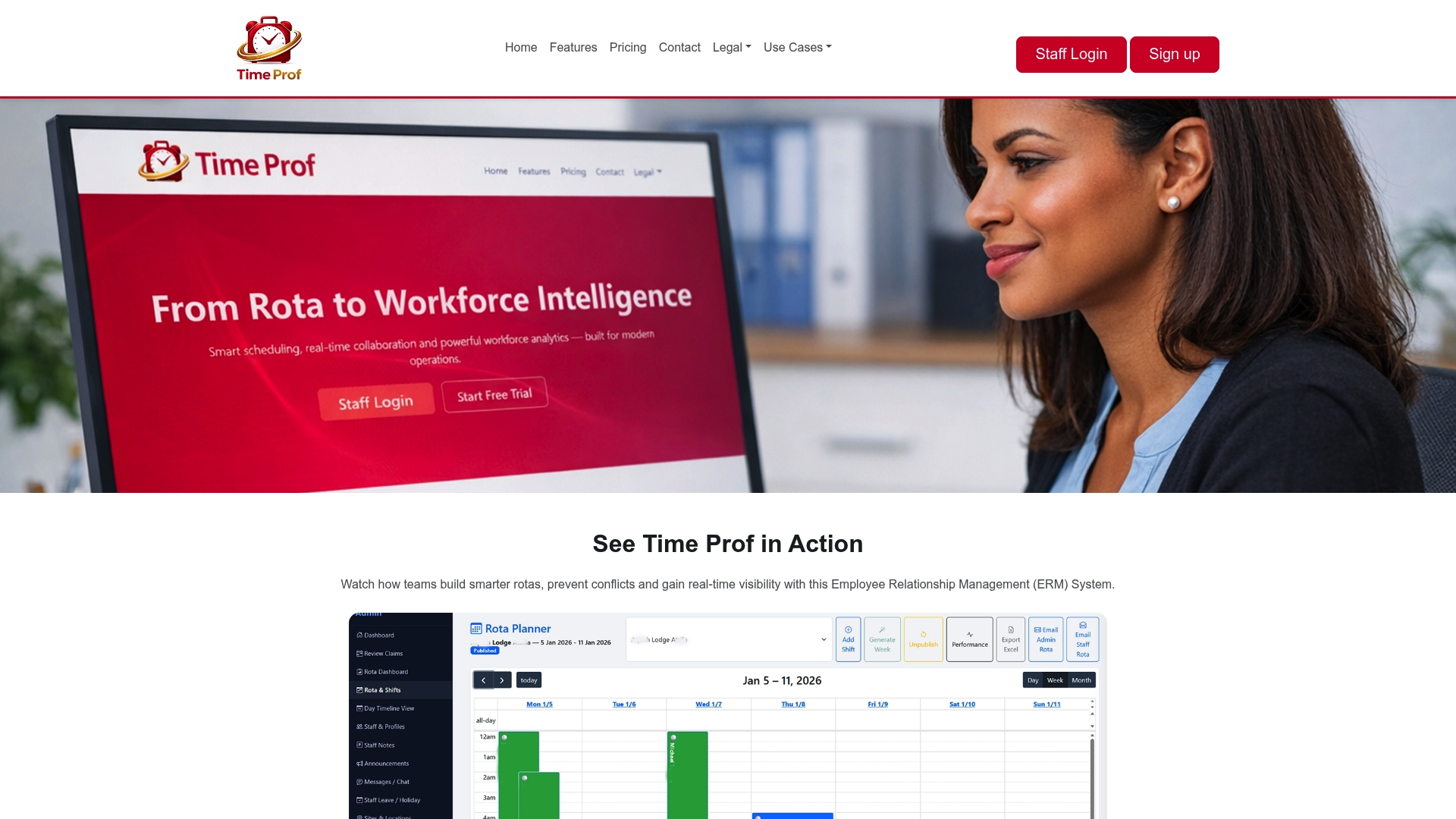
You get automated overtime alerts, geofenced clock-in, real-time notifications, and a full audit trail, without the manual double-entry that makes spreadsheet scheduling so fragile. Whether you manage a single site or a complex multi-site operation in care, hospitality, security, or retail, Timeprof gives you the visibility and control to build rotas that work first time. Admin time savings from automation compound quickly once manual steps are removed from the process.
See how it works for your operation: visit Timeprof and request a demo today.
Useful sources
- Common Scheduling Problems and Solutions — A practical overview of the most frequent scheduling errors, including late publishing, poor contingency planning, and shift overlaps, with operational fixes for each.
- The true cost of bad scheduling — Covers the measurable business costs of poor rota management: overtime spend, turnover, and service-level drops when peaks are understaffed.
- Timeprof workforce management blog — Practical guides on rota best practice, scheduling errors, availability management, and skills matching, written specifically for UK managers and rota planners.