Cut Turnover With 1:1s: Employee Relationship Management for Managers
Practical ERM steps for managers: run structured 1:1s, log incidents, track key metrics, and use a unified workforce platform like Time Prof.

Employee relationship management is the proactive, day-to-day leadership and HR practice that builds trust, reduces turnover and surfaces workplace issues before they escalate. It combines everyday manager behaviour, structured 1:1s, and formal employee relations processes into one system. Done well, it means fewer disputes, better retention, and a workforce that trusts the people running it. The rest of this guide covers how to build that system, what to measure, and which tools make it stick.
TL;DR:
- Building a strong ERM system requires consistent, weekly manager behaviors like structured 1:1s and factual incident logging, not just annual reviews.
- Effective ERM relies on clear escalation processes, a culture of psychological safety, and well-documented concerns that are accessible and regularly updated.
- Organizations that proactively track issues, resolution times, recurrence, and employee sentiment tend to have lower turnover and higher engagement than reactive approaches.
- Using unified workforce platforms that combine attendance, messaging, and incident records improves visibility and prevents issues from being overlooked.
- Managers need targeted training in conversation skills, process literacy, and bias awareness to ensure ERM practices are applied correctly and fairly.
Table of Contents
- What is employee relationship management, exactly?
- Why ERM matters: the business case HR needs
- The core components: behaviours, processes and culture
- How to implement ERM: a manager’s playbook
- Metrics that matter: what to track and why
- How a unified workforce platform supports ERM
- Building ERM skills through training and development
- How Time Prof can help you put this into practice
- Author perspective: making ERM a daily habit, not a policy binder
- Where to go for policy detail and deeper reading
- Sources
What is employee relationship management, exactly?
Employee relationship management (ERM) sits at the intersection of two things HR teams often keep separate: the informal, daily work of managing people well, and the formal machinery of employee relations. It is not just a policy folder. It is what a line manager does in a Tuesday morning 1:1, and it is the escalation process HR triggers when that conversation reveals a grievance.
The CIPD’s factsheet on employee relations draws a useful boundary here: employee relations, in the traditional sense, deals with the formal relationship between employer and employee, often shaped by collective bargaining, contracts and dispute resolution. ERM is broader. It folds in the everyday relationship building that determines whether those formal processes ever get triggered in the first place.
Ownership sits in two places at once, which is exactly where confusion tends to start:
- Line managers own the daily relationship: recognition, coaching, spotting early warning signs, having honest conversations.
- HR owns the framework: policy, escalation routes, documentation standards, legal compliance, and training managers to do their part properly.
When these two layers work together, engagement climbs and retention improves, because problems get caught at the conversation stage rather than the tribunal stage. When they don’t, HR ends up firefighting disputes that a decent 1:1 six weeks earlier would have prevented.
Why ERM matters: the business case HR needs
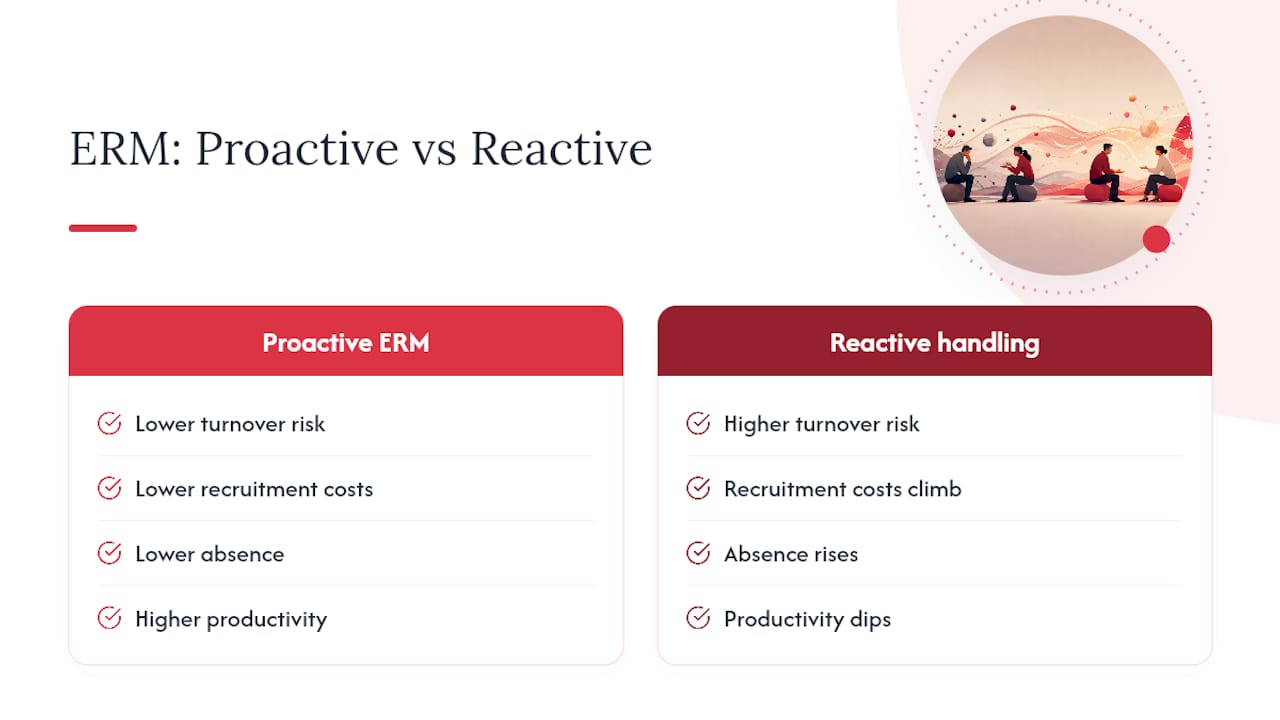
Poor employee relationships cost money in ways that rarely show up on a single line of the budget. Recruitment costs climb when people leave over grievances that were never properly heard. Absence rises when morale drops. Productivity dips when teams spend energy managing conflict instead of doing their jobs.
HR Acuity’s research on ERM practice identifies ignored workplace conflicts and unresolved safety concerns as a primary driver of disengagement and turnover. That is the pattern worth remembering: it is rarely the big, dramatic disputes that drain an organisation. It is the accumulation of small issues nobody logged, escalated, or closed out properly.
The pattern HR Acuity flags: organisations that build proactive, documented issue management see measurably lower turnover risk than those that handle problems reactively, case by case, with no consistent process behind them.
That is the core argument for investing manager time in ERM rather than treating it as HR’s problem alone. A manager who runs consistent 1:1s, documents concerns as they arise, and escalates fairly is doing retention work, whether or not anyone calls it that. The connection between ERM and workforce retention is not abstract. It shows up in exit interviews, in absence data, and in how quickly a team recovers after a difficult change like a restructure or a new rota system.
The core components: behaviours, processes and culture
Good ERM rests on three layers, and most organisations are strong in one and weak in the other two.
1. Manager behaviours
- Run structured 1:1s on a fixed cadence, not “when there’s time.”
- Give recognition close to the moment it’s earned, not batched into an annual review.
- Use data, not gut feel, to guide coaching conversations, drawing on attendance patterns and workload signals rather than assumptions.
2. Processes
- Log incidents and concerns consistently, in the same place, every time, regardless of how minor they seem.
- Build a clear escalation path so nobody has to guess who handles what.
- Run investigations transparently, with documented steps that would hold up to scrutiny later.
3. Culture
Psychological safety is the hardest of the three to build and the easiest to destroy. If staff believe raising a concern will be held against them, your 1:1s become theatre. Clarity of vision matters too. People tolerate difficult periods far better when they understand why. And rewards need to be consistent across the team, because inconsistency reads as favouritism even when it isn’t.
The most common pitfall is treating ERM as an annual-review activity rather than a weekly habit. The second most common is documenting issues inconsistently, which means when a dispute does escalate, there’s no reliable record to work from.
Pro Tip: Keep incident notes factual and dated, even for issues that resolve themselves within a day. A one-line log entry today saves hours of reconstruction if the same concern resurfaces three months later.
How to implement ERM: a manager’s playbook
Building ERM into daily practice does not require a company-wide overhaul on day one. Start small, prove it works, then scale.
Immediate steps (weeks 1 to 4):
- Schedule recurring 1:1s for every direct report, ideally fortnightly, and protect the time.
- Introduce a short pulse survey, no more than five questions, run monthly rather than annually.
- Start on-shift logging for incidents, however minor, using a consistent format.
Operational roll-out (months 2 to 4):
- Train managers on how to run a 1:1 that surfaces real concerns rather than status updates.
- Clarify roles: what a manager handles directly, what gets escalated to HR, and when.
- Pilot the approach with one or two teams before rolling it out organisation-wide.
For hybrid and shift-based teams, the challenge is different. There’s no shared office corridor for informal check-ins, so digital touchpoints have to do that work deliberately. Structured 1:1s, consistent messaging, and clear documentation become the substitute for casual hallway conversations, and handover quality between shifts often determines whether a concern raised on a Tuesday night shift actually reaches the Wednesday day manager.
- Assign shift buddies so new starters have a named contact beyond their line manager.
- Use shared digital handover notes rather than verbal-only handoffs between shifts.
- Run calibration sessions across managers periodically, checking that similar incidents are being logged and escalated consistently.
- Keep an audit trail of every escalation decision, so fairness can be demonstrated, not just claimed.
Metrics that matter: what to track and why
ERM without measurement is just good intentions. The organisations that get this right track a small set of indicators consistently, rather than drowning in dashboards nobody reads.
- Case volume and type: how many issues are being logged, and what categories dominate (conduct, workload, interpersonal, safety).
- Resolution time: how long from first log to close, and where delays cluster.
- Recurrence rate: whether the same issue with the same person or team keeps resurfacing, a strong signal that the root cause hasn’t been addressed.
- eNPS or pulse scores: short, frequent sentiment checks rather than one annual survey.
- Intent to stay: a direct question, asked periodically, that often predicts turnover better than satisfaction scores alone.
The real value of these metrics comes from turning them into manager prompts, not just HR reports. A spike in absence for one individual should trigger a coaching conversation within days, not surface three months later in a quarterly review. Qualtrics’ work on employee engagement makes this point directly: real-time, continuous listening lets managers act on attendance and sentiment trends before they harden into formal disputes, rather than waiting for the annual review cycle to catch up.
Tool categories differ in what they deliver. Pulse platforms specialise in sentiment tracking. Engagement analytics tools surface trends across teams and sites. Workforce management systems bring attendance, scheduling and communication together in one place, which matters because absence patterns feed directly into coaching decisions. Whichever category you choose, data governance cannot be an afterthought: access to sensitive case data should be role-restricted, sentiment survey responses should stay anonymous where promised, and confidentiality has to be built into the system, not bolted on.
How a unified workforce platform supports ERM
Fragmented tools, spreadsheets here, a messaging app there, paper incident forms in a drawer, create exactly the kind of silos that block proactive ERM. When rota data, attendance records, manager notes and staff messaging live in separate systems, nobody has the full picture until something has already gone wrong.
A unified workforce platform brings rota planning, geofenced clock-in, staff messaging, and audit-ready records into one platform, which matters practically: a manager can see an attendance trend on the same screen where they log a coaching note, rather than reconciling three systems to spot the pattern.
A staff member logs a concern during a shift through the mobile app. The site manager sees it flagged before the next handover, adds a note, and the record sits alongside that employee’s attendance history. Nothing gets lost between the night shift and the morning briefing.
That kind of visibility is the practical difference between reactive HR and proactive ERM.
Pro Tip: If you’re evaluating a workforce platform for ERM purposes, check whether staff notes, attendance and messaging genuinely link to the same employee record, not just three separate modules that happen to share a login screen.
Building ERM skills through training and development
Managers are rarely taught how to run a 1:1 that surfaces real problems rather than status updates. That gap is where most ERM failures start, not in policy design but in the room where the conversation actually happens.
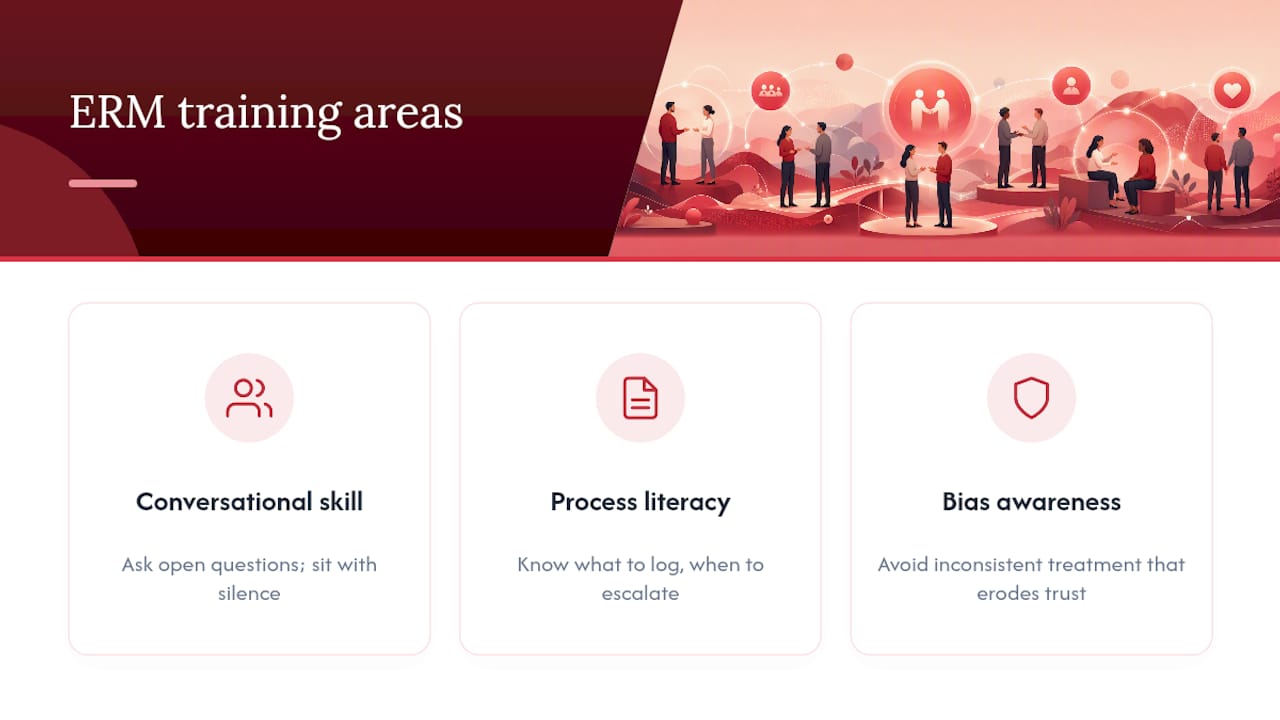
Effective training programmes for ERM tend to cover three areas. The first is conversational skill: how to ask open questions, sit with silence, and avoid jumping to solutions before a concern has been fully heard. The second is process literacy: managers need to know exactly what to log, when to escalate, and who else needs to be looped in, without guessing. The third is bias awareness, because inconsistent treatment of similar issues across a team is one of the fastest ways to erode trust, even when no manager intends unfairness.
Role-play and case-study based sessions tend to outperform slide-based training here, because ERM is a practised skill, not a memorised checklist. New managers benefit from shadowing an experienced colleague through a real escalation before handling one independently. Refresher sessions matter too. A manager trained eighteen months ago on documentation standards will drift without periodic recalibration, particularly if the organisation has since revised its escalation policy.
Development should not stop at the manager level. HR business partners benefit from calibration training that keeps decisions consistent across departments, and senior leaders need enough grounding in ERM principles to model the behaviour they expect further down the organisation.
How Time Prof can help you put this into practice
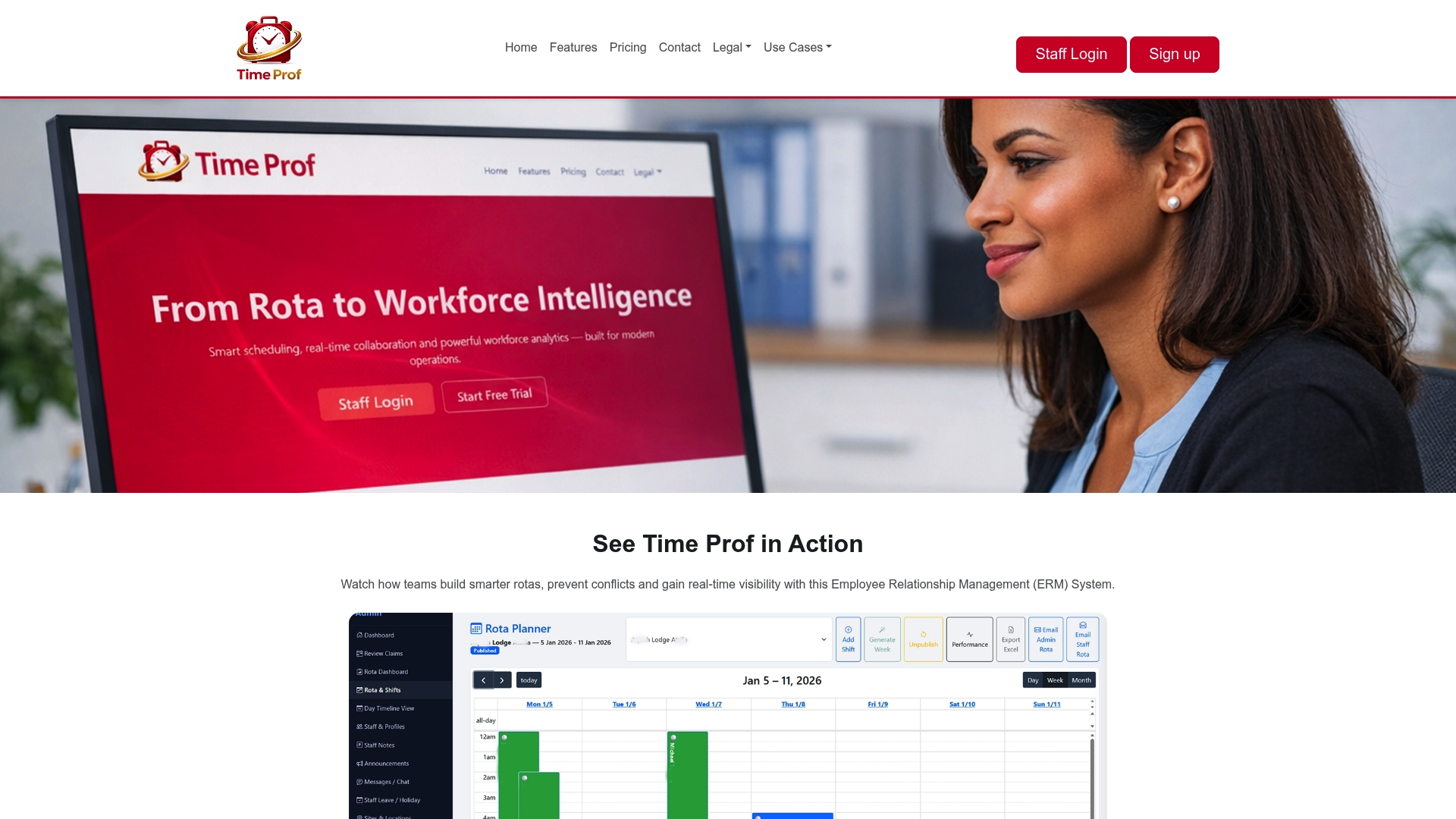
Everything covered above, structured 1:1s, consistent logging, attendance-driven coaching, fair escalation, depends on having a system that actually holds the data in one place. Such platforms combine rota planning, real-time attendance tracking, geofenced clock-in, private and site-based messaging, audit-ready records, and secure staff self-service, so managers get a single view of their team instead of piecing one together from spreadsheets and separate apps.
Before choosing any workforce platform to support your ERM practice, run through a short checklist: does it centralise attendance and communication in one record, does it support role-based access so sensitive notes stay confidential, does it give managers real-time visibility rather than end-of-month reports, and can it scale from a single site to multiple locations without adding administrative burden. Such platforms are designed to answer yes to all four, whether you’re running a single care home or a multi-site security operation.
If your organisation is still relying on spreadsheets and disconnected messaging threads to manage staff relationships, book a demo with Time Prof and see how the platform handles rota, attendance and communication in one place.
Author perspective: making ERM a daily habit, not a policy binder
This quarter, pick three things: fixed 1:1 cadence, consistent incident logging, and one metric you actually act on. Most ERM failures aren’t about missing policy. They’re about managers treating relationship work as an occasional task instead of the job itself.
— Michael
Where to go for policy detail and deeper reading
- CIPD — Employee relations: An introduction
- Gov
- Legislation
- HR Acuity — Best practices in employee relationship management
Sources
- Qualtrics — Employee engagement
- HR Acuity — Best practices in employee relationship management
- CIPD — Employee relations: An introduction
- Gov