Stop roster fatigue in 90 days: Shift fatigue management for managers
Manage shift fatigue with an implementation first plan for managers. Assess risk, cap consecutive nights to three, publish rotas earlier, and run a 90 day...
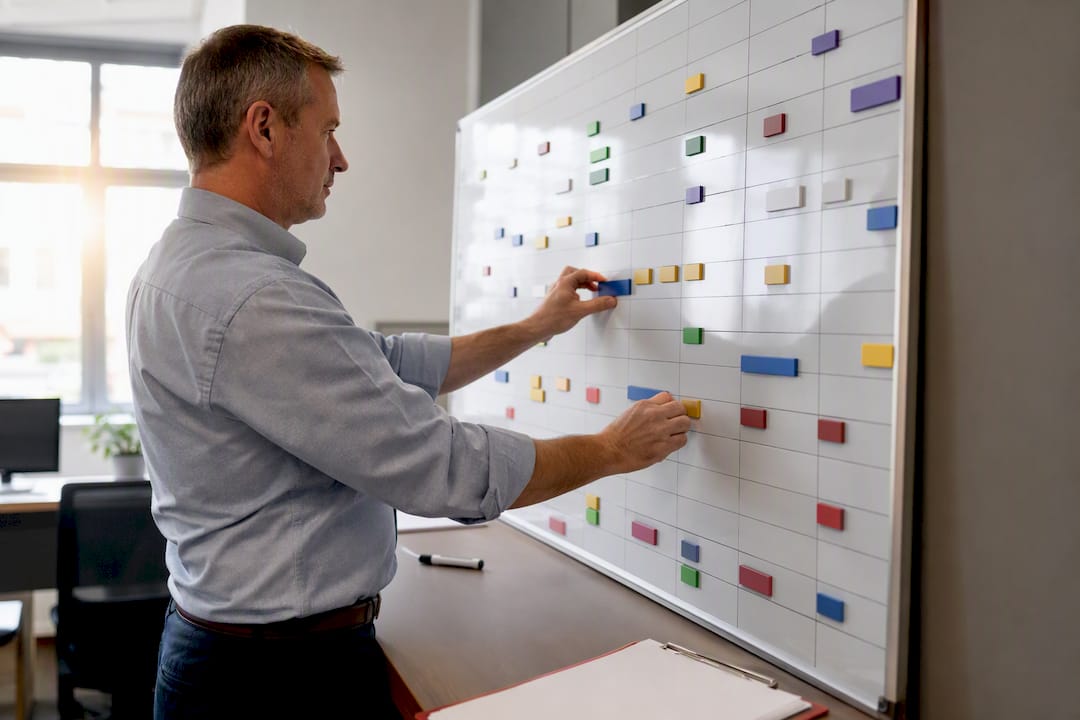
Treat fatigue as a safety risk, not a scheduling inconvenience: start with a risk assessment, fix the worst roster hazards immediately, and build a fatigue-risk management loop that monitors outcomes over time. The first actions that matter are short-term roster fixes, within-shift breaks, and honest staff briefings, backed by tools like the Fatigue and Risk Index and workforce platforms such as Time Prof.
TL;DR:
- Limiting night shifts to no more than three consecutive nights and increasing rest gaps significantly reduces fatigue-related errors and incident risks.
- A structured fatigue risk assessment should include roster history, incident data, self-reported fatigue, workload, and commute factors, with findings leading to specific actions.
- Implementing short, frequent breaks during long shifts and optimizing shift timing around circadian lows can improve alertness and safety during night work.
- A fatigue risk management system involves continuous risk assessment, monitoring, and adjusting, with tools like the Fatigue and Risk Index to inform scheduling decisions.
- Automating fatigue checks with platforms like Time Prof streamlines compliance, reduces scheduling errors, and enhances safety culture without requiring extensive new software.
Table of Contents
- At-a-glance checklist for immediate and short-term actions
- What must managers record for fatigue risk assessment?
- Designing safer shift patterns: practical guidance and common rules of thumb
- What environmental controls reduce fatigue during a shift?
- How do you build a non-punitive fatigue reporting culture?
- What is a fatigue risk management system?
- Practical implementation: how Time Prof helps managers deliver fatigue-aware rotas
- What managers get wrong about fatigue management
- Put fatigue-aware scheduling into practice with Time Prof
- Sources
At-a-glance checklist for immediate and short-term actions
Most managers inherit a rota that was built for coverage, not recovery. The first 90 days should focus on stopping the bleeding while you plan longer-term fixes to your fatigue management policy.
Here’s the sequence that works, in order:
- Pull your roster data. Look at the last three months of shift patterns, incident reports, and any sickness or near-miss logs tied to night shifts or long runs of consecutive days. If you don’t already track this, start today, even in a spreadsheet.
- Identify your worst offenders. Flag any employee working more than three consecutive night shifts, back-to-back shifts with under 11 hours off, or repeated 12-hour-plus days. These are your priority fixes.
- Cap consecutive nights and increase turnaround time. Limit runs to a small number of consecutive night shifts where operationally possible, and push for longer gaps between the end of one shift and the start of the next.
- Publish rotas further in advance. Two to four weeks’ notice lets staff plan sleep, childcare, and commuting, and it cuts the last-minute swaps that create the worst fatigue spikes.
- Add short, frequent breaks to long or monotonous shifts. A ten-minute break every two hours tends to protect alertness better than one long break halfway through.
- Check rest facilities and post-shift travel. A quiet space for a break and a safe way home after a night shift are cheap fixes with outsized safety value.
- Brief the team. Explain what’s changing and why, and make clear that reporting fatigue will never be treated as a performance issue.
None of this requires new software or a big budget, and broader HR support can streamline these changes as shown by Evy for HR Teams. It requires someone taking ownership of the roster data and acting on what it shows.
What must managers record for fatigue risk assessment?
Employers have a duty to assess and manage risks from work-related fatigue, and shift work sits squarely inside that duty. HSE guidance states plainly that fatigue is a workplace hazard like any other, and that training staff to cope with it is not a substitute for fixing the roster itself. If your fatigue management policy leans entirely on “resilience training” and skips the schedule design, it will fail an inspection and, more importantly, it will fail your staff.
A proper risk assessment for shift worker fatigue pulls together several strands of evidence, not just gut feel from the duty manager:
- Roster history: shift lengths, direction of rotation, number of consecutive nights, and the gaps between shifts over recent months.
- Incident and near-miss data: cross-referenced against shift number and time of day, since fatigue-related errors cluster in predictable windows.
- Self-reported fatigue: sleepiness scales, exit surveys, or simple check-ins where staff can flag when they felt unsafe to work.
- Workload and task demand: cognitively heavy or safety-critical tasks carry more risk on a tired shift than repetitive light work.
- Commute and second-job factors: a 90-minute drive home after a night shift changes the risk profile even if the shift itself was compliant.
Once you’ve gathered this, map each finding to a specific action and a named owner. A pattern of errors on the third night shift of a run points towards capping consecutive nights. A cluster of near misses at 4am points towards moving high-risk tasks to earlier in the shift or adding supervision at that hour. Document both the finding and the action taken. This paper trail matters if HSE ever asks how you assessed and controlled the risk, and it matters just as much internally, because it shows staff that reports lead to change.
Treat this as a living process rather than a one-off audit. Review the risk assessment at least annually, and sooner if you change shift patterns, open a new site, or see a spike in incidents. Bring in occupational health input and, where staff are represented, union or safety-rep input before finalising changes. A roster redesign that lands well with management but blind sides the people working it rarely survives contact with reality.
Designing safer shift patterns: practical guidance and common rules of thumb
There’s no single roster that works for every operation, but decades of fatigue research have produced some fairly consistent rules of thumb. Ignore them at your own risk, literally.
Forward rotation beats backward rotation. Moving from morning to afternoon to night shifts, rather than the reverse, aligns better with the body’s natural tendency to drift later rather than earlier, and it tends to produce faster adaptation and less accumulated sleep debt.
Limit consecutive night shifts to three where possible. HSG256 guidance notes that night shifts disrupt circadian rhythms and require extra recovery time, and the disruption compounds with each additional night worked in a row. A fourth or fifth consecutive night rarely buys you anything except a more exhausted, more error-prone employee.
Avoid shifts longer than 12 hours where the work is demanding. Extended shifts can work for lower-intensity roles with good break provision, but for safety-critical or physically demanding work, the extra hours often cost more in errors than they save in coverage.
Break structure matters just as much as shift length:
- Build in short, frequent breaks rather than one long break for mentally demanding or monotonous tasks; this tends to protect alertness better over a full shift.
- Provide a genuine rest area, not a corner of the staffroom, for anyone using a controlled nap policy during long night shifts.
- Keep nap windows short, typically 20 to 30 minutes, to avoid staff waking into deep sleep and feeling worse rather than better.
Recovery planning is the piece managers most often skip. After a run of night shifts, staff need at least two full nights of normal sleep to reset rather than only a single day off, to adequately recover. Where demands are unusually high, such as during a busy season or a period of understaffing, extend that recovery window rather than compressing it further.
Pro Tip: When piloting a new shift pattern, run it for at least four to six weeks before judging results. Fatigue effects accumulate slowly, and a pattern that looks fine in week one can show real problems by week four.
Different sites need different versions of these rules. A care home running 24/7 with a small team faces very different constraints from a security firm covering multiple sites, or a warehouse with seasonal peaks. The rules of thumb above are a starting point for your fatigue management strategies, not a template to copy without adjustment. What stays constant is the underlying goal: protect sleep opportunity and limit the accumulation of debt across a working week.
What environmental controls reduce fatigue during a shift?
Roster design sets the boundaries, but what happens inside the shift determines how well people cope within them. Lighting, task sequencing, and rest space design are cheap levers that most workplaces underuse.

Bright light during night shifts, particularly in the first half, helps suppress the melatonin that would otherwise push staff towards drowsiness at the worst possible time. Dimming lights towards the end of a night shift can then help staff wind down before the commute home. Where possible, rotate staff between high-attention and lower-demand tasks rather than leaving the same person on a monotonous job for hours, since monotony amplifies the subjective feeling of tiredness even when objective alertness hasn’t changed much.
Timing matters as much as the tasks themselves:
- Schedule the most demanding or safety-critical work away from the circadian low point, roughly between 2am and 6am for most people, when reaction times and judgement are at their weakest.
- Add extra supervision or a buddy system around shift handovers, since handover periods are a well-documented point where information gets lost and errors slip through.
- Rotate high-focus duties rather than assigning the same person to the riskiest task for an entire shift block.
Policy decisions around caffeine and rest also deserve more thought than they usually get. Caffeine works well as a short-term alertness tool early in a shift but loses effectiveness with heavy use, and it disrupts the sleep staff need once they get home if taken too late. A controlled nap policy, where operationally feasible, can outperform relying on caffeine alone, particularly for long night shifts. Finally, don’t overlook the journey home: staff finishing a run of night shifts are at meaningfully higher accident risk during their commute, so subsidised transport, taxi arrangements, or even a simple buddy system for driving checks are worth the modest cost.
How do you build a non-punitive fatigue reporting culture?
Structural fixes to the rota only work if staff actually use the safeguards you build around them, and that depends entirely on culture. Training is not a substitute for fixing the schedule, but it’s the piece that makes every other control actually function.
A useful training programme for combatting fatigue at work covers three things: basic sleep hygiene (what actually helps and what doesn’t), how to recognise the signs of impairment in yourself and colleagues, and exactly how to report a fatigue concern without friction. One-off inductions rarely stick; training that’s revisited periodically and tied to real changes in the roster earns far more buy-in than a single slideshow on day one.
The harder part is the culture around reporting:
- Make it explicit, in writing, that reporting fatigue or refusing a shift on fatigue grounds will not trigger disciplinary action.
- Give staff more than one route to report, since some people will always prefer talking to a supervisor over filling in a form.
- Follow up visibly on reports. If someone flags a fatigue concern and nothing changes, they won’t bother next time.
- Loop in safety representatives and, where relevant, families, since commute safety and home sleep conditions sit outside the workplace but shape fatigue risk heavily.
None of this needs to be complicated. It needs to be consistent, and it needs leadership visibly backing it rather than treating it as an HR box-tick.
What is a fatigue risk management system?
A fatigue risk management system, or FRMS, replaces rigid hour limits with an ongoing, evidence-based cycle: assess risk, apply controls, monitor outcomes, and adjust. The Working Time Society’s consensus statement recommends hybrid systems that combine prescriptive limits (hard caps on consecutive shifts, minimum rest periods) with this more flexible, risk-based layer on top, arguing that scheduling, training, monitoring, and post-incident follow-up all need to work together rather than in isolation.
Starting an FRMS doesn’t require a full software overhaul on day one. Begin with three practical steps: pick one site or team as a pilot, define what you’ll measure before you start, and set a review date. From there, the Fatigue and Risk Index gives managers a structured way to score proposed shift patterns before they go live, rather than discovering problems after they’ve already caused an incident.
The gap between tired and impaired is smaller than most managers assume. Evidence summarised by the Working Time Society shows that performance after short-term sleep loss can be comparable to being at the legal alcohol limit for driving, and chronic sleep restriction compounds that risk, with full recovery sometimes taking several nights of proper sleep.
A useful monitoring suite for shift fatigue management tracks:
- Near misses and incidents, broken down by shift number and time of day, not just totals.
- Roster exposure metrics: how many staff are working more than three consecutive nights, or with fewer than 11 hours between shifts.
- Self-reported sleepiness or fatigue scores collected on a rolling basis, not just after something goes wrong.
- Sickness absence patterns, which often rise in the weeks following an unusually demanding roster period.
When an incident does happen, run a fatigue-specific investigation alongside the standard incident review: how many hours had the person slept, where did the shift sit in their roster pattern, and had they raised any prior fatigue concerns. Feed the answer back into the roster design. That closed loop, assess, act, monitor, adjust, is what separates a genuine FRMS from a policy document that sits in a drawer. Monitoring alone, without those structural and organisational controls behind it, has limited long-term evidence of working as a stand-alone fix.
Practical implementation: how Time Prof helps managers deliver fatigue-aware rotas
Everything covered so far, capped consecutive nights, advance rota publication, break tracking, non-punitive reporting, monitoring dashboards, needs somewhere to actually live day-to-day. That’s the gap Time Prof is built to close.
The platform maps onto FRMS requirements more directly than a generic rota tool. Rule-based scheduling can flag a proposed shift before it’s published if it breaches a consecutive-nights limit or a minimum rest gap, rather than leaving that check to a tired manager scanning a spreadsheet at 11pm. Shift-linked tasks keep high-risk duties visible against the roster, geofenced clock-in gives you accurate exposure data for your monitoring dashboard, and audit trails mean your fatigue risk assessment has a documented history rather than a folder of half-updated spreadsheets.
Rolling out a pilot follows a fairly predictable path:
- Stakeholder sign-off: get safety leads, occupational health, and staff representatives aligned on what the pilot will measure before it starts.
- Data feed setup: connect roster history and incident logs so the platform has a baseline to compare against.
- Trial period: run the pilot on one site or team for four to six weeks, matching the recovery window fatigue effects need to show up.
- Training plan: brief staff on the mobile self-service features they’ll use to report concerns or swap shifts.
Pro Tip: Run your first Time Prof pilot on your highest-risk site, not your easiest one. A quiet site with few incidents won’t show you whether the system actually catches problems.
Managers who’ve automated compliance reporting this way typically describe the same shift: less time spent manually cross-checking rotas against rest-period rules, and fewer scheduling errors slipping through when someone’s covering for a colleague on annual leave.
What managers get wrong about fatigue management
Most fatigue policies fail for the same boring reason: they’re written by someone who never has to work the roster they’re describing. I’ve seen managers roll out sleep-hygiene training as a headline initiative while leaving a four-night rotation untouched, and then wonder why incident numbers don’t move. Training helps staff cope with a bad roster. It doesn’t fix one.
The second common mistake is treating fatigue reporting as a one-way street. Staff notice fast when a concern gets logged and nothing changes. After that, they stop reporting, and your data goes quiet, which looks like improvement on a dashboard but usually means the opposite.
If you want to test whether any of this actually moves the needle, run a genuinely small experiment. Pick one team, change one variable, capping consecutive nights at three is a good first move, and track three things over 30 days: near-miss reports, self-reported fatigue scores, and unplanned absence. Ask staff directly what they noticed. Thirty days won’t give you statistical certainty, but it will tell you whether the direction is right, and that’s usually enough to justify scaling it.
For more on building this into your rota process, Time Prof’s guides on automating fatigue risk checks and common scheduling challenges are worth a closer read.
— Michael
Put fatigue-aware scheduling into practice with Time Prof
Time Prof is the alternative to bolting fatigue checks onto a spreadsheet after the rota’s already published. Instead of a manager manually cross-checking rest gaps and consecutive nights before every shift goes live, the platform’s rule-based scheduling flags those risks automatically, at the point you build the rota, not after an incident forces a review.
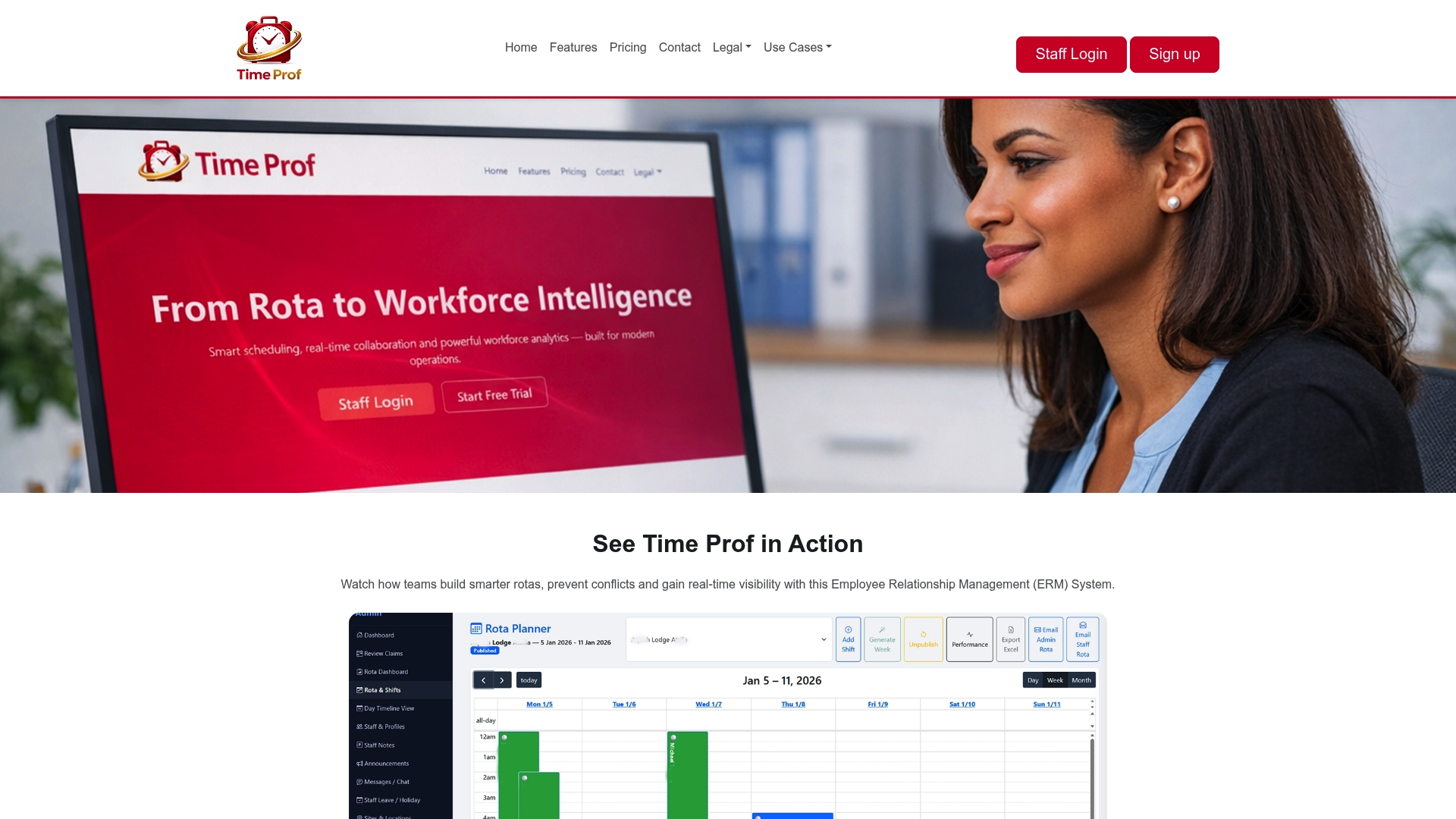
Beyond scheduling, you get geofenced clock-in for accurate exposure data, audit-ready compliance reports for when HSE or an internal review asks how you assessed fatigue risk, and a mobile-first staff portal so reporting a concern or picking up an open shift doesn’t depend on catching a supervisor in the corridor. For care, security, hospitality, cleaning, and retail teams juggling multi-site rotas, that combination replaces several disconnected tools with one system everyone can actually see.
If you’re ready to pilot fatigue-aware scheduling on one site before rolling it out further, get started with Time Prof and see what a rule-based rota looks like against your current shift patterns.
Sources
The guidance behind this article comes from established occupational health and safety research, not opinion. Worth bookmarking for your own fatigue management policy work:
- Working Time Society consensus statements: multi-level approach to managing sleep-related fatigue
- HSE HSG256: Managing shift work