16 Day Pilot to Test a 4 on 4 off Rota for Managers
Managers: run a 16 day pilot of a 4 on 4 off rota, use templates and fatigue checks, and budget for a 42 hour weekly average.

The 4 on 4 off rota puts staff through four consecutive shifts, usually 12 hours each, followed by four days off, repeating on an eight-day cycle. It suits organisations that need round-the-clock cover but can’t stretch to four full teams. The trade-off is simple: long, predictable blocks and generous rest against the fatigue risk of 12-hour shifts and weekly hours that shift from cycle to cycle.
TL;DR:
- Four consecutive 12-hour shifts in the 4 on 4 off rota lead to an average of around 42 weekly hours, but weekly hours can range from 36 to 48.
- Staff working these shifts face fatigue risks, especially in the last hours, with error rates and absences often increasing on days three and four.
- Implementing a 16-day pilot allows proper assessment of fatigue, staffing adequacy, and staff satisfaction before permanent adoption.
- Larger organizations may prefer alternative patterns like 2-2-3 or DuPont to provide steadier schedules and reduce fatigue.
- Automated scheduling tools and clear handover protocols help minimize disruptions and ensure accurate staffing during the rotation.
Table of Contents
- What is a 4 on 4 off rota? The pattern explained
- Templates, calculators and a sample rota to copy
- Pros and cons of the 4 on 4 off schedule
- How to implement a 4 on 4 off rota without disruption
- Hours, weekly averages and when overtime kicks in
- Health risks and fatigue mitigation on 12-hour blocks
- When 4 on 4 off makes sense, and when it doesn’t
- Plan and monitor your rota with Timeprof
- Sources
- FAQ
What is a 4 on 4 off rota? The pattern explained
The standard notation is DDDD, meaning four day shifts followed by four rest days, repeated indefinitely on an eight-day loop. Some operations run DDDDNNNN, splitting the block into two day shifts and two night shifts before the rest period, though this variant carries higher fatigue risk because it forces a circadian flip mid-cycle.
Here’s the pattern laid flat:
- Days 1 to 4: On shift (day or 12-hour block)
- Days 5 to 8: Off
- Cycle repeats every 8 days, with the number of cycles per year varying slightly but typically around 45
The cycle length stays fixed at eight days regardless of shift length, though some employers run 8 or 10-hour shifts instead of 12 to reduce single-shift fatigue. Full 24/7 coverage needs two teams working opposite blocks, so when Team A is on, Team B rests, and vice versa.
| Element | Detail |
|---|---|
| Cycle length | 8 days |
| Typical shift length | 12 hours (8h and 10h variants exist) |
| Teams needed for 24/7 cover | 2 (minimum), 4 for DDDDNNNN split |
| Days on per cycle | 4 |
| Days off per cycle | 4 |
| Cycles per year | ~45 |
A small care home running two 12-hour shifts a day, for instance, needs at least two teams of the right size for peak occupancy. The hours and pay section below walks through the arithmetic for weekly averages and overtime.
Templates, calculators and a sample rota to copy
You don’t need to build a rota from scratch. A ready-made 4-on-4-off Excel template gives you a working structure you can drop your own shift times and staff names into within minutes.
- Download the template and adjust the start/end times to match your operation (06:00 to 18:00 for days, for example).
- Colour-code teams so managers and staff can scan who’s on at a glance.
- Run the numbers through an online calculator to check average weekly and annual hours before you commit.
- Share the visual rota with staff at least one full cycle ahead of go-live.
A labelled 16-day sample makes the pattern click faster than any description:
| Day | 1 | 2 | 3 | 4 | 5 | 6 | 7 | 8 | — | 10 | — | 12 | — | — | — | 16 |
|---|---|---|---|---|---|---|---|---|---|---|---|---|---|---|---|---|
| Team A | D | D | D | D | O | O | O | O | D | D | D | D | O | O | O | O |
| Team B | O | O | O | O | D | D | D | D | O | O | O | O | D | D | D | D |
Some app-store tools, such as staff-facing timesheet apps like Parim, let staff check their upcoming block from their phone. That’s useful for a pilot, but it’s a separate concern from actually generating and adjusting the rota itself.
Pros and cons of the 4 on 4 off schedule
The pattern earns its popularity because it solves a staffing problem cleanly: you only need two teams to cover every hour of the year, and shift blocks are simple enough that most staff can memorise them within a fortnight.
Where it wins:
- Only two teams required for full 24/7 cover, cutting recruitment and training overheads
- Predictable four-day blocks make personal planning easier than irregular rotas
- Four consecutive rest days allow genuine recovery, including time for a short break or family commitments
Where it struggles:
- 12-hour shifts concentrate fatigue, particularly in hours 10 to 12 of a block
- Weekly hours vary between 36 and 48 depending on where the cycle falls, complicating payroll forecasting
- Staff with caring responsibilities or long commutes can find four consecutive long shifts gruelling
Younger, physically robust staff and those without school-age children tend to adapt fastest. Older staff or anyone managing a chronic health condition often find the concentrated four-day block harder to sustain.
Pro Tip: Build a simple fatigue checklist into your handover form. Ask outgoing staff to flag if they felt below par on day three or four. Three flags in a month across the same team is your early signal to review that block’s staffing.
How to implement a 4 on 4 off rota without disruption
Rolling out a new pattern works best as a deliberate trial, not a switch flipped overnight.
- Map team numbers against peak demand. Confirm you have enough qualified staff per shift, not just enough bodies, and check skill mix covers every shift equally.
- Set minimum cover levels for each role, so a single absence doesn’t leave you exposed.
- Run a 16-day pilot, covering two full cycles, before committing long term. This is long enough to see both halves of the rotation and catch problems the first cycle alone might hide.
- Track pilot metrics: overtime hours, short-notice absences, incident reports, and staff satisfaction, all measured against your payroll forecast.
- Write down the rules before day one: break entitlements, how swaps are requested and approved, minimum notice for shift changes, and who staff escalate fatigue concerns to.
- Confirm handover protocol. A written handover template, even a simple one, prevents information falling through the cracks between four-day blocks.
- Plan absence cover separately from your core two teams, whether that’s a bank of relief staff or a formal overtime agreement.
Pro Tip: Treat the pilot’s second cycle as the real test. The first eight days often go smoothly because everyone’s paying close attention; problems tend to surface once the pattern feels routine.
Multiple scheduling guides converge on this same 16-day trial window as the practical minimum before committing to the pattern permanently, which reflects how much a second cycle reveals that the first one hides.
Hours, weekly averages and when overtime kicks in
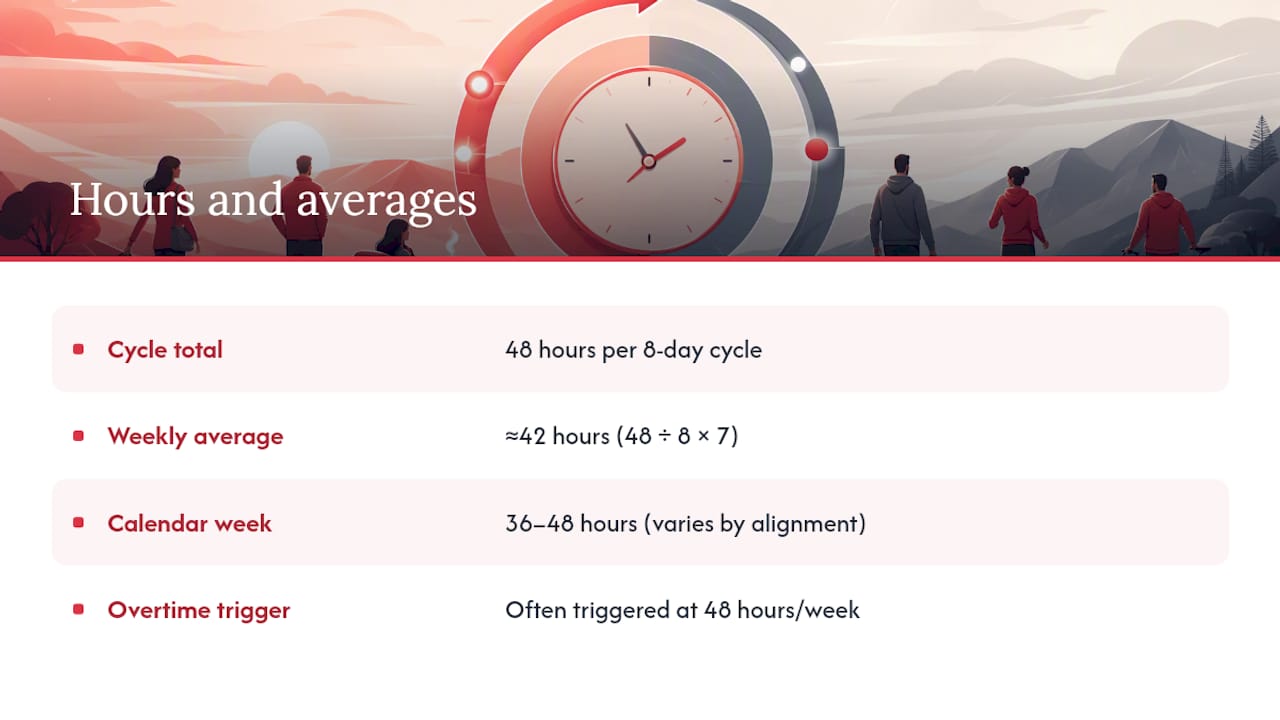
The core arithmetic is straightforward: four 12-hour shifts per eight-day cycle gives you 48 hours worked per cycle. Convert that to a weekly average by dividing by 8 and multiplying by 7: 48 ÷ 8 × 7 gives an average weekly hours figure often cited around 42 hours per week.
That 42-hour average smooths out a lumpier reality: any given week can run anywhere from 36 to 48 hours depending on where the cycle falls against the calendar. This is where payroll queries usually start. The average weekly hours calculation for 12-hour 4-on-4-off shifts settles around 42 hours, but a week containing a full four-day working block will run to 48 hours, which is often where overtime thresholds get triggered.
Before you finalise pay structures, confirm three things with finance: whether overtime is calculated against a weekly or averaged threshold, whether night shifts in a DDDDNNNN variant attract a premium, and how bank holidays falling inside a working block are compensated.
Health risks and fatigue mitigation on 12-hour blocks
Four consecutive 12-hour shifts put real strain on the body’s sleep-wake cycle, and the risk isn’t evenly spread across the block. Fatigue and error rates tend to climb hardest in hours 10 to 12 of a shift, and patterns that flip from day to night mid-cycle (DDDDNNNN) add a circadian disruption on top of that.
Watch for these signals that a rota is running staff too hard:
- A rise in short-notice absences, particularly on day three or four of a block
- Errors or gaps appearing in handover notes
- Increased near-miss or incident reports clustered late in shift blocks
The health and fatigue evidence on 4-on-4-off patterns points to a few practical mitigations: keep staff on fixed day or fixed night blocks where you can, rather than flipping them mid-cycle, encourage consistent sleep routines even on days off, and build a genuine recovery buffer into the first rest day rather than expecting staff to bounce straight back.
Pro Tip: If night shifts are unavoidable, protect the transition day. Staff coming off a night block need their first rest day treated as recovery, not as a day to schedule appointments or family commitments around.

When 4 on 4 off makes sense, and when it doesn’t
Smaller operations that can realistically staff only two teams gain the most from this pattern. It’s the pragmatic choice when headcount is tight and simplicity matters more than perfectly even weekly hours. Larger operations that can staff four teams often move to patterns like 2-2-3 or DuPont, trading staffing efficiency for steadier weekends and gentler fatigue curves. Run the 16-day pilot, and let your own metrics, not a general rule, make that call.
— Michael
Plan and monitor your rota with Timeprof
There are practical alternatives to running a 4-on-4-off pilot on spreadsheets and group chats. Rule-based rota planning generates the pattern automatically once you set team numbers and shift lengths, while clock-in and attendance tracking capture the real hours worked against what you forecast, not just what the rota says on paper.

During a 16-day pilot, the platform’s reports flag overtime creep, short-notice absences and fatigue signals as they happen, rather than after payroll’s already run. Shift claims and open shift tools also cover gaps without a manager fielding phone calls, and automated scheduling cuts the manual admin that eats a scheduler’s week. If your team’s admin overhead is already stretched thin, workflow tools like AmmarAI’s productivity guides cover similar ground for automating repetitive tasks. Start a free trial or book a demo to see how your own pilot cycle would look on the platform.
Sources
- 4-on-4-off Shift Pattern — Hours, Health Risks & Pay Guide (UK) | OffShift
- 4 On 4 Off Schedule: Honest Pros, Cons, And Real Examples
- 4-on-4-off Shift Schedule Template in Ms Excel - Free Download - XLS Download
FAQ
Is 4 on 4 off a good shift pattern?
It’s a strong fit for smaller 24/7 operations needing simple, predictable cover with only two teams, though the concentrated fatigue of four consecutive 12-hour shifts means it suits some staff far better than others.
How many weekends do you get off working 4 on 4 off?
Because the eight-day cycle doesn’t align with the seven-day week, weekends off shift progressively, so most staff get roughly one full weekend off every few cycles rather than every week.
How much does a 4-on-4-off shift pattern pay?
Pay depends entirely on the employer’s base rate and overtime rules, but budgeting should assume an average of 42 hours a week, with individual weeks running as high as 48 hours when overtime thresholds may apply.
How do you calculate a 4 on 4 off shift?
Multiply four shifts by the shift length to get hours per cycle (4 × 12h = 48 hours), divide by the 8-day cycle, then multiply by 7 to get the average weekly figure of 42 hours.