How skills matching improves care quality: a manager's guide
Discover how skills matching improves care quality. Align staff expertise with patient needs and enhance outcomes in your care service.

Aligning staff skills to patient and service-user need measurably improves care quality and reduces harm. The evidence is unambiguous: wrong skill mix kills people, and right skill mix saves them. If you manage a care service and have not yet mapped your workforce’s competencies against your current demand profile, that is your first action. A one-page skills-to-demand check, a rota audit, or a simple competency matrix will tell you more in an afternoon than months of incident reviews. Three levers produce the fastest gains:
- Skills mapping: document who can do what, at what level, across every shift and site.
- Rostering adjustments: use that map to ensure every shift carries the minimum required skill mix, not just the minimum headcount.
- Targeted CPD: close the gaps you find with training that is specific to the risks your service carries, not generic mandatory modules.
Table of Contents
- What does the evidence say about skills matching and care outcomes?
- How does skills alignment actually produce better care?
- How to align skills to care needs in your service
- What should you measure to prove impact?
- What are the common barriers and how do you get past them?
- Skills matching in practice: what good looks like
- Key takeaways
- A practical perspective on making skills matching stick
- Timeprof: workforce intelligence built for skills-aware care
- Useful sources and further reading
What does the evidence say about skills matching and care outcomes?
The research linking skill mix to patient outcomes is among the most consistent in health services literature. A cross-sectional BMJ Quality & Safety study found that each 10 percentage point reduction in the proportion of professional nurses was associated with an 11% increase in the odds of patient death. Substituting one nurse assistant for a professional nurse per 25 patients was linked to a 21% increase in mortality odds. These are not marginal effects.
More recently, a 2026 Nature study on data-driven provider–patient matching found that matched patients improved faster, were more likely to achieve reliable change, and that matching reduced cost per recovery. The study focused on mental health services, but the principle generalises well: when the person delivering care has the right skills for the specific need in front of them, outcomes improve.
UK sector data reinforces this. Sector analysis consistently links higher training levels and clearer CPD pathways with improved CQC inspection outcomes. The GOV.UK workforce policy framework frames capability development as central to delivering high-quality, compassionate care, not as an optional enhancement. Skills for Care data consistently shows that services with higher qualification levels and structured training programmes outperform on quality indicators.
| Evidence source | Finding | Relevance to managers |
|---|---|---|
| BMJ Quality & Safety | Reduction in professional nurse proportion linked to higher mortality odds | Skill mix decisions carry direct patient safety consequences |
| Nature (2026) | Data-driven matching reduced cost per recovery; patients improved 8.5% faster | Matching produces measurable efficiency and outcome gains |
| Emcare / sector data | Higher training levels correlate with improved CQC inspection ratings | CPD investment shows up in regulatory performance |
| GOV.UK policy | Workforce capability development is central to quality improvement | Skills strategy is a regulatory expectation, not optional |
Where gaps remain: most studies focus on acute or mental health settings. Evidence in domiciliary care and supported living is thinner, though the directional findings are consistent. Managers in those settings should treat the acute evidence as a floor, not a ceiling.
How does skills alignment actually produce better care?
Understanding the mechanisms matters because it tells you where to intervene. Skills alignment does not improve care through a single pathway; it works through at least three distinct routes.
Clinical mechanisms
A staff member with the right competency for a specific task assesses accurately, intervenes promptly, and makes fewer errors. This is not about intelligence or effort; it is about having the right mental model for the situation. A care worker trained in dysphagia management will spot a risk that an equally diligent but untrained colleague will miss. The BMJ evidence on nurse staffing and mortality reflects exactly this: professional nurses carry clinical decision-making capacity that healthcare assistants, however capable, are not trained to replicate. Reducing that capacity in the skill mix does not just slow things down; it removes a layer of clinical judgement entirely.
Communication, empathy, and teamworking sit alongside clinical competence. Sector commentary consistently identifies these soft skills as central to patient experience and safety, particularly in social care settings where therapeutic relationships drive outcomes as much as clinical procedures do.
Workforce mechanisms
Person–job fit is the psychological mechanism behind much of the performance gain from better matching. When a staff member’s skills match the demands of their role, they experience greater confidence, make fewer errors under pressure, and report lower burnout. Visible skills data also improves internal mobility: when managers can see who has what capability, they can redeploy people to where they are most effective rather than defaulting to whoever is available. That shift from availability-based to competency-based rostering is where the operational gains compound.
Operational mechanisms
Better task allocation, smoother handovers, and consistent rostering all follow from a clear skills picture. When a shift is built around competency requirements rather than just numbers, handover quality improves because the incoming team has the right people for the work ahead. Variation in care delivery drops. Incident rates tend to fall. These are the metrics that show up in CQC inspections.

Pro Tip: When assessing person–job fit, use competency descriptors rather than job titles alone. A “senior carer” in one organisation may hold very different capabilities from a “senior carer” in another. Descriptors that specify what a person can actually do, at what level, and in what context, give you a far more accurate picture of your real skill mix.
How to align skills to care needs in your service
This is a five-step process. The timeline below is realistic for a single-site or small multi-site service; larger organisations will need to phase it across directorates or regions.
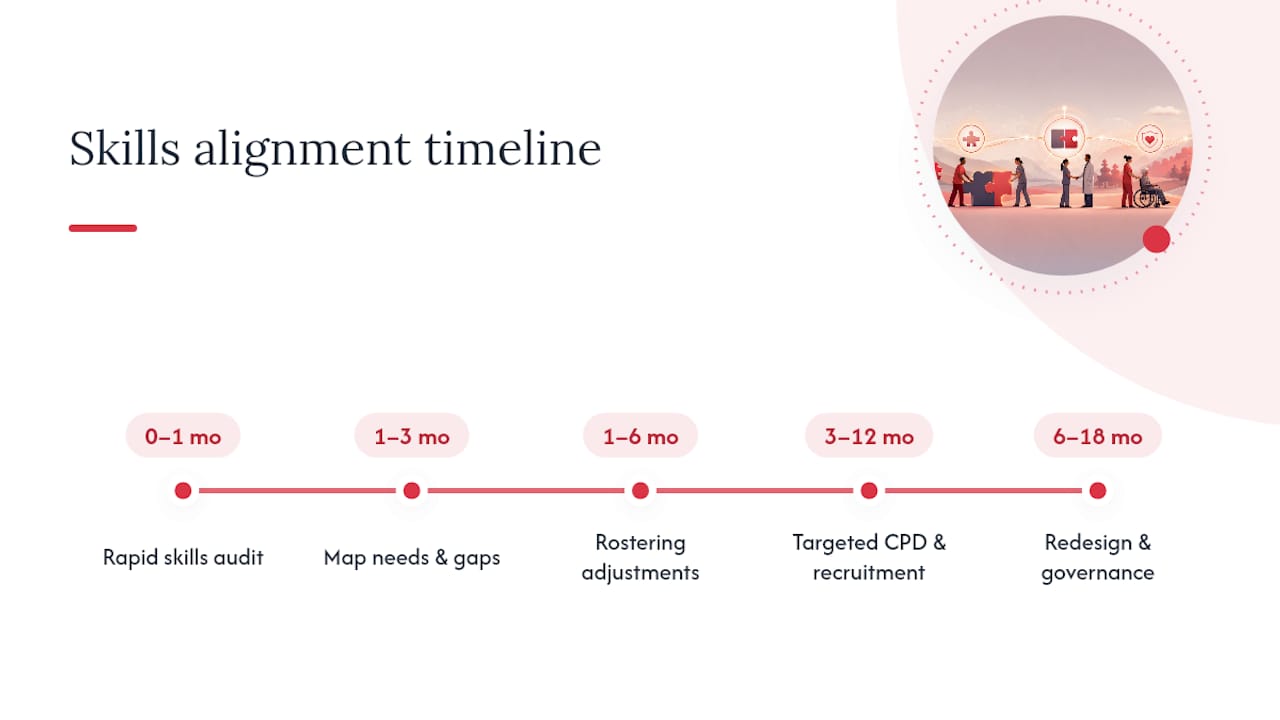
Step 1: rapid skills audit (0–30 days)
Build a competency matrix: list every role, then list the competencies required for that role, and map each staff member’s current verified level. Include both clinical and non-clinical competencies. Do not rely on job titles or contract types alone. A spreadsheet works for a small team; a workforce platform works better at scale. NHS England’s NQB guidance sets out a clear framework for this, including how to embed clinical oversight into the process.
Step 2: map care needs and identify gaps (0–30 days)
Review your current demand profile: which shifts carry the highest clinical risk? Which service-user needs require specific competencies? Where does your rota currently leave those needs uncovered? Cross-reference your competency matrix with your shift patterns to identify critical gaps, not just general shortfalls.
Step 3: short-term rostering adjustments (30–90 days)
Adjust shift composition to ensure minimum required skill mix on every shift, prioritising high-risk periods. Use internal pools and flexible deployment before reaching for agency cover. Skills-aware rostering reduces both the frequency and the cost of skill-mix failures.
Step 4: targeted CPD and recruitment (1–6 months)
Close the gaps you cannot fill through redeployment. Prioritise training for high-risk competency gaps first. The new Skills for Care workforce strategy emphasises clearer career pathways and role quality as the mechanism for sustainable capability building. Apprenticeships and funded training routes are available for many social care competencies; use them.
Step 5: workforce redesign and governance (6–18 months)
Embed skills matching into your governance cycle: include skill-mix ratios in your quality reporting, review competency matrices at appraisal, and link CPD planning to your service risk register. This is where short-term wins become systemic change.
Suggested timeline:
- 0–30 days: Complete skills audit, build competency matrix, identify top three critical gaps.
- 30–90 days: Adjust rostering for skill mix, begin targeted CPD for priority gaps, pilot skills-aware shift claims.
- 1–6 months: Full CPD programme running, recruitment plan addressing structural gaps, skills data visible on the rota.
- 6–18 months: Skills matching embedded in governance, appraisal, and quality reporting cycles.
Manager’s checklist:
- Competency matrix built and verified for all roles
- Demand profile mapped against shift patterns
- Critical skill-mix gaps identified and prioritised
- Rostering adjusted to reflect minimum skill-mix requirements
- CPD plan linked to gap analysis, not generic training calendar
- Skills data visible to shift managers in real time
- Skill-mix ratios included in monthly quality reporting
Pro Tip: Soft skills belong in your competency matrix. Communication, safeguarding awareness, and person-centred care are not assumed; they are competencies that vary across your workforce and that carry real risk when absent. Include them explicitly.
What should you measure to prove impact?
Measurement is where most skills-matching initiatives stall. Managers do the audit, adjust the rota, and then have no way to demonstrate that anything changed. The fix is to agree your KPIs before you start, not after.
Priority metrics for UK providers:
- Incident rates: medication errors, falls, safeguarding concerns. These are the most direct signal of skill-mix failure.
- CQC-relevant metrics: staff training completion rates, supervision frequency, competency assessment records.
- Staff retention and sickness absence: both improve when people are deployed in roles that match their skills.
- Shift fill rates and skill-mix ratios: the proportion of shifts filled with the required skill mix, not just the required headcount.
- Patient or service-user outcomes: where measurable, recovery speed, length of stay, or goal attainment scores.
| KPI | Why it matters | Review frequency |
|---|---|---|
| Incident rate by shift | Directly reflects skill-mix adequacy | Weekly |
| CQC training compliance | Regulatory requirement and quality proxy | Monthly |
| Staff sickness absence | Signals burnout and poor person–job fit | Monthly |
| Shift skill-mix fill rate | Measures whether matching is working operationally | Weekly |
| Service-user outcome scores | Ultimate measure of care quality improvement | Quarterly |
Data sources you already have: incident reporting systems, HR records, rostering data, supervision logs, and local audit. The challenge is usually not data availability but data integration. Workforce management reports that pull from rostering, attendance, and skills data simultaneously give you a far clearer picture than manual cross-referencing.
Monthly measurement template (adapt for your service):
- Pull incident rate for the period; compare to previous month and to skill-mix fill rate.
- Check CQC training compliance percentage; flag any staff below threshold.
- Review sickness absence rate; identify any pattern by shift or role.
- Calculate skill-mix fill rate for the period; identify shifts where minimum mix was not met and why.
- Review any service-user outcome data available; note trends.
- Report findings to quality lead or board with a one-paragraph narrative on what changed and why.
What are the common barriers and how do you get past them?
Workforce shortages, fragmented systems, and limited training budgets are the three barriers that derail most skills-matching initiatives in UK care. None of them is insurmountable, but each needs a specific response.
- Workforce shortages: prioritise matching for high-risk roles and shifts first. You cannot solve a vacancy crisis through skills matching, but you can ensure that the staff you do have are deployed where their skills matter most.
- Fragmented rostering systems: skills data held in spreadsheets, training records in a separate system, and rotas built in a third tool means managers cannot see the full picture. Workforce transparency requires a single, integrated view of skills, availability, and demand.
- Limited training budgets: use the Skills for Care funded routes, apprenticeship levy, and integrated care system (ICS) workforce development funding before reaching for discretionary budget. The Skills for Care workforce strategy identifies funded pathways specifically designed for adult social care capability building.
- Resistance to change: staff who have been rostered by availability for years will be sceptical of a competency-based approach. The fastest way to reduce resistance is to make the benefits visible to them, not just to managers. When staff can see their own skills profile, claim shifts that match their competencies, and access CPD that builds on their existing strengths, engagement follows.
- Data silos: training records, HR data, and rostering data rarely talk to each other in legacy systems. This is a technology problem with a technology solution, but it requires a governance decision to consolidate.
| Barrier | Impact | Mitigation |
|---|---|---|
| Workforce shortages | Skill-mix gaps on high-risk shifts | Prioritise matching for highest-risk roles; use internal pools |
| Fragmented systems | Managers cannot see skills and availability together | Consolidate to a single workforce platform |
| Limited training budget | CPD gaps persist | Use funded routes (Skills for Care, apprenticeships, ICS funding) |
| Resistance to change | Slow adoption, workarounds | Appoint clinical champions; make skills visible to staff |
| Data silos | Incomplete skills picture | Governance decision to integrate HR, training, and rostering data |
Pro Tip: Identify one or two clinical champions early, ideally respected senior practitioners rather than managers. When a charge nurse or experienced care coordinator advocates for skills-aware rostering in a team meeting, adoption accelerates faster than any top-down mandate.
Skills matching in practice: what good looks like
That pattern, standardising skills data, making it visible at the point of rostering, and shifting from availability-based to competency-based shift filling, is the common thread in services that have successfully reduced clinical variation. The Physician Leaders governance model describes how shared dashboards and standardised interdisciplinary rounds reduced length of stay and improved discharge rates when applied systemically, not just at individual site level.
In practice, the transition typically follows three phases. First, skills data is centralised and verified, often revealing that the organisation’s actual competency picture is significantly different from what job titles suggest. Second, rostering is adjusted to enforce minimum skill-mix requirements, which initially creates friction as managers discover gaps they had previously papered over with goodwill and overtime. Third, CPD is redirected toward the specific gaps the data reveals, rather than the generic mandatory training calendar.
The metrics that tend to move first are operational: shift fill rates improve, agency spend drops, and skill-mix compliance on high-risk shifts increases. Clinical metrics, incident rates, CQC compliance scores, and service-user outcome measures, follow within two to three quarters.
| Phase | Primary metric | Typical timeframe |
|---|---|---|
| Skills data standardised | Competency matrix completeness | 0–30 days |
| Rostering adjusted for skill mix | Skill-mix fill rate on high-risk shifts | 30–90 days |
| CPD redirected to gap analysis | Training completion on priority competencies | 1–6 months |
| Clinical metrics improve | Incident rate, CQC compliance, outcomes | 2–4 quarters |
Three lessons other organisations can replicate:
- Standardise competency descriptors before you build the rota. Job titles are not competencies.
- Make skills data visible to shift managers at the point of rostering, not in a separate HR system they have to log into separately.
- Measure the operational metrics first; they move faster and build the internal case for continuing the investment.
Key takeaways
Skills matching improves care quality by ensuring the right competencies are present at the point of care, reducing errors, improving outcomes, and producing measurable gains in CQC performance and staff retention.
| Point | Details |
|---|---|
| Skill mix carries mortality risk | Each 10pp reduction in professional nurse proportion is linked to an 11% increase in mortality odds (BMJ). |
| Data-driven matching improves outcomes | Matched patients improved faster, and matching reduced cost per recovery (Nature, 2026). |
| Start with a competency matrix | Map who can do what before adjusting rosters; job titles alone give an inaccurate skills picture. |
| Measure operational metrics first | Shift fill rates and incident rates move within weeks; clinical outcome metrics follow within quarters. |
| Timeprof supports the full cycle | Timeprof’s skills register, competency-tagged shifts, and real-time dashboards operationalise skills matching from audit to governance. |
A practical perspective on making skills matching stick
The biggest implementation failure I see is not a lack of evidence or intent. It is the gap between the skills audit and the rota. Organisations complete a thorough competency mapping exercise, file it in a shared drive, and then continue rostering exactly as before because the skills data is not visible at the point where shift decisions are made. The audit becomes a compliance document rather than an operational tool.
The non-obvious fix: embed skills auditing into shift handover practice. When the outgoing shift lead notes a competency gap as part of the handover, it becomes a live operational signal rather than an annual HR exercise. That small change, making skills visibility a daily habit rather than a quarterly event, is what separates services that sustain improvement from those that plateau after the initial audit.
For supporting templates, competency frameworks, and further reading on workforce intelligence in care, the Timeprof workforce management blog carries practical guides for UK managers across care, healthcare, and related sectors.
Timeprof: workforce intelligence built for skills-aware care
Fewer rostering errors, a single source of truth for skills and availability, and audit-ready compliance reporting: these are the operational gains care managers report when they move from spreadsheets and disconnected systems to Timeprof.
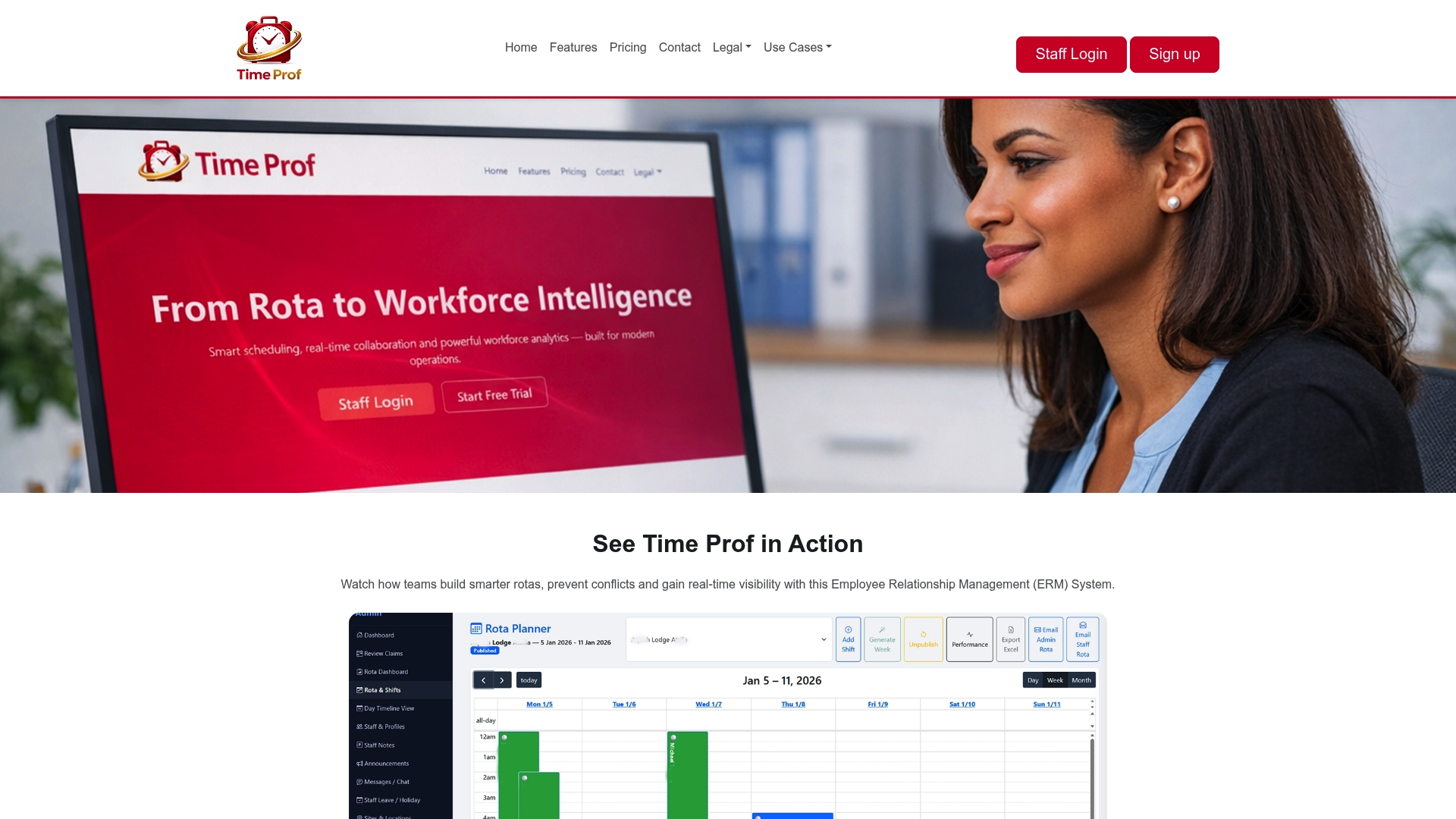
Timeprof directly supports every stage of the implementation roadmap above. The platform holds a centralised skills register linked to the rota, so shift managers see only eligible staff when filling competency-tagged shifts. Open shifts can be claimed by staff whose skills match the requirements; managers do not have to cross-reference a separate training spreadsheet. Real-time dashboards give multi-site visibility of skill-mix compliance, attendance, and shift fill rates. Audit logs, role-based access, and two-factor authentication meet CQC governance requirements without additional administration.
For services moving from manual rostering to skills-aware scheduling, Timeprof replaces the fragmented combination of spreadsheets, phone calls, and disconnected HR records with one platform that managers and staff can use from any device. The result is less time spent on administration and more confidence that every shift carries the right skills for the work ahead.
Book a demo or start a free trial at timeprof.co.uk to see how the platform supports skills matching in your service.
Useful sources and further reading
- RN staffing and patient outcomes: cross‑sectional study (BMJ Quality & Safety)
- Data‑driven provider–patient matching study (Nature, 2026)
- How to ensure the right people, with the right skills, are in post (NHS England / NQB guidance)
- Delivering high quality, effective, compassionate care (GOV.UK publication)
- How training leads to improved care‑quality ratings (Emcare)
- New Skills for Care workforce strategy (Care Management Matters)
- Operational alignment and clinical variation reduction (Physician Leaders / PLJ)