Types of workforce management reports: 2026 guide
Discover the types of workforce management reports and learn how they enhance decision-making on staffing and productivity for 2026.

Types of workforce management reports: 2026 guide
Workforce management reports are structured data outputs that convert raw workforce metrics into management information used to drive decisions on staffing, productivity, and cost. The four industry-standard report categories are summary, operational, exception, and ad hoc reports. Each serves a distinct function, from high-level leadership overviews to targeted investigations of specific anomalies. Platforms like Timeprof bring these reports together in one place, giving managers real-time visibility without the manual effort of pulling data from disconnected systems.
1. Types of workforce management reports: the four core categories
Every reporting framework for workforce management starts with four foundational types. Understanding what each one does prevents you from building reports that nobody reads or that answer the wrong question.
Summary reports consolidate key workforce metrics into a single view for leadership. They cover headcount, attendance rates, labour costs, and shift coverage across a defined period. A weekly summary report, for example, gives a site director a snapshot of whether the operation ran to plan without requiring them to dig into raw data.

Operational reports track day-to-day workforce activity in real time or near real time. They cover attendance, shift allocation, task completion, and schedule adherence. Operational reporting helps frontline teams and first-line managers spot issues and maintain productivity before small problems become costly ones.
Exception reports surface deviations from expected performance. They flag unusual absenteeism, overtime spikes, or missed clock-ins. Exception reports allow fast escalation and proactive management of workforce anomalies, which is why they are the most time-sensitive category.
Ad hoc reports are custom queries built for specific questions not covered by standard reports. A manager investigating why one site consistently runs short-staffed on Fridays would commission an ad hoc report pulling shift claims, availability data, and historical attendance for that day only.
Pro Tip: Before building any report, write down the decision it supports. If you cannot name a specific decision, the report will not get used.
2. Summary reports: the leadership view
Summary reports are the most widely used format in management information systems. They aggregate data across teams, sites, or time periods to give decision-makers a concise picture of workforce performance.
A well-designed summary report covers four areas: total hours worked versus contracted hours, absence rates, labour cost against budget, and shift fill rates. Each metric should appear alongside a target or benchmark so the reader knows immediately whether performance is on track.
Managerial reports segmented by audience, such as executive, financial, or operational views, perform better at driving decisions than generic all-in-one dashboards. A finance director needs cost variance data. An operations manager needs shift coverage rates. Giving both the same report wastes their time.
3. Operational workforce reporting: daily management in practice
Operational workforce reporting is defined as the practice of tracking daily workforce activities to support real-time management decisions. It differs from strategic reporting in one key way: the data is used today, not next quarter.
Typical data points in an operational report include:
- Attendance and clock-in status by site and shift
- Schedule adherence rates for individual staff members
- Open shifts and whether they have been claimed
- Task completion rates linked to specific shifts
- Real-time headcount against planned staffing levels
Real-time workforce control depends on operational reports being accurate and current. A report showing yesterday’s attendance figures is useful for trend analysis but useless for a manager deciding whether to call in cover at 7:00 AM.
Pro Tip: Set operational reports to refresh automatically at the start of each shift. Manual refreshes introduce delays that undermine the entire point of real-time visibility.
The best operational reports are narrow in scope. They answer one question per view: who is in, who is absent, and where are the gaps. Managers who try to read ten metrics at once end up reading none of them carefully.
4. Exception reports: catching problems before they escalate
Exception reports are the most underused category in workforce analytics reporting, yet they deliver some of the highest value per minute of management attention. They work by comparing actual performance against a defined threshold and surfacing only the records that fall outside it.
Common exceptions worth tracking include:
- Absenteeism rates above a set threshold for a rolling period
- Overtime hours exceeding contracted limits
- Shifts with no clock-in recorded within 15 minutes of the start time
- Staff working across sites without the required skills or clearances
- Consecutive late arrivals by the same individual
The power of exception reporting lies in what it removes. A manager overseeing 200 staff does not need to read 200 attendance records. They need to see the six records that require action. Exception reports surface deviations from normal performance, which is precisely what makes them indispensable for organisations managing large or dispersed workforces.
Timeprof generates exception-style alerts automatically, notifying managers when a clock-in is missed or when a shift is uncovered, without requiring manual checks across multiple spreadsheets.
5. Ad hoc reports: targeted analysis for specific questions
Ad hoc reports are customised investigations created for specific business questions that standard reports do not answer. They are built once, used once or a few times, and then retired.
The most common triggers for an ad hoc report include a sudden spike in absence on a particular shift pattern, a client complaint about service levels at a specific site, or a request from HR to understand turnover patterns in one department. Each of these requires pulling data that does not appear in any standard report.
The risk with ad hoc reporting is scope creep. A question that starts as “why did overtime spike in March?” can expand into a six-week analysis project if the boundaries are not set upfront. Define the question, the time period, and the data sources before building the report. That discipline keeps ad hoc work useful rather than endless.
6. Workforce analytics reporting domains: extending your data range
Modern workforce reporting platforms cover up to 21 separate data domains, replacing manual spreadsheet analyses with automated formatted tables and charts. Understanding which domains exist helps managers ask better questions of their data.
| Data domain | Example metrics |
|---|---|
| People | Headcount, compensation, contract type, tenure |
| Time and attendance | Overtime hours, shift coverage, lateness frequency |
| Talent and performance | Appraisal scores, skills gaps, training completion |
| Recruiting | Time to fill, pipeline volume, offer acceptance rates |
| Operations | Task completion, service desk tickets, workflow throughput |
The People domain gives HR and finance a shared view of headcount and cost. The Time and Attendance domain is where operational managers spend most of their time, tracking shift coverage and scheduling errors that affect service delivery. Talent and recruiting data connects performance management to workforce planning, showing whether the pipeline supports future capacity needs.
Automation across these domains removes the manual effort of pulling figures from separate systems. Managers get consistent data in a consistent format, which makes trend analysis far more reliable.
7. Employee performance reports: connecting individual output to operational results
Employee performance reports sit at the intersection of HR data and operational data. They track individual output, attendance patterns, task completion, and skill utilisation against defined targets.
The most useful performance reports are built around recurring decisions, not one-off curiosity. A monthly performance report that feeds directly into a line manager’s one-to-one conversation has clear purpose. A quarterly report that sits in a shared folder and is never discussed has none. Recurring, decision-driven reports improve repeatability and reduce data overload, which is the single biggest reason reporting programmes fail.
Performance data becomes significantly more useful when it is connected to operational context. A staff member with a low task completion rate looks like a performance problem in isolation. The same data alongside shift length, site conditions, and team size tells a different story.
8. Labour cost and staffing efficiency reports
Labour cost reports track actual spend against budget across shifts, sites, and departments. They are the primary tool for finance teams and operations managers to identify where the workforce is costing more than planned.
Staffing efficiency analysis goes one step further by comparing labour input to output. A site running at 110% of its planned hours but delivering 90% of its target throughput has an efficiency problem that a cost report alone would not reveal. Combining cost data with output data gives managers the full picture.
Workforce intelligence focuses on real-time operational visibility rather than long-term strategic analytics. That distinction matters for labour cost reporting: a report showing last month’s overspend is useful for budgeting, but a report showing this week’s projected overspend gives managers time to act.
Timeprof’s clocking and attendance data feeds directly into cost and efficiency analysis, giving managers accurate hours worked without relying on manual timesheets.
Key takeaways
Effective workforce management reporting requires matching the right report type to the right decision, using consistent data definitions, and reviewing reports regularly to keep them aligned with operational needs.
| Point | Details |
|---|---|
| Four core report types | Summary, operational, exception, and ad hoc reports each serve a distinct management purpose. |
| Operational reports need real-time data | Reports based on yesterday’s figures cannot support decisions made at the start of today’s shift. |
| Exception reports filter the noise | Managers of large teams should use exception reports to see only the records that require action. |
| Define metrics before building reports | Agreeing on what “active employee” means before designing a report prevents conflicting figures later. |
| Segment reports by audience | Executive, financial, and operational views each need different metrics to drive the right decisions. |
Why most reporting programmes fail before they start
The most common mistake I see is building reports before defining the decisions they support. Teams spend weeks designing dashboards, then discover that nobody uses them because the data does not map to any real management question. The report looks impressive. It changes nothing.
The fix is unglamorous but effective. Define your metric inputs before you touch the layout. Agree on what counts as an “active employee,” what qualifies as an absence, and which sites are included in each report. Without that foundation, teams argue about the numbers instead of acting on them.
Start with three recurring reports tied to decisions that happen every week. A shift coverage report for Monday morning. An exception report for the payroll run. A summary report for the weekly operations review. Integrating one operational data source with your existing HR system can shift the quality of internal conversations within 90 days. That is a faster return than any dashboard project I have seen.
The final thing I would stress is review cadence. Reports go stale. The metrics that mattered when you launched a reporting programme may not be the ones that matter after a restructure or a new contract. Build a quarterly review into your reporting governance from day one. The organisations that do this consistently get more value from their data than those running on reports designed three years ago.
— Michael
Timeprof and your workforce reporting needs
Timeprof brings together rota management, real-time attendance tracking, and operational reporting in one platform, removing the need to pull data from separate systems before you can answer a basic management question.
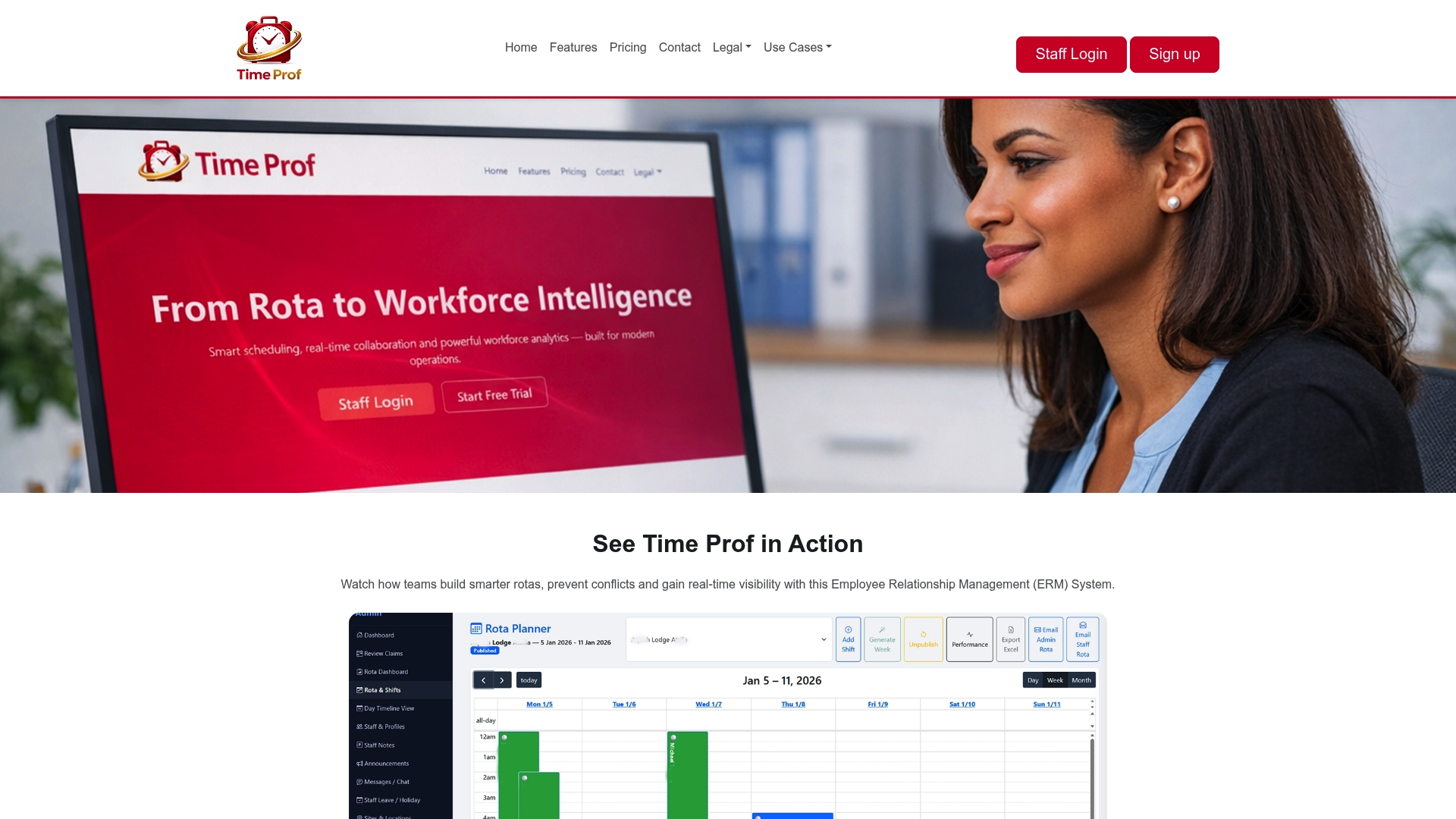
The platform generates attendance, shift coverage, and exception reports automatically, with consistent data definitions applied across every site and every report. Managers get the workforce data insights they need without building spreadsheets from scratch each week. Whether you manage a single site or a complex multi-site operation, Timeprof gives you the reporting foundation to make faster, better-informed decisions about your people and your operations.
FAQ
What are the main types of workforce management reports?
The four standard types are summary, operational, exception, and ad hoc reports. Each serves a different management purpose, from high-level overviews to targeted anomaly detection.
What is operational workforce reporting?
Operational workforce reporting tracks daily workforce activities such as attendance, shift allocation, and task completion. It supports real-time decisions by frontline managers rather than long-term strategic planning.
How do exception reports differ from standard workforce reports?
Exception reports show only the records that fall outside a defined threshold, such as overtime limits or absence rates. Standard reports show all data; exception reports filter it to what requires action.
How many data domains can modern workforce reporting platforms cover?
Modern platforms can cover up to 21 separate data domains, including People, Time and Attendance, Talent, Recruiting, and Operations, replacing manual spreadsheet analysis with automated outputs.
How should managers start building a workforce reporting programme?
Start with three recurring reports tied to weekly decisions, agree on metric definitions before designing any layout, and review the programme quarterly to keep reports aligned with current operational needs.