What is carer wellbeing in scheduling: a manager's guide
Understand what is carer wellbeing in scheduling. Discover how effective rota design can enhance worker health and care quality.

Carer wellbeing in scheduling means designing rotas so that shift patterns actively protect the physical and mental health of paid care workers, not merely fill gaps in cover. It sits at the intersection of fatigue management, fairness, and legal compliance. Get it wrong and you pay in sickness absence, high turnover, and care quality failures. Get it right and you have a more stable, safer workforce.
Three things you can do before the end of today:
- Check for backward-rotating shifts (night → late → early) in next week’s rota and swap at least one to a forward-rotating pattern.
- Count consecutive shifts above three for any single carer and flag anyone on four or more without a rest day.
- Pull last month’s shift-decline rate — if more than one in five shifts was declined or swapped at short notice, your rota is already under strain.
Rota design is not an administrative afterthought. A single scheduling decision — a backward rotation, a fourth consecutive night, a shift posted with less than 24 hours’ notice — can trigger a chain of fatigue, stress, and error that costs far more to fix than it would have cost to prevent.
Table of Contents
- Why does scheduling drive carer wellbeing, safety, and retention?
- What principles should every wellbeing-focused rota respect?
- Practical scheduling measures you can trial this week
- How do you measure whether rotas are protecting carer wellbeing?
- What UK legal requirements affect your rota design?
- Which technology features actually support wellbeing-focused rostering?
- How do you run a wellbeing-focused scheduling pilot at one site?
- Key takeaways
- What good rostering actually looks like in practice
- Timeprof puts wellbeing rules at the centre of your rota
- Useful sources and further reading
Why does scheduling drive carer wellbeing, safety, and retention?
The causal pathways are short and direct. Fatigue impairs judgement and reaction time; short-notice changes spike stress hormones and erode trust; an unfair distribution of nights and weekends breeds resentment that eventually becomes a resignation letter.
Research confirms the pattern: a participatory AI-driven scheduling study found that reducing backward-rotating shifts produced objectively longer N3 and REM sleep for geriatric caregivers. Better sleep is not a perk — it is a direct safety input.
From an operational standpoint, the costs land on your desk as overtime bills, agency spend, and inspection risk. A systematic review of organisational interventions in elderly care found that flexible scheduling and task modification showed the clearest evidence of reducing burnout where applied, yet such interventions remain rare. That gap is an opportunity for any manager willing to treat the rota as a structural health intervention rather than a logistics puzzle.
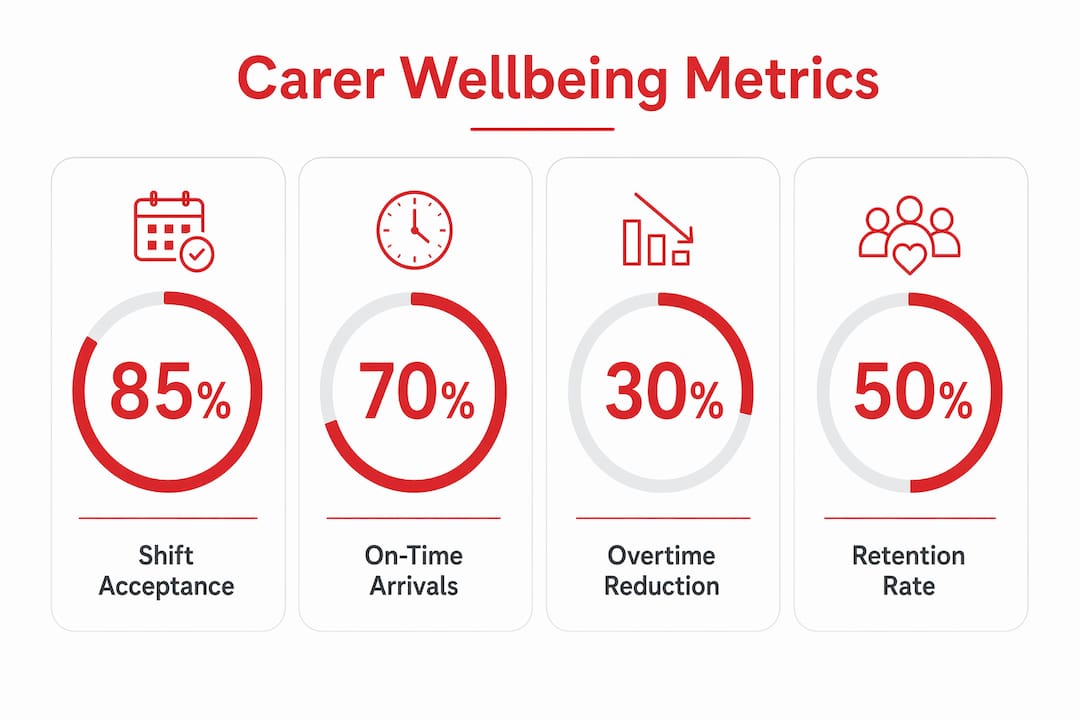
The importance of carer wellbeing also shows up in retention data. Carers who feel their schedule is unpredictable or unfair leave. Replacing a single care worker costs time, recruitment fees, and weeks of reduced service quality — all avoidable with better rota design.

What principles should every wellbeing-focused rota respect?
Six principles form a practical framework. Apply them in order of urgency.
- Worktime control. Give carers meaningful input into their hours within operational constraints. Research links participatory scheduling to better health outcomes. This does not mean unlimited choice — it means carers can flag unavailability, claim open shifts, and see their rota at least two weeks ahead.
- Forward rotation only. Shift sequences should move morning → afternoon → night, never the reverse. Backward rotation cuts sleep duration and degrades alertness.
- Limit consecutive high-acuity shifts. No more than three consecutive shifts in a demanding care environment without a rest day. Four or more in a row is where errors cluster.
- Minimum rest between shifts. Eleven hours is the statutory floor under the Working Time Regulations; twelve hours is the wellbeing standard for care work.
- Fair distribution of nights and weekends. Track who carries the unsocial hours burden. Concentrated night allocation is a leading predictor of burnout and resignation.
- Transparent notice periods. Post rotas at least two weeks in advance. Last-minute changes should trigger a formal process, not a WhatsApp message.
Pro Tip: When balancing individual preferences against operational needs, use a tiered open-shift system: post unfilled shifts to carers who have expressed availability first, then to the wider team. This preserves fairness without creating a free-for-all that leaves managers chasing cover at midnight.
Practical scheduling measures you can trial this week
Policy snippets you can copy into your rota policy:
- “No shift change will be posted with less than 24 hours’ notice except in a declared emergency. Emergency changes must be documented with a reason and offered to available staff before agency cover is sought.”
- “A minimum of 11 hours must separate the end of one shift and the start of the next. Twelve hours is the target standard.”
- “Night shifts will be allocated on a rotating basis across all eligible staff. No individual will carry more than 40% of available night shifts in any four-week period.”
Quick operational changes for this week:
Open shifts with priority rules cut last-minute scrambles. Post any unfilled shift to carers who have pre-registered availability before broadcasting to the full team. A short self-rostering pilot — even for one team over four weeks — gives carers worktime control without removing managerial oversight. Apply a hard “no backward rotation” rule in your scheduling tool or flag it manually before publishing.
Do/don’t for shift swaps and last-minute cover:
- Do: require both parties in a swap to meet the minimum rest rule before approving.
- Don’t: approve a swap that puts either carer onto a fourth consecutive shift.
- Do: log every last-minute change with a reason code for your audit trail.
- Don’t: rely on informal messages as the record of a rota change.
How do you measure whether rotas are protecting carer wellbeing?
| KPI | Why it matters | How to measure | Frequency |
|---|---|---|---|
| Sickness absence rate | Early signal of fatigue and stress | Hours lost / hours scheduled | Monthly |
| Staff turnover | Lagging indicator of chronic dissatisfaction | Leavers ÷ average headcount | Quarterly |
| Overtime hours | Reveals chronic understaffing | Overtime hours / total hours | Monthly |
| Shift-decline rate | Shows whether rotas match real availability | Declined shifts ÷ shifts posted | Weekly |
| Last-minute cover requests | Flags rota instability | Count of requests with <24 hrs notice | Weekly |
| Wellbeing survey score | Direct staff self-report | Pulse survey (3–5 questions) | Quarterly |
Sample wellbeing survey questions to deploy now:
- “In the last four weeks, how often did you feel your shift pattern left you enough time to recover?”
- “How much notice did you typically receive before a shift change?”
- “Do you feel the distribution of nights and weekends is fair across your team?”
Track these six KPIs on a simple dashboard. A spike in shift-decline rate or last-minute cover requests is your earliest warning sign — it usually precedes a sickness surge by four to six weeks.
What UK legal requirements affect your rota design?
The Working Time Regulations 1998 set the statutory floor for every rota in England, Scotland, and Wales.
- Maximum working week: 48 hours averaged over a 17-week reference period (workers may opt out in writing, but opt-outs must be documented and voluntary).
- Daily rest: 11 consecutive hours between working days.
- Weekly rest: 24 uninterrupted hours per week, or 48 hours per fortnight.
- Rest breaks: A 20-minute break when a shift exceeds six hours.
- Night workers: Average of no more than eight hours in any 24-hour period; free health assessments must be offered before night work begins and at regular intervals.
- Recordkeeping: Employers must keep records sufficient to demonstrate compliance. Rota changes, opt-out agreements, and night-worker health assessments must all be retained and available for inspection.
Practical compliance checklist:
- Confirm every rota respects the 11-hour daily rest gap before publishing.
- Check that no worker’s average weekly hours exceed 48 unless a signed opt-out is on file.
- Record all rota amendments with a date, reason, and manager sign-off.
- Offer night-worker health assessments and document uptake.
- Retain rota records for at least two years.
Which technology features actually support wellbeing-focused rostering?
| Rostering principle | Feature you need | How Timeprof delivers it |
|---|---|---|
| Worktime control | Mobile staff portal for availability and shift claims | Carers submit availability and claim open shifts via the Timeprof app |
| Fatigue-aware patterns | Rule engine blocking non-compliant shift sequences | Automated rules flag backward rotation and short rest gaps before publishing |
| Fair distribution | Shift-allocation reporting by individual | Audit reports show night and weekend hours per carer across any period |
| Legal compliance | Audit-ready recordkeeping | Timeprof stores rota versions, change logs, and opt-out records for inspection |
| Attendance accuracy | Geofenced clock-in | GPS-verified clock-in prevents buddy-punching and confirms on-site presence |
Mobile scheduling tools remove the friction that causes wellbeing rules to be ignored in practice. When carers can see their rota, flag availability, and claim shifts from a phone, managers spend less time chasing cover and more time managing exceptions. The participatory scheduling study estimated that an app-assisted approach could save roughly one-twelfth of scheduling time compared with manual planning. For care settings running complex multi-site rotas, that saving is material.
Tools that support scheduling for caregiver health by combining time tracking with availability management give managers a clearer picture of who is working, how much, and whether patterns are drifting into risk territory.
How do you run a wellbeing-focused scheduling pilot at one site?
- Week 1 — Stakeholder briefing. Brief team leaders and union or staff representatives on the pilot goals, the six rostering principles, and the KPIs you will track.
- Week 2 — Baseline data. Pull four weeks of historical data on the six KPIs. This is your comparison point.
- Week 2 — Policy changes. Publish the updated rota policy (minimum rest, notice periods, night-shift rotation cap) and confirm it with staff in writing.
- Weeks 3–6 — Live pilot. Apply the new rules to one team or one site. Log every exception and the reason for it.
- Week 6 — Mid-point pulse survey. Run the three wellbeing survey questions. Share anonymised results with the team within one week.
- Week 8 — Evaluation. Compare KPIs against baseline. Use a phased rollout: if sickness absence and shift-decline rates have dropped, extend the model to a second site.
Staff consultation is not optional. The systematic review evidence points clearly to multi-component interventions — rota rules combined with individual support and manager training — as the approach most likely to produce lasting change. Brief line managers on how to apply the rules consistently, and create a simple escalation path for carers who feel the rules are not being followed.
Key takeaways
Wellbeing-focused rostering requires six enforceable rules, five measurable KPIs, and a structured pilot — not a one-off policy document.
| Point | Details |
|---|---|
| Define it clearly | Carer wellbeing in scheduling means designing rotas to protect physical and mental health, not just fill shifts. |
| Apply six rota rules | Forward rotation, minimum 11-hour rest, consecutive shift limits, fair nights, worktime control, and two-week notice. |
| Track six KPIs weekly | Monitor sickness, turnover, overtime, shift-decline rate, last-minute cover requests, and wellbeing survey score for early warning signs. |
| Meet UK legal minimums | Working Time Regulations set the floor: 48-hour week, 11-hour daily rest, night-worker health assessments, and full recordkeeping. |
| Use Timeprof to enforce rules | Timeprof’s rule engine, mobile portal, and audit reporting turn wellbeing principles into automated, inspectable practice. |
What good rostering actually looks like in practice
Most managers who improve their rotas do not overhaul everything at once. The ones who see real results pick one site, apply two or three of the six principles, and measure for eight weeks. A typical pattern: shift-decline rates fall within the first fortnight because carers feel heard. Sickness absence takes longer — usually six to eight weeks before the trend becomes visible in the data.
The harder lesson is managing expectations during the change. Carers who have worked chaotic rotas for years are sceptical. Posting the rota two weeks ahead and actually sticking to it — even once — does more for trust than any policy document. When the mid-point pulse survey comes back and you share the results, even anonymised, that act of transparency compounds the goodwill.
The systematic review is clear that rota changes alone are not enough. Pair them with manager training on consistent rule application and a simple way for carers to raise concerns. The rota is the structural intervention; the culture around it determines whether the rules hold under pressure.
Timeprof puts wellbeing rules at the centre of your rota
Spreadsheets cannot enforce an 11-hour rest gap or flag a backward rotation before it goes live. Timeprof can. The platform’s rule engine blocks non-compliant shift sequences at the point of scheduling, so wellbeing rules are not aspirational — they are built into every rota you publish.
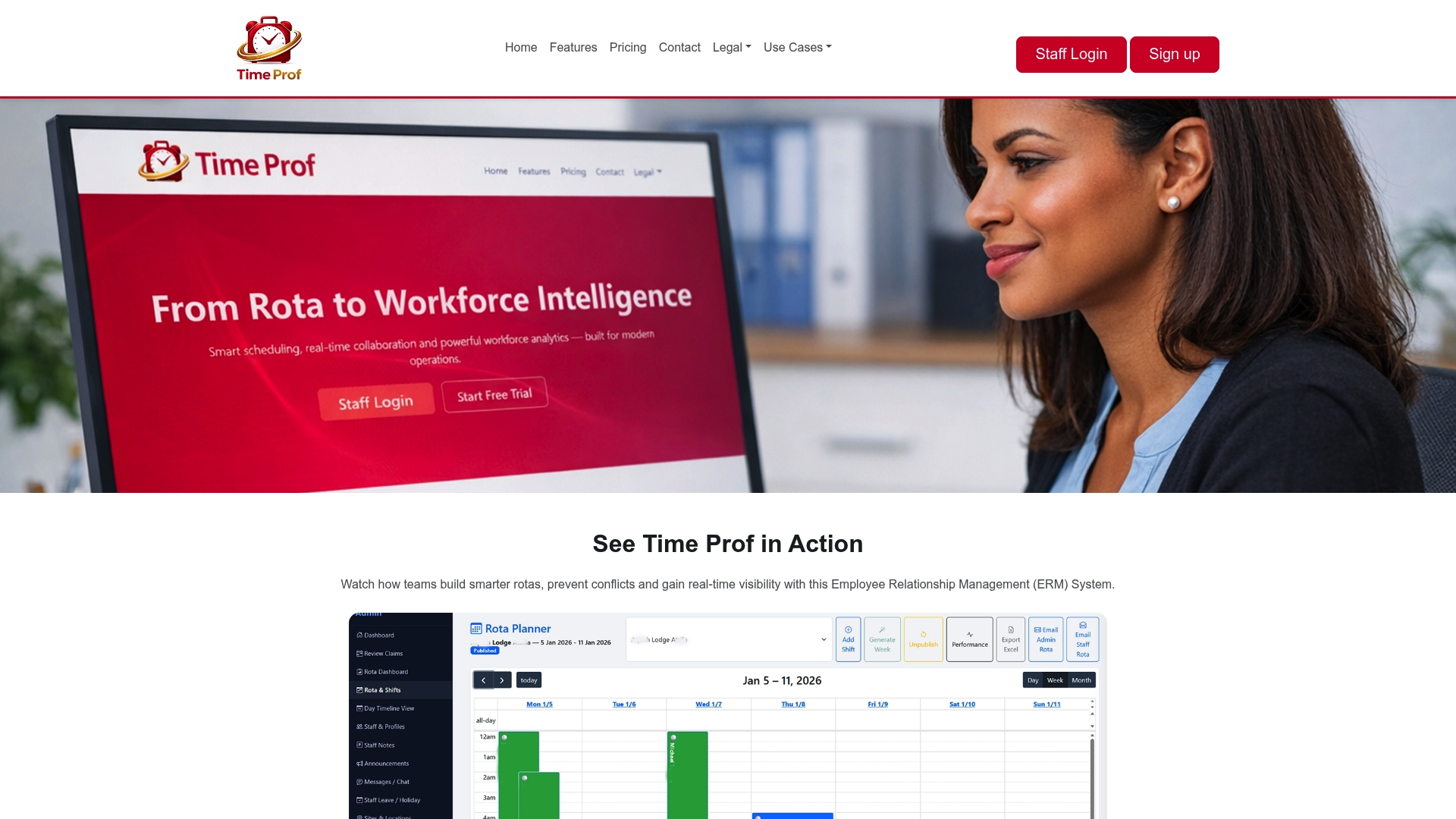
Carers access their rota, submit availability, and claim open shifts through the Timeprof mobile portal. Managers get geofenced clock-in, audit-ready change logs, and real-time dashboards across every site. The result: less time spent chasing cover, a cleaner compliance record, and a workforce that can see you are taking their schedules seriously.
If you are ready to move from manual rostering to automated, rule-based scheduling, book a demo with the Timeprof team and see how the platform maps to the six wellbeing principles in this guide.
Useful sources and further reading
The sources below underpin the evidence in this guide. For legal detail, start with the Working Time Regulations text and the GOV.UK guidance. For sleep and fatigue evidence, the participatory scheduling study is the most directly applicable to care settings.
For the strongest evidence on scheduling and sleep: the participatory AI-driven shift-scheduling study is the most directly applicable to paid care settings — it tested real carers, real rotas, and measured sleep objectively.
- Participatory AI shift-scheduling study — fatigue-aware rostering, backward rotation, and sleep outcomes in geriatric care.
- Systematic review: organisational interventions in elderly care — evidence base for flexible scheduling and multi-component wellbeing programmes.
- Six mechanisms behind carer wellbeing effects — qualitative study on how service timing and location affect carer wellbeing (the IMPACT framework).
- Mayo Clinic: caregiver stress — practical overview of fatigue, sleep disruption, and stress symptoms relevant to workforce monitoring.
- Timeprof scheduling and retention guide — practical manager guidance on how rota decisions affect staff retention in UK care settings.