Role Based Access Control: 7 Steps to Deploy for HR Teams
Seven practical steps to deploy role based access control for HR and workforce teams, with automated provisioning, access reviews, just in time elevation,...

Role based access control (RBAC) restricts what a person can see or do in a system by assigning them to a role, rather than granting permissions one person at a time. The main benefit is simple: it enforces least privilege while cutting the administrative work of managing individual permissions. Most enterprise systems, from cloud platforms to workforce software, run on some version of this model.
TL;DR:
- Most organizations need hierarchical RBAC to manage permissions efficiently as they grow, not just flat models for small teams.
- Stale role assignments are common without automation, so regular reviews and automatic deprovisioning are critical to reduce security risks.
- Building roles from the ground up based on specific job functions and minimum permissions prevents role explosion and over-permissioning.
- Combining RBAC with attribute-based access control enhances security for context-sensitive scenarios, while ACLs are better for fine-grained resource-level control.
- Automating joiner-mover-leaver processes and establishing clear role ownership significantly reduces administrative overhead and access errors.
Table of Contents
- What is role based access control and why does it matter?
- How does role based access control actually work?
- Which RBAC model fits your organisation?
- RBAC vs ABAC vs ACL: which one do you actually need?
- How do you implement RBAC step by step?
- What goes wrong with RBAC, and how do you avoid it?
- What does RBAC look like in workforce management?
- Author perspective: practical priorities for a first RBAC rollout
- How Timeprof handles role based access without the spreadsheet overhead
- Sources
What is role based access control and why does it matter?
RBAC maps three things together: users, roles, and permissions. Instead of giving Sarah in payroll access to specific screens one at a time, you assign her to a “Payroll Officer” role, and that role carries the permissions she needs. Change her job and you change her role, not fifteen individual settings.
NIST formalised this idea into a reference model built on three rules, and they’re worth knowing in plain terms:
- Role assignment — a user can only exercise a permission if they’ve been assigned a role that carries it
- Role authorisation — a user’s active role must be one they’re actually authorised to hold
- Permission authorisation — a user can only exercise permissions their active role is authorised for
The payoff is threefold. You get least privilege by default, because roles are scoped to what a job actually needs. You get separation of duties, since conflicting permissions (say, approving and processing the same payment) can be kept apart. And you get auditability, because a security review becomes a question of “who holds this role” rather than a forensic trawl through individual grants. IBM’s explainer frames this the same way: assign permissions to roles, then assign users to roles, and the rest of the governance follows.
How does role based access control actually work?
Underneath the concept sits a fairly small set of moving parts, and understanding them is what separates a working RBAC setup from a theoretical one.
Every identity in the system needs representation, and that’s not just human staff. Service accounts, automated agents, and integration bots need roles too, often with tighter scopes than a person would get. Each role carries a defined permission set, and that set is usually bound to a scope, such as a specific site, department, or resource group rather than the whole organisation.
Users don’t always operate with every role active at once. Many systems let someone hold a primary role and one or more secondary roles, activating the secondary role only when needed. Snowflake’s access control model is a clear example: a session runs with one active role, and users switch roles deliberately rather than stacking every permission they own at all times.

Roles can also inherit from one another. A senior manager role might inherit everything a standard manager role has, plus a few extra permissions, which avoids rebuilding permission sets from scratch for every tier.
Here’s the typical sequence for wiring RBAC into a real system:
- Define roles based on job function, not individual person
- Attach permission sets and scopes to each role
- Connect the system to an identity provider (IdP) for authentication
- Provision role assignments automatically via SCIM, syncing group membership to roles
- Layer in role hierarchies where inheritance makes sense
Azure RBAC illustrates this well in practice: role definitions, scopes, and role assignments are separate, reusable objects, which is exactly what lets one role definition apply across many resources without being rebuilt each time.
Pro Tip: Build your role hierarchy top down but assign permissions bottom up. Start with the narrowest, most junior role and add inherited layers on top. Doing it the other way round tends to produce senior roles with permissions nobody actually checked.
Which RBAC model fits your organisation?
Not every organisation needs the same flavour of RBAC, and picking a model that’s too complex early is a common way projects stall.
- Core (flat) RBAC assigns permissions directly to roles with no inheritance. Fine for small teams or simple applications with few distinct job functions.
- Hierarchical RBAC lets roles inherit from other roles, so a “regional manager” role can inherit everything a “site manager” role has, without duplicating permission sets.
- Constrained RBAC adds separation-of-duties rules, preventing a single user from holding two roles that shouldn’t overlap, such as someone who can both create and approve a purchase order.
- Advanced (administrative) RBAC adds governance features on top: entitlement mapping, visibility into who holds what across the estate, and delegated administration of roles themselves.
Most organisations start with core RBAC, discover they need hierarchy within the first year of growth, and add constraints once an auditor or compliance requirement forces the separation-of-duties conversation. There’s rarely a reason to build advanced administrative features before you have enough roles to make manual tracking painful.
RBAC vs ABAC vs ACL: which one do you actually need?
RBAC assigns permissions through roles. Attribute based access control (ABAC) grants access based on attributes such as time of day, location, or device, evaluated at the moment of the request. Access control lists (ACLs) attach permissions directly to individual resources, specifying exactly which users or roles can touch that particular object.
RBAC is easier to manage at scale because you’re administering roles, not thousands of individual rules. ABAC is more flexible for context-sensitive decisions but harder to audit, since the logic lives in policy conditions rather than a role assignment you can simply list. Combining the two is common: a role determines the baseline permission set, and an attribute rule restricts when or where that role can actually be exercised, such as blocking clock-in access outside a geofenced site.
A quick way to decide:
- If access depends mainly on job function, RBAC alone is usually enough
- If access depends on shifting context (time, location, device), layer ABAC on top
- If you need fine-grained control over a specific file or record, an ACL fills that gap
- If you’re managing more than a handful of one-off exceptions, that’s a sign you need attributes, not more roles
How do you implement RBAC step by step?
Getting RBAC right is less about the model and more about the sequence you follow to build it.
- Map roles to business functions, not to individuals or org chart titles. A “shift manager” role should reflect what shift managers do everywhere, not what one particular manager happens to need today.
- Adopt a naming convention early, something like
department_function_level, and start with coarse-grained roles. It’s far easier to split a role later than to untangle fifty overlapping ones. - Provision through your identity provider using SCIM, mapping existing security groups to roles rather than assigning permissions manually per user.
- Automate joiner, mover, and leaver events. New starters should inherit the correct role on day one; someone changing department should lose the old role automatically, not “eventually”; leavers should be deprovisioned the moment HR marks them as gone.
- Schedule regular access reviews, ideally quarterly for sensitive systems, so role assignments get checked against who’s actually meant to hold them.
- Handle exceptions with just-in-time elevation. Rather than granting a permanent elevated role for occasional tasks, use time-boxed, approved elevation that expires automatically.
- Assign an owner to every role and log every change to a role definition or assignment, so the audit trail shows who changed what and why.
NIST’s research into RBAC adoption points to measurable reductions in administrative overhead and provisioning errors once organisations move off manual, person-by-person permission grants. That’s the entire economic case for RBAC in one line: fewer people manually deciding who gets what, and fewer mistakes when they do.
The order matters here. Teams that jump straight to automation before roles are properly mapped tend to automate the wrong structure, then have to redo the mapping and the automation together later.
What goes wrong with RBAC, and how do you avoid it?
Role explosion is the classic failure mode. It happens when every business exception gets modelled as a brand new role instead of a variation on an existing one, and within a couple of years an organisation ends up with more roles than employees. The fix is to favour broader functional roles and push genuine exceptions into attribute overrides or hierarchy, rather than minting a new role for every edge case.
Stale assignments are the second big problem: people keep roles from a job they no longer do, because nobody removed them. Automated joiner-mover-leaver processes and focused, role-by-role access reviews catch this far more reliably than annual, organisation-wide audits.
Default over-permission creeps in when new roles are copied from an existing “safe” template rather than built from actual need, quietly inheriting permissions nobody meant to grant. And separation-of-duties conflicts can sit unnoticed for years until a policy tool or a constrained RBAC rule actually checks for them.
- Role explosion → consolidate into fewer, broader roles with attribute-based exceptions
- Stale assignments → automate leaver deprovisioning and run scheduled reviews
- Over-permission → build new roles from least privilege, never copy a broad template
- SoD conflicts → enforce constraints programmatically, don’t rely on manual checks
Pro Tip: If you can’t name the business reason a role exists in one sentence, it’s probably a symptom of role explosion, not a genuine requirement.
What does RBAC look like in workforce management?
In a rota and workforce platform, RBAC typically separates a handful of core roles: managers who build schedules, schedulers who handle shift claims, payroll staff who process hours, frontline staff who clock in and view their own rota, and auditors who need read-only visibility across everything.
Joiner-mover-leaver automation matters just as much here as in any enterprise IT system. When a new starter is onboarded, their role should govern which sites they can clock in at, often tied to geofence verification so access is location-bound as well as role-bound. When someone moves site or changes position, their permissions should update with them, not lag behind on a spreadsheet somewhere.
- Managers and schedulers see rota, leave, and open-shift data for their sites only
- Payroll roles see hours and pay data but not scheduling controls
- Auditors get read-only access to logs and reports, never edit rights
- Support staff can receive short, time-limited elevation to investigate an issue, then lose it automatically
Audit logs and role-based reports do the compliance heavy lifting, turning “prove who could access this data” from a manual investigation into a query.
Author perspective: practical priorities for a first RBAC rollout
Most first RBAC projects fail from over-design, not under-design. Teams spend months mapping every conceivable role before assigning a single permission, and the business changes faster than the spreadsheet does. Start coarse, automate provisioning early, and refine roles once real usage shows where the gaps actually are.
If I had to rank priorities, joiner-mover-leaver automation beats almost everything else, because stale access is the most common real-world failure, not clever policy design. Audit logs come a close second. They’re often the first place a misconfigured role reveals itself, long before a formal review catches it.
— Michael
How Timeprof handles role based access without the spreadsheet overhead
Timeprof is the alternative to managing permissions through spreadsheets and shared logins for multi-site teams: role-based access, audit trails, and joiner-mover-leaver automation are built into the platform rather than bolted on afterwards.
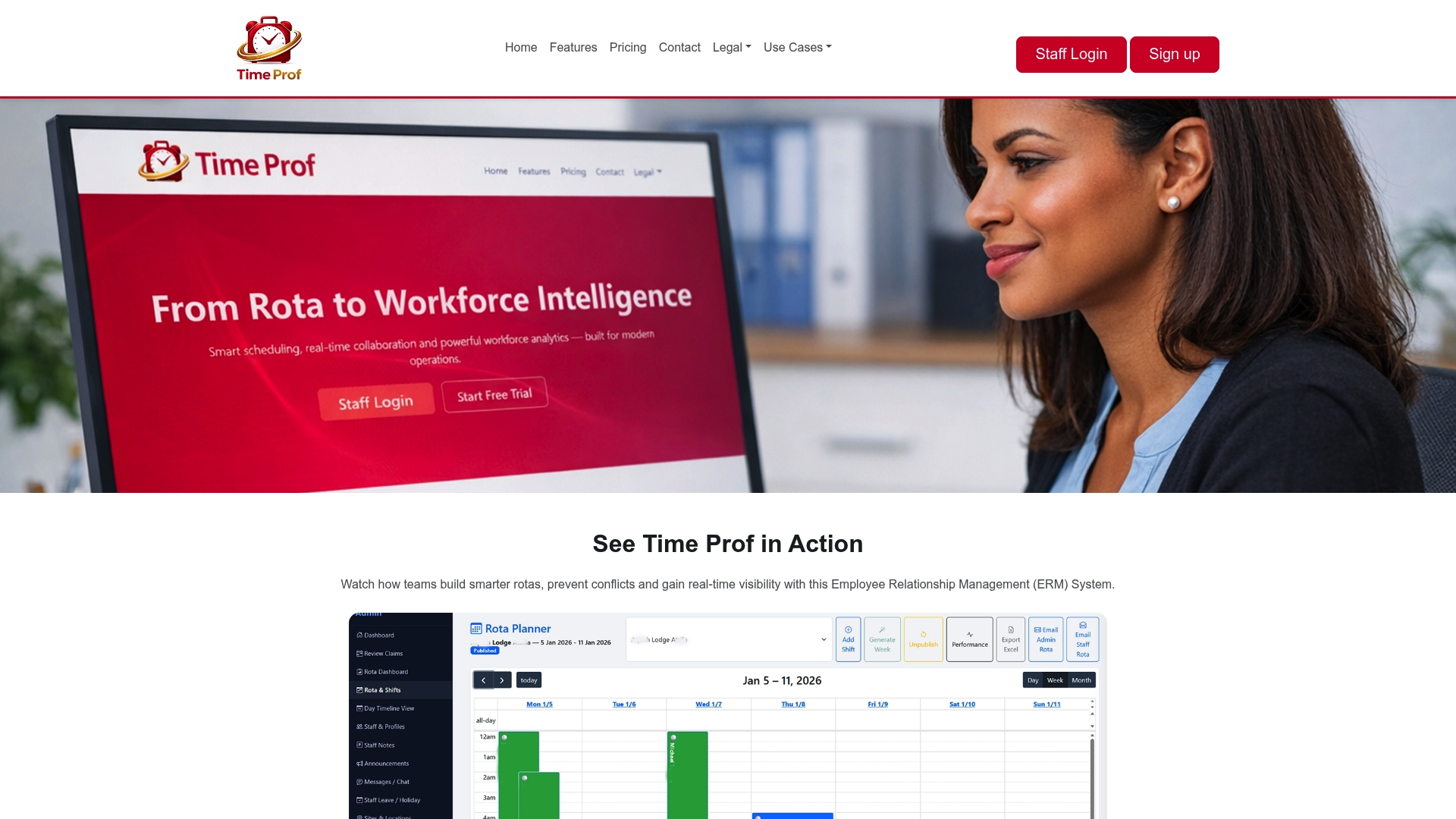
Managers can assign roles by site and function, from schedulers to payroll to auditors, with automated updates to permission sets when personnel change. Security features and administrative tools support audit-ready reports, making compliance checks more efficient. That structure also underpins real-time visibility across sites, and ties directly into the kind of data security practices HR teams are increasingly expected to demonstrate.
If you’re weighing up which workforce tools actually need this level of control, the workforce management tools checklist is a useful starting point. From there, book a demo of Timeprof to see role-based administration set up against your own sites and teams.
Sources
- Role Based Access Control | CSRC
- What Is Role-Based Access Control (RBAC)? | IBM
- Overview of Access Control | Snowflake Documentation