Labour cost calculation: how to get your effective hourly rate
Learn how to accurately calculate effective labour costs to determine true employee expenses and improve your budgeting strategies.

Effective hourly labour cost = total employer labour cost ÷ productive hours per year. That single formula tells you what an employee genuinely costs once tax, pension and downtime are stripped out of the guesswork.
To use it, gather three inputs:
- Gross pay for the period (hourly rate × hours, or salary ÷ pay periods).
- Employer-side burden: employer National Insurance, pension contributions, and any other employer-paid benefits.
- Productive hours: scheduled hours minus holiday, sickness and training time.
Quick example: an employee on £30,000 a year costs more once you add employer NI and pension. After accounting for leave and training, the effective hourly cost is notably higher than the salary-based rate.
Key Takeaways
Accurate labour cost calculation depends on including employer-side burden and productive hours, not just gross pay, in every figure you produce.
| Point | Details |
|---|---|
| Use the core formula | Effective hourly cost equals total employer labour cost divided by productive hours, not scheduled hours. |
| Include the full burden | Add employer NI, pension contributions and benefits consistently across every worker. |
| Watch the percentage | Track labour cost as a share of revenue monthly, not just annually, to catch drift early. |
| Convert margin correctly | Use Markup% = Margin% ÷ (1 − Margin%) when turning cost into a quoted price. |
| Automate for accuracy at scale | Timeprof captures attendance, overtime and leave automatically, reducing manual reconciliation across multiple sites. |
Table of Contents
- What counts as a labour cost? Direct, indirect, fixed and variable
- How do you calculate labour cost step by step?
- What is labour cost percentage and why does it matter?
- Common mistakes that quietly wreck your numbers
- Turning labour cost into a price, quote or budget
- Which tools should you use to calculate labour cost?
- How automated attendance data sharpens your labour-cost figures
- How do you annualise labour costs for long-term budgeting?
- Adjusting labour cost calculations by industry and role
- Why does labour cost fluctuate through the year?
- Get accurate labour cost figures without the manual reconciliation
- Sources
What counts as a labour cost? Direct, indirect, fixed and variable
Direct labour is the wage or salary paid for time actually spent producing the work a customer pays for. Indirect labour is everything that supports the workforce without directly generating output: recruitment, induction and training, timesheet administration, and the management time spent on rotas and appraisals. Miss the indirect side and your figures will always look cheaper than reality.
Then there’s the employer-side layer that catches most people out. Employer National Insurance contributions, automatic enrolment pension contributions, statutory sick pay, holiday pay and any benefits you fund (health cover, uniforms, travel allowances) all sit on top of gross pay, and none of it shows up on a payslip the way take-home pay does. Labour cost extends well beyond gross wages into these employer-paid additions, which is exactly why so many quotes and budgets come in under actual spend.
It helps to sort costs by behaviour as well as source:
- Fixed costs: contracted salaries, pension commitments, benefits that don’t flex with hours worked.
- Variable costs: hourly pay, agency or temporary cover, and overtime that rises and falls with demand.
Get this split right and your budgeting becomes a lot more honest, because fixed costs need covering whether or not the phone rings, while variable costs should track activity.
How do you calculate labour cost step by step?
Work through this in the order below, and you’ll end up with a defensible, repeatable number rather than a guess.
- Calculate gross pay per period. For hourly staff, multiply the hourly rate by scheduled hours. For salaried staff, divide the annual salary by the number of pay periods.
- Add the employer-side burden. Apply employer NI, pension contributions and any funded benefits, either as a percentage of gross pay or as fixed dropped figures per employee. A fully loaded approach adds base wages, burden and overtime together before dividing by hours worked.
- Subtract non-productive time. Take scheduled hours and remove holiday, sickness, and training time to arrive at productive hours, the real denominator.
- Add overtime separately where it’s structural, then apply the full formula: Effective hourly cost = (gross pay + burden + overtime) ÷ productive hours.
Worked example, hourly worker: a warehouse operative on £12.50/hour, working 37.5 scheduled hours a week with some hours lost to leave and sickness, leaves fewer productive hours. Adding employer burden raises the total employer cost, resulting in an effective hourly cost higher than the base rate.
Worked example, salaried worker: a supervisor earning £34,000 annually has additional employer NI and pension costs. Considering productive hours after leave and training, the effective hourly cost exceeds the base salary divided by hours.
To scale this to a team, sum every employee’s total employer cost and productive hours separately, then divide the totals. Never average individual hourly rates. A team of five with mixed contracts will skew badly if you just average the five effective rates rather than the underlying totals.
Pro Tip: Keep burden as a percentage of gross pay in your spreadsheet rather than a fixed number. When National Insurance thresholds or pension rates change, one cell update ripples through every worker’s calculation instead of forcing a manual rebuild.
What is labour cost percentage and why does it matter?
Labour cost percentage = (total labour costs ÷ total revenue) × 100. It tells you what share of every pound coming in is being spent on people, which matters more for spotting trouble early than for any single decision.
Use this metric when you’re building an annual budget, sanity-checking a rota against forecast sales, or reviewing margins on a contract. Norms vary hugely by sector: a hospitality kitchen running at 30 to 35% labour cost against revenue might be perfectly healthy, while a security contract at the same percentage could be losing money once overheads are added.
A short example: a cleaning contract generating £10,000 a month against £4,200 in labour costs runs at 42%. If overtime creeps the labour bill to £4,800 without a corresponding revenue increase, the percentage jumps to 48%, and that six-point shift is usually the first warning sign that a rota needs tightening before the numbers show up in the annual accounts.
Common mistakes that quietly wreck your numbers
Most inaccurate labour cost figures aren’t the result of bad maths. They’re the result of leaving something out or double-counting something else.
- Omitting employer-side costs. Pension and employer NI get forgotten more often than any other single item, so apply your burden percentage consistently across every worker, every time.
- Using scheduled hours instead of productive hours. Holiday, sickness and training all reduce the hours actually worked, and skipping this step understates your true hourly cost.
- Double-counting between burden and overhead. If pension contributions are already inside your burden percentage, don’t add them again under general overhead further down the budget.
- Confusing margin with markup when converting cost into a price. Margin and markup are not the same calculation, and mixing them up systematically underprices work.
Pro Tip: Run a quick reconciliation once a quarter: pick one employee, recalculate their effective hourly cost from scratch, and compare it against what your spreadsheet says. If the two numbers drift apart, something upstream (usually productive hours) has gone stale.
Turning labour cost into a price, quote or budget
Once you have the effective hourly cost, three more steps get you to a price you can actually quote.
- Add allocated overhead (rent, admin, equipment) spread across productive hours, giving you a fully loaded cost per hour.
- Apply markup to hit your target margin using Markup% = Margin% ÷ (1 − Margin%). A 20% margin needs a 25% markup on cost, not a 20% one, which is where a lot of quotes quietly lose money.
- Allocate shared team costs across projects or departments on a time-tracking basis, so no single job absorbs costs it didn’t actually generate. Manufacturing and project-based sectors rely heavily on this kind of job allocation to keep direct labour separate from general overhead.
Build in a contingency buffer on top of the calculated figure. Practitioners generally recommend covering for scope creep and unexpected inefficiencies rather than quoting the bare calculated number, a habit borne out in software project estimation guidance as much as in trades and services. Higher-risk or longer projects warrant a larger buffer than short, well-defined jobs.
Which tools should you use to calculate labour cost?
A spreadsheet works fine for a handful of staff. Structure it with four column groups: inputs (gross pay, hours), burden percentage, productive hours, and outputs (effective hourly cost, billable rate). Keep burden as a formula, not a typed number, so rate changes update automatically.
Online calculators are useful for a fast sanity check. Most return four tiers: base wage, loaded labour rate, overhead-inclusive rate and suggested billable rate, which is handy when you just need a ballpark figure rather than a full team model. Tools like the Labor Rate Calculator from GenToolLab follow this same structure.
Beyond a handful of staff, spreadsheets start to strain. Workforce-management platforms automate attendance, overtime and leave capture directly, which removes the manual data entry that causes most drift between estimated and actual cost, particularly across multiple sites or shift patterns that change week to week.
How automated attendance data sharpens your labour-cost figures
Manual timesheets are the single biggest source of labour cost errors because they rely on someone remembering to log hours accurately and someone else remembering to check them. Automating time and attendance removes the largest source of that error by capturing what actually happened rather than what was scheduled.
Timeprof captures the inputs your calculation actually needs, as they happen:
- Live clock-in and clock-out data, including optional geofence verification.
- Authorised overtime, logged and flagged the moment it’s approved rather than reconstructed at month end.
- Approved leave and absence, feeding straight into productive-hours calculations without manual adjustment.
Multi-site dashboards and audit-ready reporting then consolidate all of that into one burdened labour cost figure, rather than leaving a manager to stitch together spreadsheets from three different sites. Manual reconciliation work carries a real hidden cost that rarely shows up until someone totals the hours spent chasing it.
Systems that integrate attendance and payroll data materially cut the time managers spend reconciling hours worked against hours paid, particularly where overtime or multi-site variation is frequent.
How do you annualise labour costs for long-term budgeting?
Take whatever period you’ve calculated (weekly, monthly) and convert it to a full year using the actual number of pay periods, not a rough multiplier. Weekly pay doesn’t multiply cleanly by 52 once you account for the extra pay period that odd calendar years sometimes produce.
Build the annual figure from real components rather than a flat scale-up. Take annual gross pay, add the annual value of employer NI and pension contributions, add any benefits paid across the full year, then subtract nothing yet, because productive hours get applied at the effective hourly cost stage, not here. This gives you a true annual employer cost per employee that you can sum across the whole team.
For budgeting purposes, split that annual figure into fixed and variable components. Fixed labour cost, salaries and contracted benefits, should be treated the same way you’d treat rent: a baseline that has to be covered regardless of trading conditions. Variable labour cost, overtime, temporary cover and seasonal hires, needs modelling against expected demand rather than a flat annual assumption.
Review the annualised figure at least twice a year. Pay rises, National Insurance threshold changes and pension rate adjustments all move the underlying numbers, and a budget built on last year’s burden percentage will drift further out of line every month you don’t update it. Businesses with predictable annual pay reviews often find it easiest to recalculate straight after the review lands, while the new rates are fresh in the payroll system.
Adjusting labour cost calculations by industry and role
The core formula doesn’t change between sectors, but what counts as burden and what counts as productive hours shifts noticeably.

In hospitality, high staff turnover means recruitment and onboarding costs deserve their own line rather than being buried in general overhead, since they recur far more often than in office-based roles. In care and healthcare settings, mandatory training, DBS checks and compliance-related paid time all reduce productive hours more heavily than in most other sectors, so leaving them out understates cost by a wider margin than usual.
Security and cleaning contracts often run on a high proportion of part-time or shift-based staff, which pushes more of the calculation onto variable costs and makes accurate hours tracking, rather than assumed rotas, essential to getting the number right. Manufacturing and other project-based sectors need labour allocated to specific jobs rather than treated as a single pool, distinguishing direct labour charged to a job from indirect labour sitting in overhead.
Retail sits somewhere in between: a mix of salaried management and hourly floor staff, with seasonal peaks that push overtime and temporary cover into variable costs for only part of the year. Whichever sector you’re in, the fix is the same: identify which of your specific cost categories are genuinely structural to that industry, and build them into the burden percentage rather than treating every role the same way.
Why does labour cost fluctuate through the year?
Seasonal demand is the most obvious driver. A business that ramps up hiring for a busy quarter will see its variable labour cost spike well above the annual average during that period, even if the annualised figure looks stable on paper. Budgeting against the annual average alone hides these peaks and can leave a manager short-staffed or over-committed when the season actually arrives.

Part-time and full-time staff also behave differently in the calculation. Full-time employees carry a higher proportion of fixed costs relative to hours worked, particularly where benefits and pension contributions don’t scale down for part-time hours the same way gross pay does. That means a part-time employee’s effective hourly cost can, in some cases, sit closer to a full-timer’s than the headline hourly rate would suggest, because certain fixed employer costs get spread over fewer hours.
Overtime is the other major swing factor. A team that runs lean for most of the year but leans hard on overtime during peak periods will show a labour cost percentage that looks fine on average and alarming in the peak months. Tracking labour cost monthly rather than only annually catches this kind of variability before it becomes a budgeting surprise.
A manager’s shortlist for getting this right
Start with the three checks that catch most errors: verify your gross-pay inputs are current, confirm productive hours reflect real leave and training data, and make sure your burden percentage includes NI and pension, not just one or the other.
A quick estimate is fine for a one-off quote. Run a full audit whenever you’re setting an annual budget, reviewing pricing, or noticing your labour cost percentage has drifted. Once you’re managing overtime across more than one site, spreadsheets stop being the fastest option, and that’s usually the point to look at an automated platform.
— Michael
Get accurate labour cost figures without the manual reconciliation
Every formula in this article depends on two things being accurate: the hours people actually worked and the burden sitting on top of their pay. Timeprof removes the guesswork from both, because it captures live attendance, authorised overtime and approved leave as they happen, then rolls them into consolidated, audit-ready reports across every site you run.
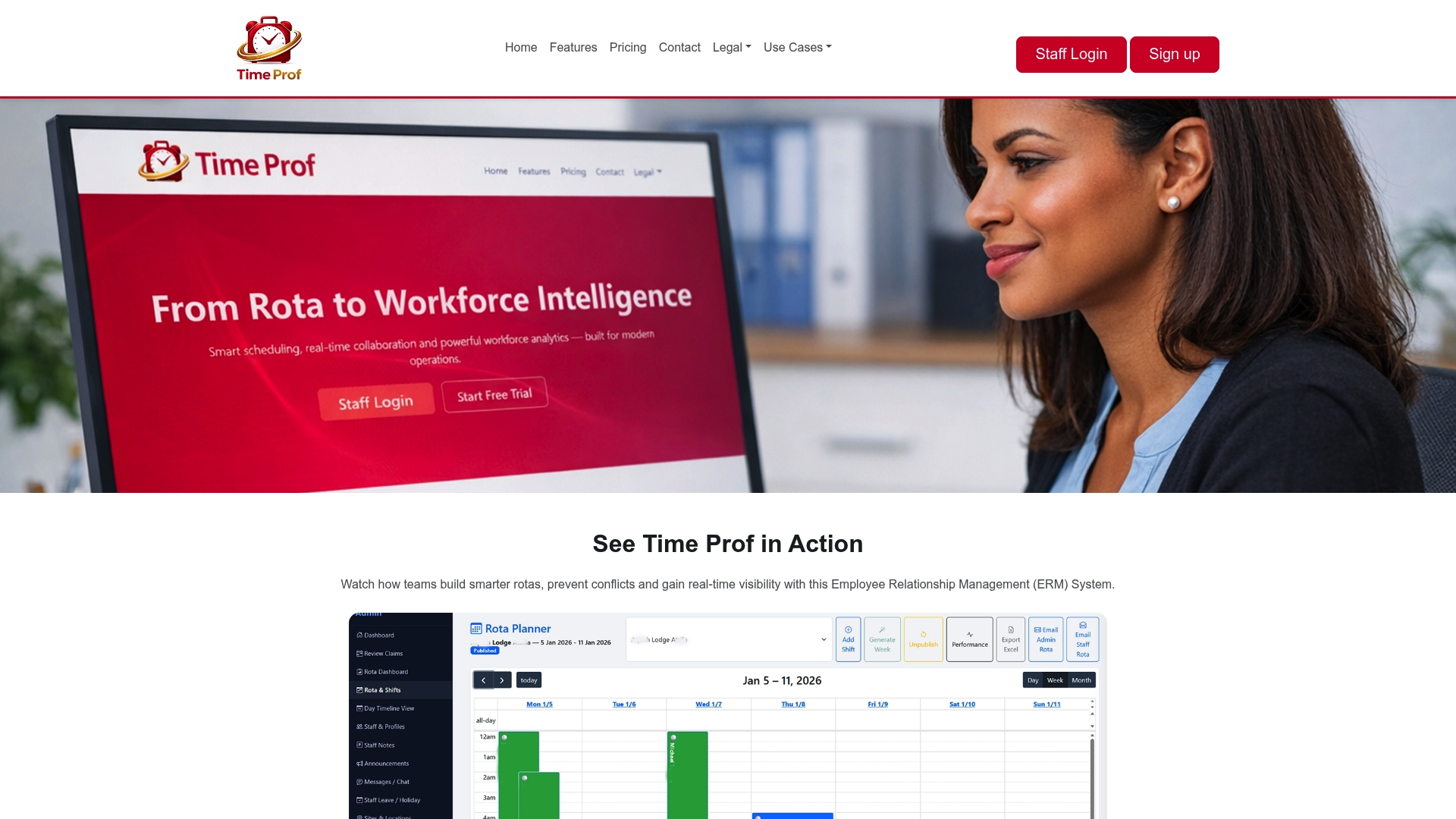
That matters most once your team grows past the point where a spreadsheet stays current. If you’re running multiple sites, dealing with frequent overtime, or need compliance-ready reporting for audits, Timeprof gives you a single, reliable source of burdened labour cost data instead of a monthly scramble to reconcile timesheets. It also feeds straight into the reports managers use to spot where labour cost is running ahead of budget, and helps close off the timesheet errors that distort a labour cost calculation before they reach your accounts. Visit the Timeprof platform to see how it maps onto your own rota and start a trial.
Sources
- What Is Labor Cost? (Definition, Formula and Examples) | Indeed
- How to Calculate Labor Cost (Formula, Burden & Effective Hourly Rate) | GenToolLab