How workforce reports reduce labour costs in the UK
Discover how workforce reports reduce labour costs for UK businesses by transforming data into proactive management strategies for savings.

How workforce reports directly reduce labour costs in UK businesses
Workforce reports are the difference between guessing at your labour spend and actually controlling it. At their core, they aggregate data from attendance, scheduling, payroll, and performance systems into a single view that tells you not just what happened, but why it cost what it did.
For UK businesses, where workforce spend often represents 70% or more of total operating costs in service industries, that shift from reactive accounting to proactive management is where the real savings live. Most managers only see labour costs as a month-end figure. By then, the overtime has already been paid, the agency cover has already been booked, and the opportunity to intervene has passed.
Workforce reports change that by surfacing the right signals at the right time. The key benefits:
- Controlled overtime through real-time scheduling visibility before shifts are confirmed
- Lower turnover costs by identifying retention pressure points early
- Accurate wage management by benchmarking pay against productivity and market rates
- Compliance assurance through audit-ready records that prevent costly disputes
- Flexible staffing efficiency by tracking the true cost of temporary and agency workers
The critical caveat, as analyst Chris Pickles notes, is that dashboards overloaded with data create noise rather than insight. UK organisations achieve better results by selecting a focused set of KPIs tied directly to business priorities like overtime control and recruitment efficiency, rather than tracking every available metric.
Table of Contents
- How reports help you cut the cost of staff turnover and absenteeism
- How to use scheduling reports to avoid expensive overtime
- Reviewing wages, benefits, and flexible staffing with labour cost data
- How Timeprof’s workforce intelligence platform drives down labour costs
- How cutting over-planning reduces your administrative labour spend
- Connecting workforce analytics to financial forecasting
- Using employee performance reports to close skill gaps and lift productivity
- Using compliance reports to avoid fines, disputes, and tribunal costs
- Timeprof gives you the reporting layer your labour costs need
- Key takeaways
How reports help you cut the cost of staff turnover and absenteeism
Replacing an employee is expensive. Research indicates that replacing a skilled employee can cost between 50% and 200% of their annual salary when factoring in recruitment, training, and lost productivity. For a mid-sized UK business, even modest reductions in turnover translate directly into five-figure savings.

Workforce reports make this possible by tracking turnover per employee as a live metric rather than an annual HR review figure. When you can see which departments, shift patterns, or managers correlate with higher attrition, you can act before people hand in their notice.
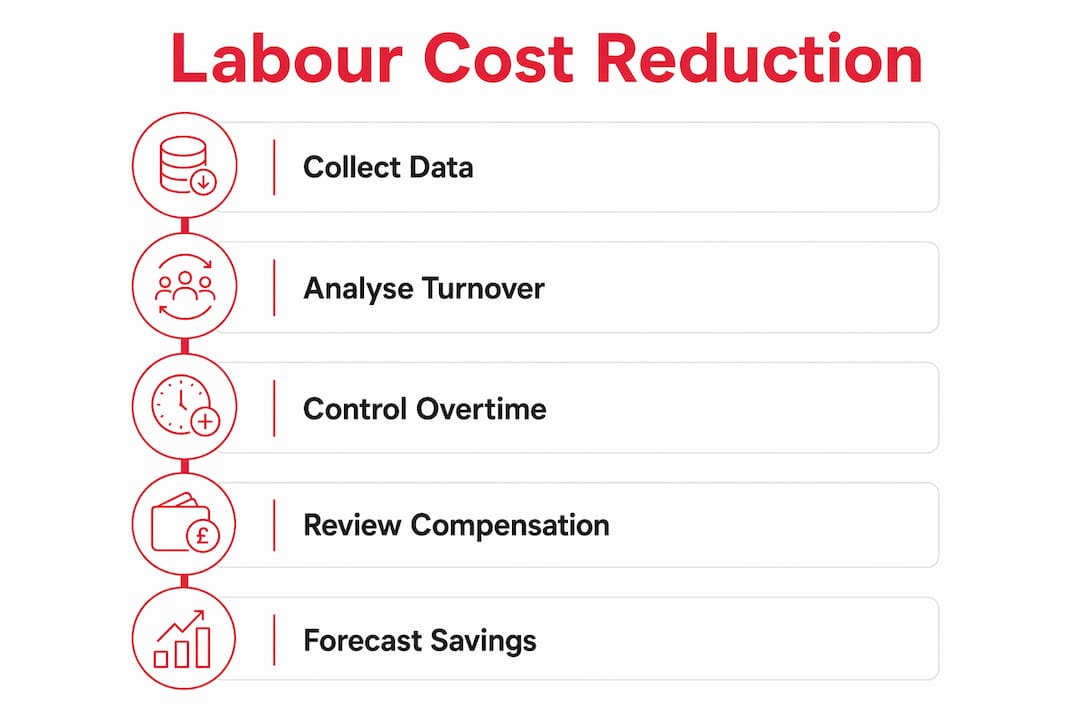
Absenteeism tells a similar story. Absence rate monitoring through workforce data enables targeted wellbeing initiatives rather than blanket policies that miss the actual problem. A spike in Monday absences in one team is a different issue from chronic short-term absence spread across a site.
Key metrics to track:
- Absence rate by team and shift pattern to identify structural causes
- Time to fill vacancies to measure the downstream cost of turnover
- Return-to-work interview completion rates to gauge manager engagement with absence management
- Engagement scores correlated with attrition data to spot flight risk before it becomes resignation
The employee engagement data behind these patterns matters as much as the headline numbers. Person-job fit and sentiment metrics, when fed into workforce reports, give HR a much earlier warning signal than exit interviews ever could.
The cost of doing nothing: A UK enterprise could save significant amounts annually in replacement costs by reducing turnover through better use of workforce data.
How to use scheduling reports to avoid expensive overtime
Overtime is one of the most controllable labour costs in any business, yet it remains one of the most consistently overspent. The reason is almost always the same: scheduling decisions are made without visibility of their cost impact until the payroll run confirms the damage.

The fix is treating labour spend as a live operational metric rather than a retrospective one. When managers can see the cost implication of a rota change in real time, they make different decisions. A shift swap that avoids a sixth consecutive day for one employee, or a coverage adjustment that prevents an unplanned agency call-out, saves money in the moment rather than after the fact.
UK contact centres using advanced scheduling analytics have lowered abandonment rates by 8–11% and improved first-contact resolution by 7–10 percentage points, with direct labour cost benefits through efficiency gains and reduced overtime. The same principle applies across retail, care, hospitality, and security.
Practical steps reports enable:
- Demand-aligned staffing using historical attendance and sales data to predict required headcount by shift
- Overtime threshold alerts that flag individuals approaching contractual limits before the shift is confirmed
- Coverage gap identification so absence can be filled proactively rather than reactively at premium rates
- Shift swap tracking to ensure cost-neutral cover rather than inadvertent overtime accumulation
Reducing unplanned overtime also reduces employer National Insurance contributions, which compounds the saving beyond the basic wage cost.
Reviewing wages, benefits, and flexible staffing with labour cost data
Compensation data only becomes useful when it is set against productivity and outcomes. A report that shows your highest-paid team is also your lowest-performing one is a very different conversation from a simple payroll summary.
Workforce spend analysis must go beyond absolute costs to evaluate return on investment in people, considering employee sentiment and person-job fit for retention and performance. Aon’s analysis of UK workforce data makes this point clearly: the question is not just what you are paying, but what you are getting for it.
Flexible staffing adds another layer of complexity. The hidden costs of flexible workforce management include planning, scheduling, and rescheduling overhead that rarely appears in a basic hourly rate comparison. When those costs are captured in reports, the true cost per hour of agency or temporary staff often looks quite different from the invoice rate.
What good compensation reporting covers:
- Wage benchmarking against productivity metrics to identify over- and under-investment by role
- Benefits utilisation rates to assess whether spend on perks is actually influencing retention
- Agency and temporary staff cost tracking including coordination overhead, not just the hourly rate
- Internal equity analysis to identify pay gaps that create legal exposure and retention risk
How Timeprof’s workforce intelligence platform drives down labour costs
Timeprof was built specifically to solve the problem that sits behind most labour cost overruns: fragmented data. When your rota lives in a spreadsheet, your attendance in a separate system, and your payroll in a third, you cannot see the full picture until it is too late to change it.
The platform brings scheduling, attendance, staff management, leave, tasks, and reporting into one system. That single source of truth means managers are not reconciling data across three tools before they can make a decision. Manual reconciliation across fragmented HR, payroll, and rota data consumes excessive time; an integrated reporting layer with a single governed data source enables strategic focus rather than administrative firefighting.
Timeprof’s features that directly affect labour costs:
- Intelligent shift planning that accounts for staff availability, skills, and fatigue risk
- Real-time attendance tracking with geofenced clock-in to eliminate time theft and inaccurate records
- Audit-ready compliance reporting that protects against costly employment tribunal claims
- Live multi-site dashboards giving managers visibility across locations simultaneously
- Open shift and shift claim management to fill gaps without defaulting to agency cover
The platform serves organisations across care, healthcare, security, hospitality, cleaning, and retail, where shift-based labour costs are the dominant operational expense. For managers dealing with common scheduling challenges across multiple sites, the reduction in manual admin alone frees up significant management time.
Pro Tip: Set up Timeprof’s overtime threshold alerts before your next rota cycle. Catching a potential breach at the planning stage costs nothing; catching it on the payroll run costs the premium rate plus employer NI.
How cutting over-planning reduces your administrative labour spend
Over-planning is a real cost that rarely appears on a budget line. It shows up as managers spending hours building rotas that could be generated in minutes, running reports that duplicate information already available elsewhere, and holding planning meetings to discuss data that a live dashboard would make immediately obvious.
Workforce reports, when properly configured, replace the planning overhead with a decision-support layer. Instead of building a rota from scratch each week, a manager reviews a system-generated draft based on historical demand, confirmed availability, and skills requirements. The time saved is not trivial. For a manager overseeing 30 staff across multiple shifts, moving from manual rota-building to report-guided scheduling can recover several hours per week.
The principle extends to workforce management ROI more broadly: every hour a manager spends on administrative reconciliation is an hour not spent on the work that actually requires human judgement. Integrated reporting removes the reconciliation step entirely.
Connecting workforce analytics to financial forecasting
Labour cost forecasting is only as good as the data feeding it. When workforce analytics and financial planning operate in separate systems, finance teams build budgets on assumptions while HR operates on actuals, and the gap between the two creates either overspend or unnecessary headcount reductions.
Integrated workforce reports give finance a real data feed: actual hours worked, overtime trends, agency spend, and absence rates, all feeding into forward-looking models. Better collaboration between HR, operations, and finance through a single trusted source of labour cost data enhances planning accuracy and reduces waste.
In practical terms, this means a finance director can model the cost impact of a 5% increase in absence rates, or the saving from reducing agency reliance by 20%, using real operational data rather than estimates. Seasonal staffing requirements, particularly relevant in retail and hospitality, become predictable rather than reactive when historical workforce data informs the forecast.
Using employee performance reports to close skill gaps and lift productivity
Skill gaps are a hidden labour cost. When a team lacks the capability to complete work efficiently, the result is either slower output, higher error rates, or the need to bring in more expensive resource to compensate. Performance reports surface this before it becomes a structural problem.
AI-powered workforce analytics can identify productivity patterns and skills gaps across departments and locations, enabling more targeted investment in professional development. Generic training programmes spread thinly across a workforce rarely move the needle. Targeted interventions, directed at the specific gaps the data identifies, deliver measurable productivity improvement for a fraction of the cost.
The same data supports succession planning. Unexpected departures of key personnel disrupt operations and incur substantial costs through knowledge transfer delays. When performance reports track development progress and flag readiness for progression, organisations can manage succession proactively rather than scrambling when someone leaves.
Using compliance reports to avoid fines, disputes, and tribunal costs
Employment law compliance is not just a legal obligation; it is a direct cost control mechanism. A single employment tribunal claim can cost a UK employer tens of thousands of pounds in legal fees, management time, and potential awards, before considering reputational damage.
Workforce reports that track working time against the Working Time Regulations, rest break compliance, holiday accrual, and right-to-work documentation create an audit trail that protects the business. When a dispute arises, the difference between having timestamped, system-generated records and relying on manager recollection is often the difference between a swift resolution and a prolonged claim.
The AI workflow automation that underpins modern workforce platforms also reduces the risk of human error in compliance-critical processes. Automated alerts for expiring certifications, rest period breaches, or holiday carry-over limits mean compliance is maintained continuously rather than audited retrospectively.
Timeprof gives you the reporting layer your labour costs need
Most businesses already have the data. The problem is that it is sitting in three different systems, none of which talk to each other, and extracting anything useful requires an afternoon of spreadsheet work.
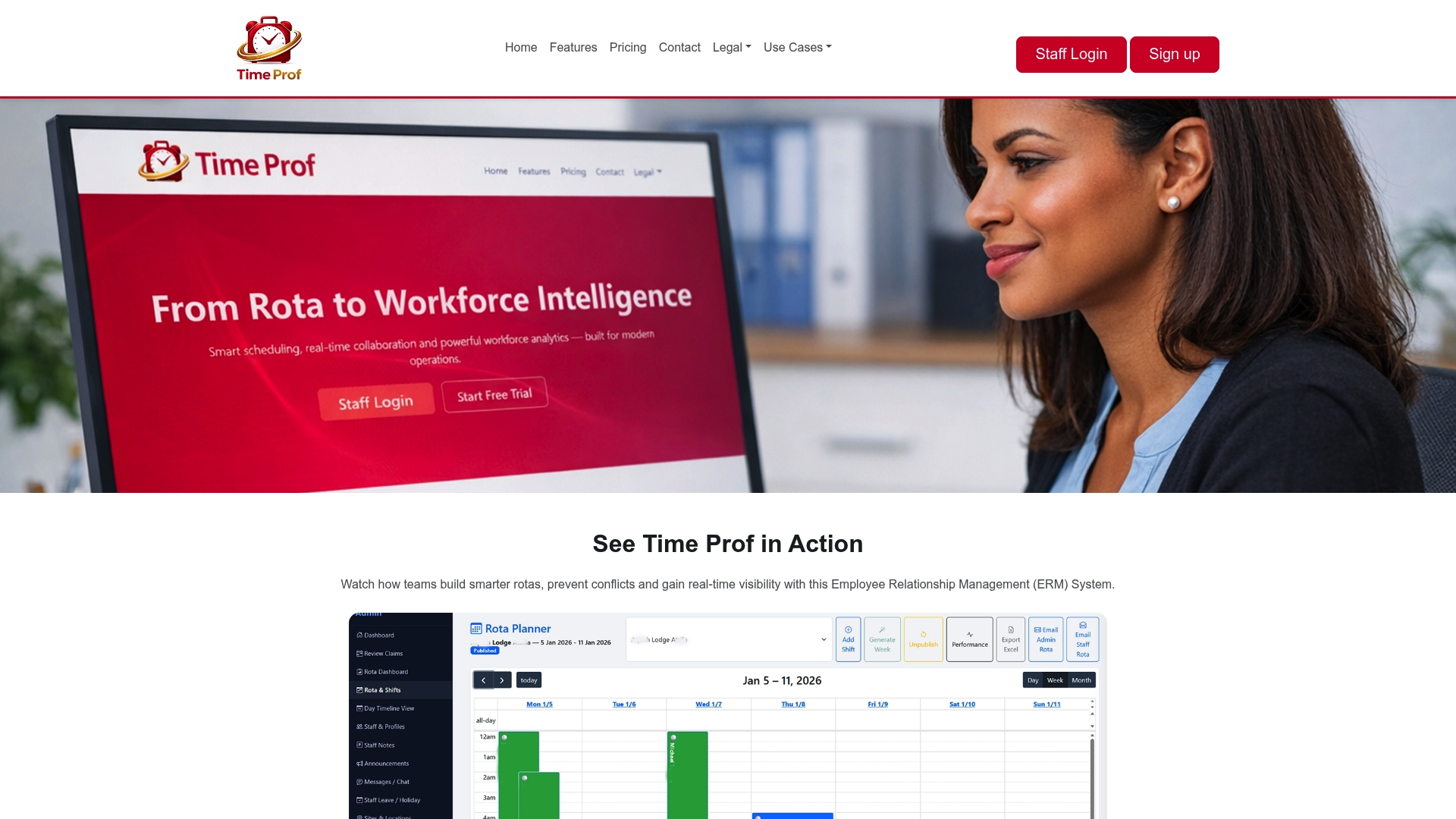
Timeprof consolidates rota planning, attendance, leave, tasks, and operational reporting into one platform, giving managers the live visibility they need to make cost-effective decisions before the payroll run confirms the damage. For businesses in care, hospitality, security, retail, and cleaning, where shift-based labour is the dominant cost, that visibility is the difference between a controlled wage bill and a reactive one.
The platform is mobile-first, requires no complex IT infrastructure, and scales from a single site to large multi-location operations. If your current approach to workforce intelligence involves reconciling spreadsheets at the end of each week, Timeprof is the direct alternative. Book a demonstration to see how the reporting layer works in practice for your sector.
Key takeaways
Workforce reports reduce labour costs most effectively when they provide real-time visibility that enables managers to act before costs are incurred, not after.
| Point | Details |
|---|---|
| Focus on fewer KPIs | Dashboards overloaded with data create noise; select metrics tied directly to overtime, turnover, and absence. |
| Treat labour spend as live data | Viewing cost impact during rota editing enables on-the-fly adjustments that prevent overspend before it happens. |
| Capture the true cost of flexible staff | Agency and temporary worker costs include hidden coordination overhead that basic hourly rates do not show. |
| Connect workforce data to finance | Feeding real attendance and overtime trends into financial forecasting replaces budget assumptions with operational actuals. |
| Timeprof as your single source of truth | Timeprof integrates scheduling, attendance, compliance, and reporting in one platform to give managers real-time labour cost control. |