What is a cash budget and why every SME needs one
Learn how cash budgets can help your SME anticipate cash flow shortfalls, manage expenses, and maintain financial stability effectively.

A cash budget forecasts your business’s cash receipts and payments, period by period, so you know whether you’ll have enough in the bank to cover payroll and supplier invoices when they fall due. It’s the single tool that tells you, before the fact, whether next month is a squeeze or a surplus.
Build one properly and you get three things immediately:
- Advance warning of a payroll or supplier shortfall, weeks before it happens
- A clear signal for when to arrange short-term finance rather than scramble for it
- A way to spot slow-paying customers or creeping costs before they become a crisis
What follows is the full method: how a cash budget differs from your profit and loss account, the inputs you need, a worked example you can copy, and the mistakes that make most first attempts unreliable.
Key Takeaways
A reliable cash budget depends on realistic collection assumptions, mapping payments to actual bank dates, and reviewing plan against actual often enough to catch problems early.
| Point | Details |
|---|---|
| Cash timing beats profit timing | Track when money moves through the bank, not when it’s recognised on the P&L. |
| Use real collection history | Base receipts timing on your own accounts receivable pattern, not an optimistic guess. |
| Budget from the low point | Seasonal and irregular-income businesses should plan against their weakest month, not their best. |
| Review on a fixed cadence | Check plan versus actual weekly if cash is tight, monthly otherwise, and act on variances immediately. |
| Payroll accuracy protects the forecast | Tools like Timeprof link real attendance and rota data to payroll costs, reducing the surprise variances that throw a cash budget off. |
Table of Contents
- What is a cash budget and how does it differ from a P&L?
- Why a cash budget matters for your business right now
- Key components and where to get reliable input data
- How to build a cash budget step by step
- A worked monthly example you can copy
- Common mistakes that make a cash budget useless
- How to monitor and update your cash budget
- Why payroll accuracy is the hidden variable in cash forecasting
- Does cash budgeting differ for seasonal businesses and startups?
- A note on preparing cash budgets in practice
- How Timeprof keeps payroll predictable inside your cash budget
- Frequently asked questions about cash budgets
- Sources
What is a cash budget and how does it differ from a P&L?
A cash budget tracks when money actually moves through your bank account, not when you record a sale or an expense on paper. That distinction trips up more business owners than any other part of financial planning.
Your profit and loss statement uses accrual accounting: it recognises revenue when you invoice a customer and costs when you incur them, regardless of when cash changes hands. A cash budget ignores all of that timing fiction. It only cares about the date money lands or leaves your account, which is why non-cash entries like depreciation have no place in one, as Investopedia’s clarification of the cash budget makes plain: many owners confuse the two, but a cash budget is built specifically around bank timing and liquidity, not accounting profit.
Most SMEs work with three timeframes:
- Weekly cash budgets, for businesses running close to their overdraft limit or managing seasonal swings
- Monthly cash budgets, the standard choice for stable trading businesses reviewing performance against plan
- Quarterly or annual budgets, which fold in strategic items like capital purchases, loan repayments and tax payments
Short-term budgets solve day-to-day liquidity questions. Long-term ones exist for strategic planning around bigger outlays/06%3A_Cost_Behavior_and_Cost-Volume-Profit_Analysis/6.06%3A_Cash_Budgets). Most SMEs run a rolling monthly view and only drop to weekly detail when cash gets tight.
Why a cash budget matters for your business right now
Payroll doesn’t wait for a good month. Neither does HMRC, your landlord, or the supplier who’s already given you 60 days’ credit. A cash budget forces you to see, in advance, whether the money will be there when those obligations land, rather than discovering the gap the week wages are due.
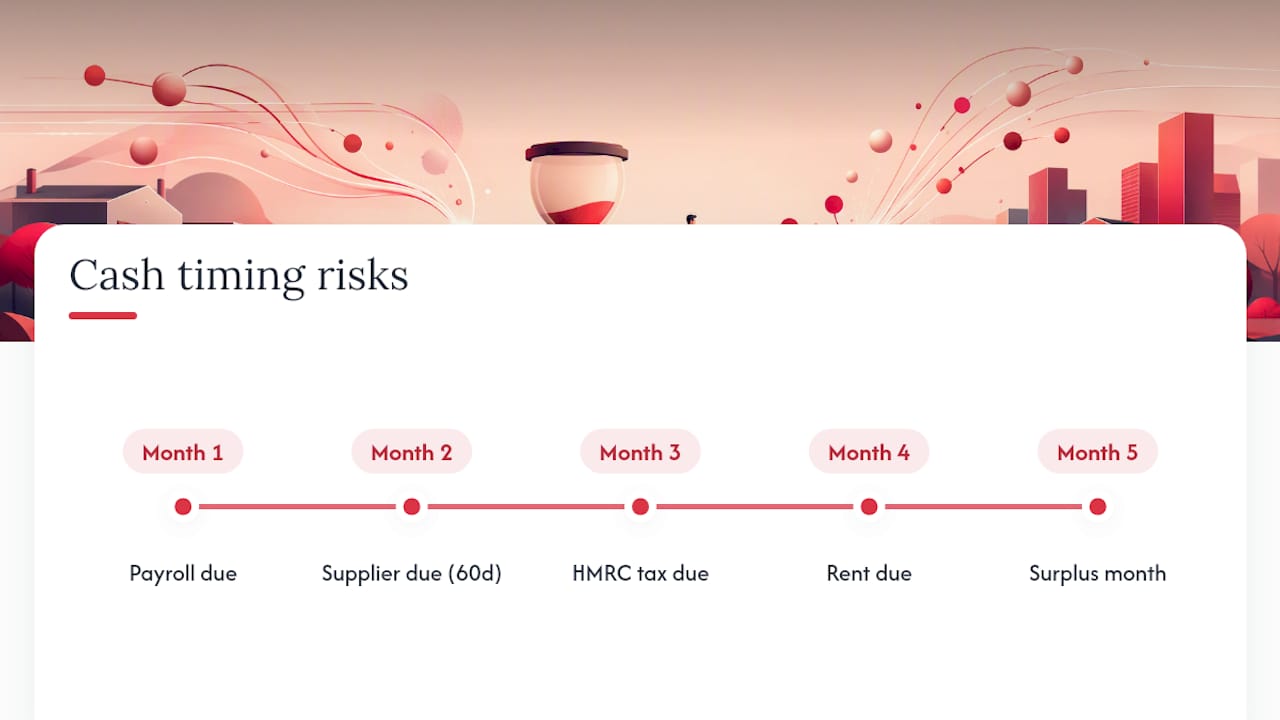
It also changes how you time capital spending. Buy the new van or upgrade your kitchen equipment in a month your cash budget shows as a surplus, and you avoid drawing on an overdraft at commercial rates. Time it against a forecast deficit, and you’ve manufactured a cash crisis that was entirely avoidable.
The real power shows up once you start comparing plan against actual. ACCA frames the cash budget as a diagnostic tool: when actual receipts consistently lag budgeted receipts, that’s rarely bad luck. It usually points to a specific, fixable problem, slower-paying customers, a credit control gap, or costs creeping above plan.
Late payment is one of the most common causes of cash strain in small businesses, which is exactly why the receipts side of your budget deserves as much attention as the payments side. A cash budget that only tracks outgoings tells you half the story.
Key components and where to get reliable input data
Every cash budget rests on five moving parts. Get the inputs wrong and the whole forecast is fiction, however good the spreadsheet looks.
- Opening cash balance, the actual bank balance at the start of the period, taken straight from your statement.
- Cash receipts, covering cash sales, collections from customers who bought on credit, and anything else landing in the account, such as asset sales or grants.
- Cash payments, including payroll, supplier bills, rent, tax instalments and loan repayments, each mapped to its actual payment date.
- Financing activity, any drawdown or repayment of an overdraft, loan or credit line during the period.
- Closing balance, which becomes next period’s opening balance, and the figure you check against your minimum buffer.
Collection timing is where most budgets fall apart. Look at your last six to twelve months of accounts receivable and work out, honestly, what proportion of credit sales you actually collect in the month of sale versus the month after. Contract terms matter too. A customer on 30-day terms behaves very differently from one you’ve quietly let stretch to 60.
Pull your numbers from primary sources, not guesswork: bank statements, payroll reports, supplier statements showing agreed terms, and your sales ledger. MoneyHelper’s budget planner recommends entering irregular annual costs, like insurance renewals or equipment servicing, as yearly totals and then averaging them across months, which stops one-off bills from distorting a single month’s picture.

Pro Tip: Reconcile your opening cash figure to your actual bank balance every single time you roll the budget forward. A small drift here compounds fast, and by month three you’re forecasting against a number that was never real.
How to build a cash budget step by step
Start by picking your period. Monthly, rolling twelve months forward, is the right default for most SMEs; drop to weekly if you’re within a few weeks of a potential shortfall. Set a minimum cash buffer too, an amount below which you never want the balance to fall, sized against roughly one payroll run plus your largest recurring supplier payment as advised in Start-up budgeting essentials for Finnish founders.
- Confirm the opening balance from your bank statement for day one of the period.
- Build the receipts schedule. Convert your sales forecast into realistic cash collections. A common working assumption in worked examples is that around 60% of credit sales are collected in the month of sale and the remainder the following month, though your own customer payment history should override any generic split.
- Build the payments schedule. Map every functional budget, wages, materials, overheads, tax, to the date it actually leaves the account, not the date it was incurred.
- Calculate cash available, opening balance plus receipts, before payments.
- Subtract payments to get the closing position, then compare it against your minimum buffer.
- Model financing if the closing position dips below buffer, an overdraft draw, a short-term loan, or simply delaying a non-essential payment.
- Roll the balance forward as next period’s opening figure, and repeat.
A simplified skeleton for one month looks like this:
Once the structure is built, the real value comes from treating it as a living document rather than a one-off exercise. Update it weekly if cash is tight, monthly otherwise, replacing forecast figures with actuals as each period closes and pushing the forecast window one more period into the future each time. That’s what makes it a rolling forecast rather than a static plan that goes stale after month one.

A worked monthly example you can copy
Numbers make this concrete faster than any explanation. Here’s a three-month cash budget for a small trades business, showing how a deficit month gets visible before it becomes a crisis.
That closing row is the whole point of the exercise. Month 2 tips negative, which is your cue, weeks in advance, to either chase collections harder, delay a non-urgent supplier payment, or line up short-term finance before month 3 makes the gap worse.
For irregular or seasonal income, the fix isn’t a cleverer spreadsheet. MoneyHelper’s guidance on budgeting for irregular income is to build the plan around your lowest realistic monthly figure, covering essential costs, payroll, rent, tax, from that floor, and treating anything above it as genuinely discretionary. Apply the same logic to a seasonal business: budget payroll and fixed costs against your quietest realistic month, not your best one.
Common mistakes that make a cash budget useless
Most cash budgets fail for the same handful of reasons, and every one of them is avoidable once you know to watch for it.
- Budgeting on best-case receipts. If a customer usually pays late, assume they’ll pay late again, not that this time will be different.
- Mixing in non-cash accounting items. Depreciation, accruals and provisions belong on the P&L, not here; a cash budget only cares about bank timing.
- Ignoring payroll and tax payment dates. A buffer that doesn’t account for the exact day PAYE or VAT leaves your account isn’t a real buffer.
- Treating irregular income as average income. Averaging a lumpy income stream smooths over the exact months where you’ll actually run short.
Pro Tip: When cash is tight, drop the monthly view and run a rolling 13-week cash budget instead. It forces you to look only at what’s imminent, which is precisely when weekly spot-checks catch a problem while there’s still time to act on it.
How to monitor and update your cash budget
A cash budget you build once and never revisit is worth less than a rough guess, because it quietly starts lying to you. Set a review cadence, weekly if cash is tight, monthly if it isn’t, and stick to it.
- Compare actual receipts against forecast for the period just closed. A recurring gap usually means customers are paying slower than assumed.
- Compare actual payments against forecast, checking supplier timing and payroll accuracy in particular.
- Check the closing balance against your minimum buffer. Any month projected to breach it needs action now, not next week.
- Take corrective action where variances appear: tighten credit control, renegotiate supplier terms for more breathing room, arrange short-term finance, or defer non-essential spend until the position recovers.
This variance loop is what turns a cash budget from a forecasting exercise into an operational management tool, catching problems in the ledger before they show up as a bounced payment.
Why payroll accuracy is the hidden variable in cash forecasting
Payroll is usually the largest single line in an SME’s payments schedule, and it’s also the one most prone to silent forecasting errors. Unplanned overtime, last-minute agency cover, and shift swaps that nobody logged properly all push the actual wage bill above what the budget assumed, and you often only find out when the payment leaves the account.
Accurate shift planning and real-time attendance tracking close that gap before it reaches the bank. When rota data reflects who actually worked, not who was scheduled to work, the payroll figure feeding into your cash budget stops being a guess.
- Rota reports that match planned hours to actual clocked hours flag overtime and agency spend as it happens, not at month end
- Feeding that data into your cash payments schedule turns a rough payroll estimate into a number grounded in real attendance
- Seasonal or fluctuating staffing needs become visible in the forecast weeks before the invoice for temporary cover arrives
For businesses where staffing costs swing with demand, connecting workforce data to the payments side of the budget is one of the most direct ways to make the whole forecast more reliable.
Does cash budgeting differ for seasonal businesses and startups?
A retail shop that does half its annual trade in November and December can’t budget the same way a consultancy with flat monthly billing does, and treating them identically is where a lot of seasonal cash budgets go wrong.
Seasonal businesses need to budget for the trough, not the peak. Build the low season’s cash budget first, working out how far reserves built up in the busy months need to stretch to cover fixed costs, rent, core staff, loan repayments, when revenue drops away. A seasonal staffing pattern also changes when labour costs actually hit the bank, since temporary and casual staff are often paid on different cycles to permanent employees, which needs its own line in the payments schedule rather than being folded into a generic payroll figure.
Startups face the opposite problem: no trading history to base collection assumptions on. Early-stage cash budgets should lean conservative on receipts timing, assume slower payment than you’d like, and build in a larger buffer than an established business would need, simply because there’s no track record to smooth over a bad forecast. Startups also tend to have lumpier one-off costs, equipment, deposits, initial stock, that a mature business would have already absorbed, so those need explicit lines rather than being averaged into “overheads.”
Established, stable businesses have it easiest: once you have twelve months of actuals, your collection percentages and payment timing become genuinely reliable, and the budget mostly needs updating for growth and price changes rather than rebuilt from scratch each year.
A note on preparing cash budgets in practice
Every cash budget I’ve reviewed that failed, failed for the same reason: someone trusted an optimistic receipts figure over their own payment history. The method isn’t complicated. The discipline to use real numbers is what’s actually rare.
How Timeprof keeps payroll predictable inside your cash budget
Payroll is the line item most likely to blow a hole in an otherwise careful cash budget, usually because the hours actually worked don’t match the hours that were planned. Timeprof closes that gap by connecting rota planning directly to real-time attendance, so the wage figure feeding your cash forecast reflects clocked hours, overtime and agency cover as they happen, not as a surprise at month end.

For businesses juggling seasonal staffing swings or temporary cover, that visibility matters more than any spreadsheet formula. Timeprof’s multi-site dashboards flag rising overtime or last-minute shift gaps early enough to adjust the cash budget before the payment leaves the account, rather than after. If payroll variance is the weak point in your cash forecasting, book a demo of Timeprof and see how accurate rota and attendance data changes the reliability of your monthly numbers.
Frequently asked questions about cash budgets
What’s the difference between a cash budget and a cash-flow statement? A cash budget is forward-looking, a forecast of receipts and payments for future periods. A cash-flow statement is historical, reporting what actually happened in a period that’s already closed. You build the budget first, then check it against the statement once actuals are in.
How often should a small business update its cash budget? Monthly is the standard for stable trading. Businesses running close to their minimum buffer, or managing seasonal swings, should move to a weekly or rolling 13-week view until the position stabilises.
What software can help with cash budgeting? Spreadsheets remain the most common starting point for SMEs, alongside dedicated tools like MoneyHelper’s budget planner for personal-style inputs. For businesses where payroll drives most of the payments schedule, feeding attendance data from a platform such as Timeprof directly into the budget removes a major source of forecasting error.
Should depreciation appear in a cash budget? No. Depreciation is a non-cash accounting entry with no bank movement attached, so it has no place in a cash budget, only in the profit and loss account.
What’s a realistic minimum cash buffer for a small business? There’s no universal figure, but a common practical approach is to size the buffer against one full payroll run plus your largest recurring supplier payment, adjusted upward for businesses with seasonal or irregular income.